Shopify Agentic Storefronts: Your Products Are Already in the AI Channels, and Here Is What to Check
Shopify shares eligible products with ChatGPT, Google AI Mode and Gemini, Microsoft Copilot and, since 8 September 2026, Meta, by default and through Shopify Catalog. What is switched on, what data goes, the direct checkout decision, and the product data to fix before an assistant recommends you.


Loading Article banner
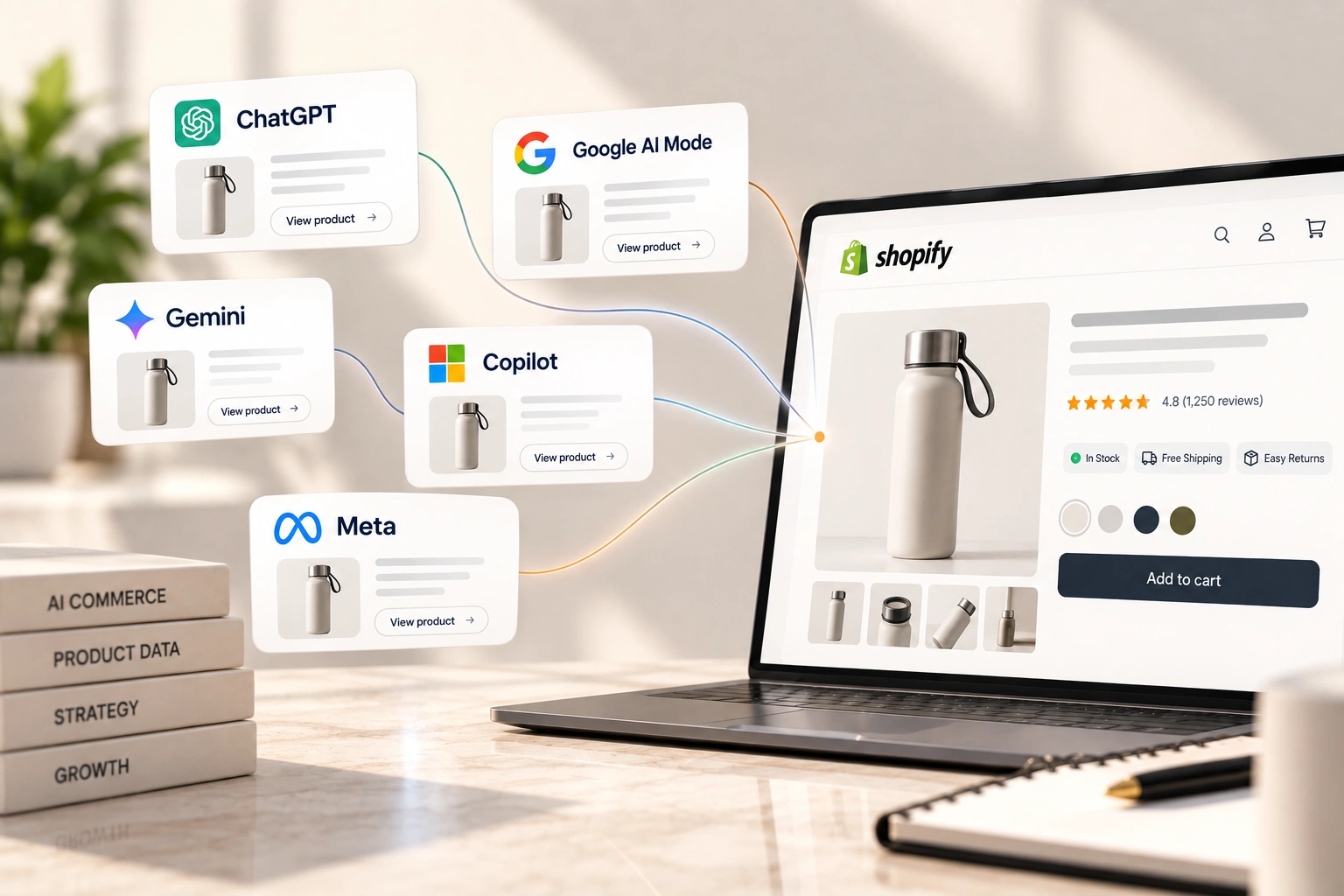
Most store owners found out their products were being sold inside AI assistants the way they find out about most Shopify changes: a line in the changelog and a new entry under Sales channels. Shopify's agentic storefronts, in its own words, "lets customers discover and purchase your products in AI channels, such as ChatGPT, Google AI Mode and Gemini, Microsoft Copilot, and Meta", and the feature is "active by default for eligible stores".
On 8 September 2026 Meta joined the list, and on 28 September Shopify extended WebMCP, the protocol that lets AI agents operate a page, to the checkout. So the question for a store is no longer whether to be in the AI channels. It is whether the product data those channels are reading is good enough to be recommended on, and whether the store wants the sale to close inside the assistant or on its own pages. This article is the checklist.
What is switched on, and through what
The channels run on Shopify Catalog, Shopify's product data index, and in one case on Google Merchant Center. Shopify's help page: products are made available "through Shopify Catalog" or, for Google AI Mode and Gemini, through the Google & YouTube sales channel or Merchant Center. The Meta entry of 8 September says it plainly: "Meta now appears alongside your other AI channels in Agentic Storefronts in your admin", with products shared by default through Shopify Catalog, and Catalog access, direct checkout and performance for Meta managed in the agentic settings.
Two purchase models sit behind the channels. Shopify describes ChatGPT as "a discovery-focused referrer platform": the shopper finds the product in ChatGPT and completes the purchase on the store's own checkout, in an in-app browser or a new tab. For Google AI Mode and Gemini, Microsoft Copilot and Meta's surfaces, including its Muse assistant, "if you have direct checkout activated, then customers can complete their purchases in the channel's Shopify-powered direct checkout" without leaving the assistant.
The controls are under Sales channels, then Agentic, in the admin, where each channel can be switched on or off and direct checkout managed. Using the feature means agreeing to Shopify's Agentic Storefronts Supplemental Terms of Service. Stores on the Agentic plan, which exists for running agentic storefronts beside an existing online store, have direct checkout deactivated by default.
What data goes, and what does not
By default, Shopify sends "title, description, options, images, price, availability, and other key attributes" for every eligible product. Eligible means direct-to-consumer: Shopify's products page says agentic storefronts "support only direct-to-consumer (D2C) sales", and products are automatically excluded when they are B2B-only, detected through B2B catalogues, customer authentication requirements or a password-protected storefront.
Custom data does not travel on its own. Metafields, metaobjects and custom categorisation reach the channels through Shopify Catalog Mapping, which tells Catalog where to source each attribute. A store whose sizing, materials or compatibility live in metafields has to map them or the assistant will not know them.
Two things that surprise people. To keep a product out of the AI channels entirely, Shopify's route is to set it to Unlisted, which also "hides the product from sitemaps, search engines such as Google, and your online store search"; there is no AI-only hide. And blocking AI crawlers in robots.txt does nothing here, because, in Shopify's words, Catalog sends product data to activated channels regardless; the two are separate mechanisms.
The direct checkout decision
Direct checkout is a commercial choice rather than a technical one. On, the sale closes inside the assistant on a Shopify-powered checkout: fewer steps for the buyer, no visit to the store, and whatever the store does at checkout (the upsell, the newsletter opt-in, the remembered card) happens inside the channel's frame or not at all. Off, the assistant refers the shopper to the store, where the brand controls the page and the checkout but adds a step the assistant was built to remove.
The honest test is the same one applied to any marketplace: how much of the store's margin comes from what happens around the purchase rather than from the purchase itself. A store that lives on repeat orders and account sign-ins has reason to keep the shopper on its own pages, where the 2026 checkout changes for signed-in customers do their work. A store selling a considered one-off purchase has less to lose by closing it where the shopper already is.
What the assistant is reading, and what to fix first
An assistant recommending a product is reading the fields Catalog sends and deciding, from them, whether this product answers the shopper's question better than the next one. That makes the quality of those fields the whole of the opportunity, and Shopify's own advice is to keep "complete and well-structured product information in Shopify Catalog" and follow SEO best practice.
The description. If it was copied from the supplier, every other retailer sent the same paragraph and the assistant has no reason to prefer yours. Product descriptions and supplier feeds is the longer argument; the short version is that the description has to state who the product is for and what question it answers.
The options and attributes. Size, colour, material, compatibility, what is in the box: as structured fields, mapped through Catalog, not buried in a paragraph. This is the same work structured data for online stores does for search engines, now with a second reader.
Price and availability. Sent live, which means an assistant will recommend a product that is in stock and not one that is not. A store that lets stock and price drift on long-tail products has handed the recommendation to a competitor whose data is current.
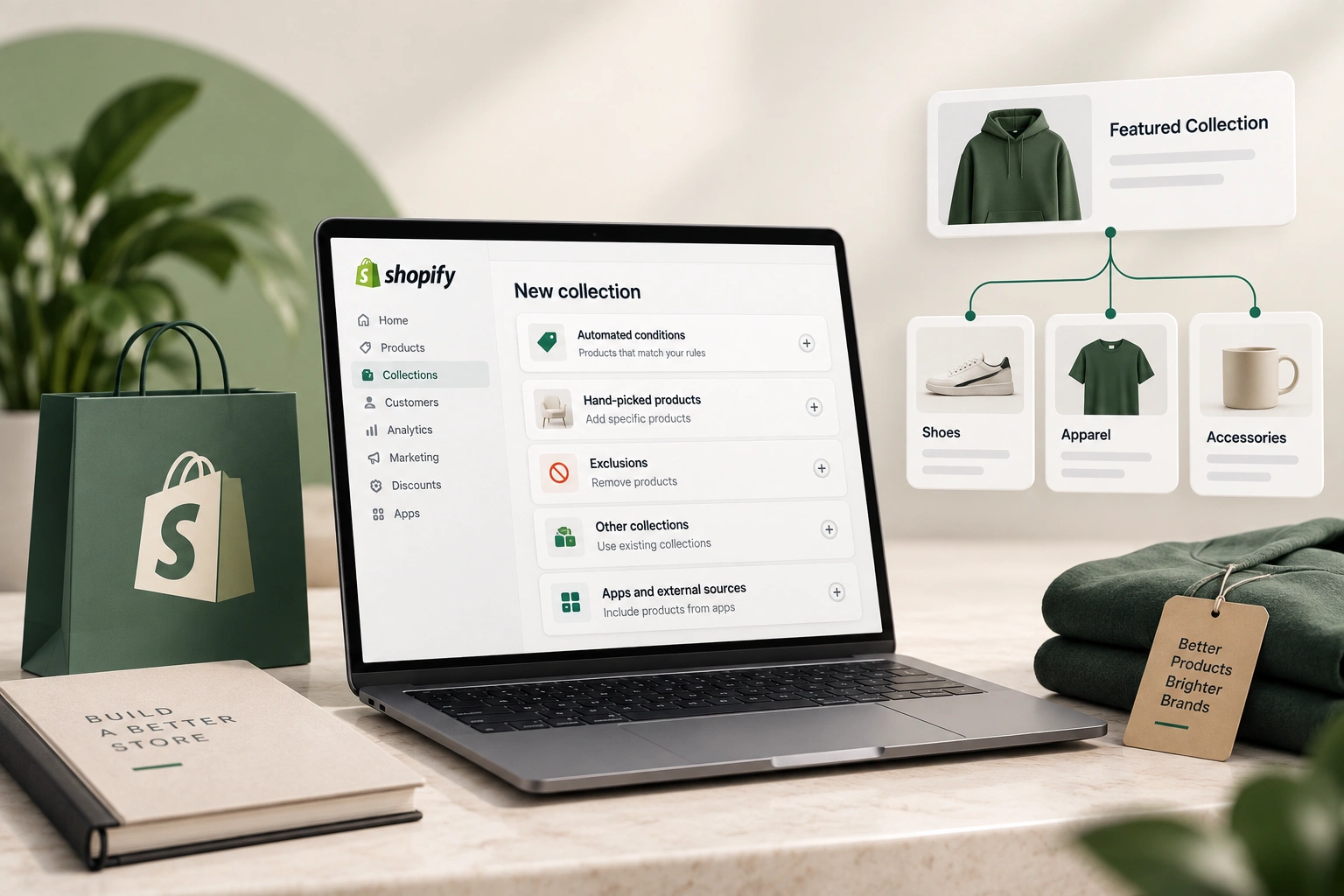
The collections. Catalog reads how the store is organised, and Shopify's new collections describe how that organisation is now built at variant level and nested, which is how an assistant understands a range.
The answers. The reasons a shopper hesitates, stated on the page. Answer engine optimisation for Shopify stores covers how a store gets cited by an assistant; agentic storefronts are the step after citation, where the assistant sells the product directly, and the content requirements are the same.
What to do this month
Open Sales channels, then Agentic, and read what is on. Decide direct checkout per channel on the margin test above. Export the catalogue and read the default fields for the twenty best sellers as a stranger would. Map the metafields that carry the answers. Set to Unlisted anything that should not be sold through an assistant, knowing what else that hides. Then read the performance view for each channel monthly, because this is a sales channel with its own numbers and it should be run as one.
That review, and the product data work behind it, is what our commerce services are for: the listing content, the structured attributes, the search and the margin, treated as one system because an assistant reads them as one. If you would like to know what an AI channel currently sees when it reads your catalogue, that is a short export and we are glad to look.
Frequently asked questions
The questions that come up most often on this subject.
Shopify's feature for selling in AI channels. In Shopify's words, it lets customers discover and purchase your products in AI channels such as ChatGPT, Google AI Mode and Gemini, Microsoft Copilot and Meta, with products shared through Shopify Catalog (or Google Merchant Center for Google's channels). It is active by default for eligible stores and managed under Sales channels, then Agentic, in the admin.
For eligible stores, yes. Shopify says agentic storefronts are active by default, and its changelog of 8 September 2026 says products are shared with Meta by default through Shopify Catalog. Each channel can be switched off in the agentic settings, and direct checkout is a separate control.
By default: title, description, options, images, price, availability and other key attributes, for direct-to-consumer products only. Metafields, metaobjects and custom categorisation reach the channels through Shopify Catalog Mapping, so they have to be mapped to be used.
Shopify's route is to set the product's status to Unlisted, which also hides it from sitemaps, search engines and the store's own search. Blocking AI crawlers in robots.txt does not stop Shopify Catalog sending product data to activated channels; the two are separate mechanisms.
It depends on where the store's margin comes from. With direct checkout on, the sale closes inside the assistant on a Shopify-powered checkout and the shopper never visits the store; off, the assistant refers the shopper to your checkout. ChatGPT refers to the store either way. A store that lives on repeat orders and sign-ins has more reason to keep the shopper on its own pages.