Reserved Inventory on Amazon: What It Means and When to Worry
Units that are in stock and cannot be sold. The three reasons Amazon holds them, how long each usually lasts, how to read the column so a normal transfer is not mistaken for lost stock, and the one case where reserved units are a claim.


Loading Article banner
The inventory dashboard says two hundred units in stock and forty reserved, the listing shows less than the seller thinks it should, and the forum thread that follows asks whether Amazon has lost the stock. Usually not. Reserved is a state with three causes, all of them ordinary, and the column tells which. The trouble is that it looks the same as a problem, and the two are told apart by how long it lasts.
This is what reserved means in each case, what normal looks like, how to read the report so the number is a fact rather than a worry, and the one situation where reserved units become a reimbursement claim.
The three reasons a unit is reserved
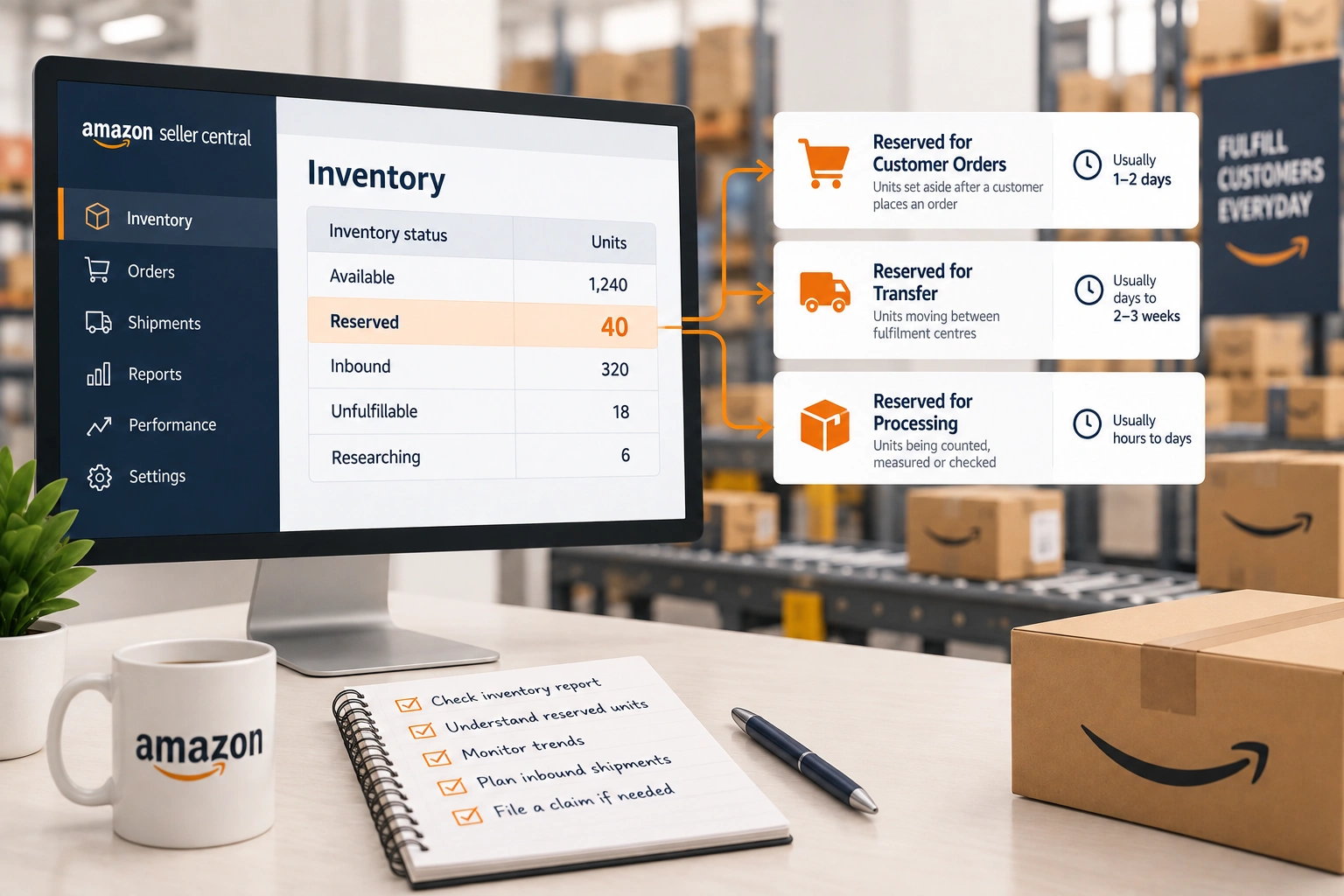
Amazon's FBA inventory report gives three: reserved for customer orders, reserved for transfer between fulfilment centres, and reserved for processing. The first is the healthiest number on the account: a customer has placed an order and the unit is set aside until it ships, which at volume means a standing reserved count that rises with sales. The second is Amazon moving stock around its network to be nearer the customers who buy it, and a shipment received at one centre is often partly in transfer for a week or two afterwards. The third is the unit being counted, measured, or checked, which happens on receipt and during periodic counts.
The report breaks the reserved total into those three, and reading it that way turns the number into three numbers, each with its own normal. Orders: a day or two per unit, continuously. Transfers: days to two or three weeks, in waves after an inbound shipment or before a peak. Processing: hours to days, in waves on receipt.
What normal looks like, and what does not
A product selling ten units a day with forty reserved is a product with four days of orders in flight and nothing wrong. A product selling one unit a day with forty reserved after a shipment arrived last week is in transfer, and the units come back to available as they land. A product with forty units reserved for processing for three weeks is the case to look at, because processing does not take three weeks; it is stock that went into a check and did not come out, which usually means a discrepancy the centre has not resolved.
The tell is the trend rather than the number. Reserved units that rise and fall with sales and shipments are the network working. Reserved units that sit at the same figure for weeks, in the transfer or processing category, are stuck, and stuck is the word to use in the case. The inventory management article covers the wider question of how much to hold so a transfer wave does not become a stock out on the listing.
The columns beside it
Reserved sits in a row with four other states, and the confusion usually comes from reading one without the others. Available is what the listing sells from. Inbound is what has been shipped and not yet received, with its own three stages: working, shipped and receiving. Unfulfillable is stock Amazon holds and will not sell, damaged, expired or customer returned in a condition it will not relist, and it is the column that turns into removal fees if it is not read. Researching is the small category of units Amazon is actively looking for, which is where a lost unit sits before the ledger decides it is lost.
Read as a row, the five columns tell the product's story for the week: what sold, what is on the way, what is moving inside the network, what came back broken, and what nobody can find. Read as five separate numbers on five separate days, they tell nothing, which is how a normal transfer wave ends up as a support case about missing stock.
Why the listing shows fewer than you have
The listing sells from available units, not from the total. A product with two hundred units in the network and sixty in transfer offers one hundred and forty, and if those sell out, the listing shows as out of stock while sixty units sit on a truck between two centres. That is the case that costs sales, and the answer is the forecast: an inbound shipment is placed so that the transfer wave after it lands before the available units run out, which means the shipment is timed on the available count rather than the total. During the holiday inbound period, when Amazon says its centres focus on receiving, the transfer and processing waves are longer, and the shipment calendar allows for it.
When reserved units are a claim
A unit that entered processing and never came out, or a transfer that shows as reserved long past any reasonable transit, is inventory Amazon has and cannot find, and after the reconciliation window it is reimbursable: lost in the warehouse, or lost in transfer. The claim is built from the inventory ledger, which shows the unit's every movement, and the reserved report, which shows where it was last said to be. The reimbursements article has the method and the windows; the reserved column is where the first sign appears, weeks before the ledger calls the unit lost.
For the brands we run under Amazon marketplace management, the reserved report is read weekly with the ledger: orders reserved against sales, transfers reserved against recent inbounds, and anything reserved for processing older than a fortnight opened as a case that day. The units are usually found. The point of looking is the week it saves when they are not, and the cost of looking is ten minutes. Where the stock goes when it is not reserved but is moved between centres by Amazon's own placement decisions is a separate subject, and the fee that comes with it is in Amazon seller fees explained.
Frequently asked questions
The questions that come up most often on this subject.
Units Amazon holds that cannot be sold at that moment, for one of three reasons the FBA inventory report names: reserved for customer orders that have not shipped, reserved for transfer between fulfilment centres, or reserved for processing such as counting or measuring on receipt.
Customer orders clear in a day or two per unit. Transfers take days to two or three weeks, in waves after a shipment lands. Processing takes hours to days. Units reserved in transfer or processing for weeks at a steady figure are stuck and worth a case.
The listing sells from available units only. Units in transfer or processing are not available, so a product can be out of stock on the page with stock in the network. Time inbound shipments on the available count rather than the total.
Not for units that are reserved, but for units that never came back: stock that entered processing or a transfer and was never returned to available is lost in the warehouse or in transfer and reimbursable after the reconciliation window, with the inventory ledger as the evidence.