Shipping Hazmat From a Marketplace: Lithium Batteries, Perfume, Aerosols and the USPS Fee
Since July, an undeclared hazmat parcel costs $50 on top of the postage, and half the products in a typical store count. What USPS treats as hazmat, which services will carry it, how to declare it on the labels each marketplace sells, and what a wrongly charged fee needs to be disputed.


Loading Article banner
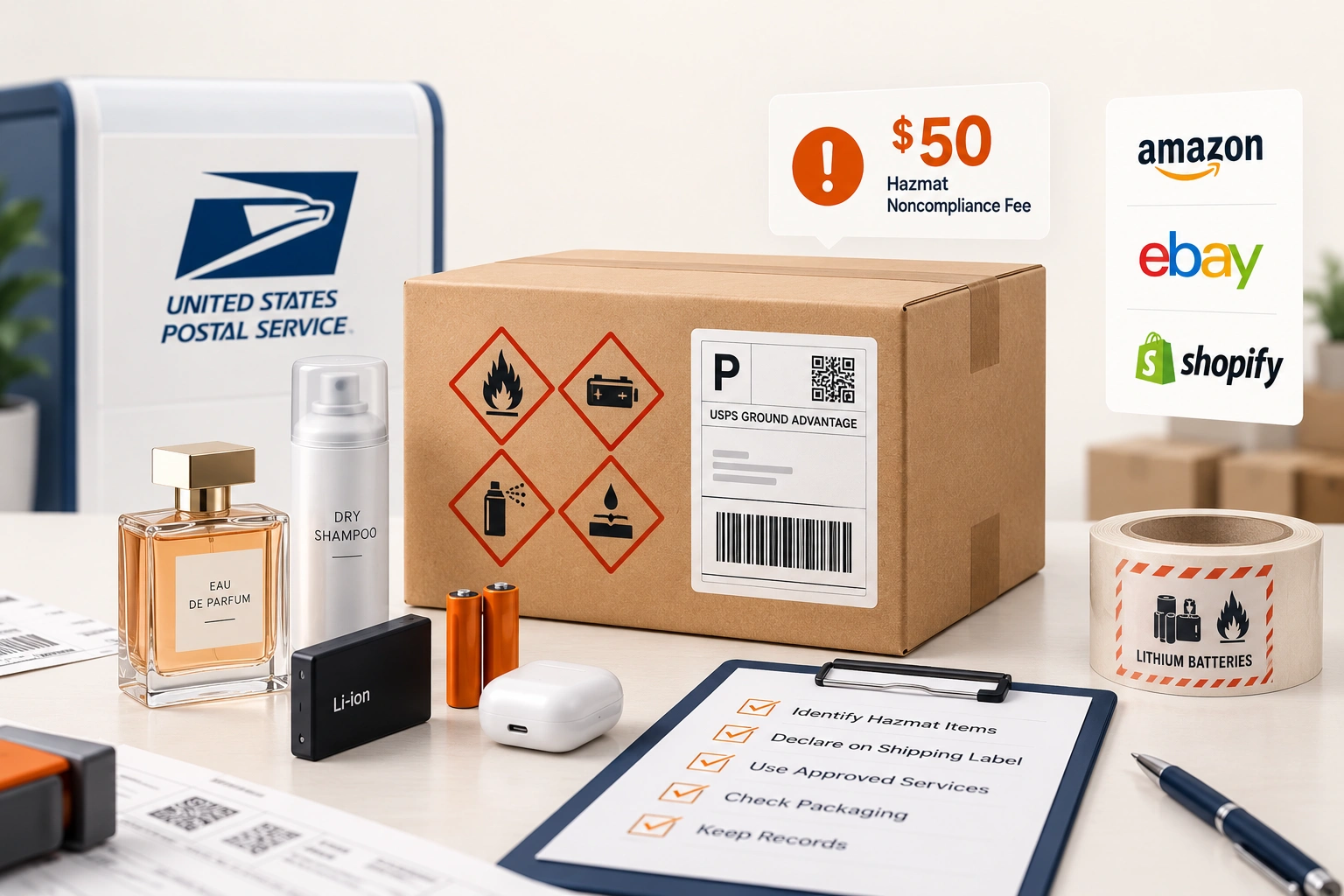
USPS charged me $50 hazmat wrongfully, a seller wrote on the eBay Community this week, and the thread filled within the hour with sellers who had been charged the same and did not know why. Most of them were shipping something ordinary: a bottle of perfume, a phone case with a battery in it, a can of dry shampoo. Since 12 July 2026, as reported, a parcel with hazmat in it that was not declared as hazmat draws a $50 noncompliance fee from USPS on top of the postage, and the fee lands on the account that bought the label, weeks later, through whichever marketplace or shipping tool sold it.
This is what counts as hazmat to the Postal Service, which services will carry it, how it is declared on the labels the marketplaces sell, and what a dispute needs when the fee was wrong. It applies to a seller on any channel who ships their own parcels; Amazon's own fulfilment has its own hazmat rules, which are a different subject.
What USPS counts as hazmat
More than most sellers expect. USPS's own examples are lithium batteries, whether in a device, packed with one or on their own; perfumes and colognes, which are flammable; nail polish; aerosols of every kind, from hairspray to spray paint; hand sanitiser and anything else alcohol based; mouthwash; and household products with flammable, corrosive or pressurised ingredients. The test is the product's contents, not its packaging or its size: a 30ml bottle of perfume is hazmat, and so is a single AA lithium cell.
The categories that trip sellers up are the ones where the product is ordinary and the ingredient is not. Cosmetics, personal care, fragrance, electronics with batteries, and cleaning products account for most of the fees in the threads, and a store in any of those categories is a hazmat shipper whether it knows it or not.
Which services will carry it, and the ground only rule
Most consumer hazmat cannot fly, so it travels by ground: USPS Ground Advantage and Parcel Select, where, as reported, declared hazmat carries no handling fee. Priority Mail and Priority Mail Express accept a narrower set of hazmat, and declared hazmat on those services carries a $7.50 handling fee per package. Some hazmat is not mailable at all on any service, and the carrier's rules, not the seller's judgement, decide which.
Lithium batteries have their own rules under USPS's Publication 52. New devices with batteries installed ship under limits on quantity and cell size, with the required markings. Used, damaged or defective devices containing or packed with lithium batteries ship by ground only and must carry the specified marking, because a damaged cell is the one that starts fires. A returned phone going back to a seller is that case, and it is the case most often shipped wrong.
Declaring it on the label each marketplace sells
The fee is for hazmat that was not declared, so the fix is the declaration, and every label tool has one. On eBay's shipping labels there is a hazmat option when the label is bought, which restricts the services offered to the ones that carry it and adds the marking. Amazon's Buy Shipping asks the same question and does the same. Shopify Shipping, Pirate Ship and the other label tools carry the declaration through to the carrier's system. A label bought without the declaration, for a parcel that contains hazmat, is the parcel that draws the fee when USPS finds it, which it does by scanning, by the box's own markings, and by inspection.
The declaration has to be right at the product level, not the order level: the SKU carries the hazmat flag, and every label for that SKU is bought with it. A seller who declares by memory declares wrongly on the day the packing bench is busy, and the fee arrives a month later.
The box itself
One warning in the carrier's guidance is worth its own paragraph, because it is the wrongfully charged fee in most of the threads. A reused box that still carries old hazmat markings, a lithium battery label from the box's first life, a printed warning from the manufacturer, can draw the noncompliance fee even when the contents are not hazardous, because the marking says hazmat and the label says none. Sellers who reuse supplier cartons, which is most small sellers, are shipping in boxes with markings they never read. Cover them or do not reuse them.
For hazmat that is declared, the marking on the box is part of the declaration, and it has to match the label. The tools print it; the packer has to apply it on the face of the parcel the carrier scans.
Disputing a fee that was wrong
The fee arrives as an adjustment on the account that bought the label, which for most marketplace sellers means through the marketplace's own shipping billing, the same route as the carrier's other after the fact charges, which Amazon seller fees explained places in the fee stack for one marketplace. The dispute goes back the same way: through the marketplace's or the tool's support, with the tracking number, a photograph of the parcel and the product, and the reason the parcel was not hazmat. A parcel that was hazmat and was undeclared is not disputable; the fee is the rule working.
The evidence that wins is the product's own documentation: an ingredient list without a flammable component, a battery free product listing, a box photograph without markings. Sellers who keep a photograph of every parcel at the bench, which is a habit the item not received claims on eBay already reward, have the evidence before the fee arrives; the Top Rated Seller requirements are what that habit protects on eBay.
The routine
Go through the catalogue once and flag every SKU that is hazmat by USPS's list. Set the flag in every channel's listing or shipping profile so the label tool declares it. Buy ground services for it. Strip or cover markings on reused boxes. Keep a parcel photograph. And read the shipping adjustments monthly, because a fee that arrives and is not read is a fee paid twice, once in money and once in the next parcel packed the same way. For the brands we run across channels under marketplace management, the hazmat flag is set on the SKU on the day the product is listed, and the fee stack it sits inside, from postage to surcharges, is the one the eBay inventory management article sits beside, where the same parcel is sold on more than one channel. The multi channel stock behind it is the subject of the multi channel fulfilment article.
Frequently asked questions
The questions that come up most often on this subject.
As reported, a $50 fee per package for hazmat that was shipped undeclared, mislabelled or otherwise out of compliance, charged from 12 July 2026 to the account that bought the label. Declared hazmat carries no handling fee on Ground Advantage and Parcel Select and $7.50 on Priority Mail and Priority Mail Express.
Yes. Perfumes and colognes are flammable and are on USPS's own list of hazmat, along with nail polish, aerosols, hand sanitiser, mouthwash and lithium batteries. The contents decide it, not the size of the bottle.
Within the limits of Publication 52 and with the required markings. New devices with batteries installed ship under quantity and cell size limits. Used, damaged or defective devices containing or packed with lithium batteries ship by ground only with the specified marking.
Most often because the box carried old hazmat markings from a previous life, which USPS's guidance warns can draw the fee on its own. Cover or remove markings on reused cartons, and dispute the fee through the marketplace or tool that sold the label with a photograph of the parcel and the product's documentation.
Both label tools ask whether the parcel contains hazmat when the label is bought, restrict the services to the ones that carry it, and print the marking. Set the hazmat flag on the SKU so every label for it is bought with the declaration rather than from memory.