The FBA Claims Calendar for Q4 2026: The Windows That Close While You Are Busy, and the Prep Rule That Closed One
Amazon's manual claim windows are 60 days for most losses, and the fourth quarter is when they expire unnoticed: inbound deadlines in October, the peak fee to 14 January, and a January count that finds what November lost. The windows in Amazon's words, the prep rule of 1 January 2026, and the January audit.


Loading Article banner
Every FBA seller loses stock in the fourth quarter. More units go in, more move between warehouses, more come back, and more get counted wrong, and Amazon's own policy is to pay for most of it. The catch since October 2024 is that the window to ask is sixty days, and sixty days from a November loss is January, when the team that would have filed the claim is doing the stock count instead.
FBA reimbursements: what Amazon owes you covers what is reimbursable and how Amazon values it. This article is the calendar: the windows in Amazon's words, where they fall against the Q4 2026 dates Amazon has published, the prep rule that took one class of claim off the table on 1 January 2026, and the audit a seller runs in January so the money is not left in the warehouse.
The windows, in Amazon's words
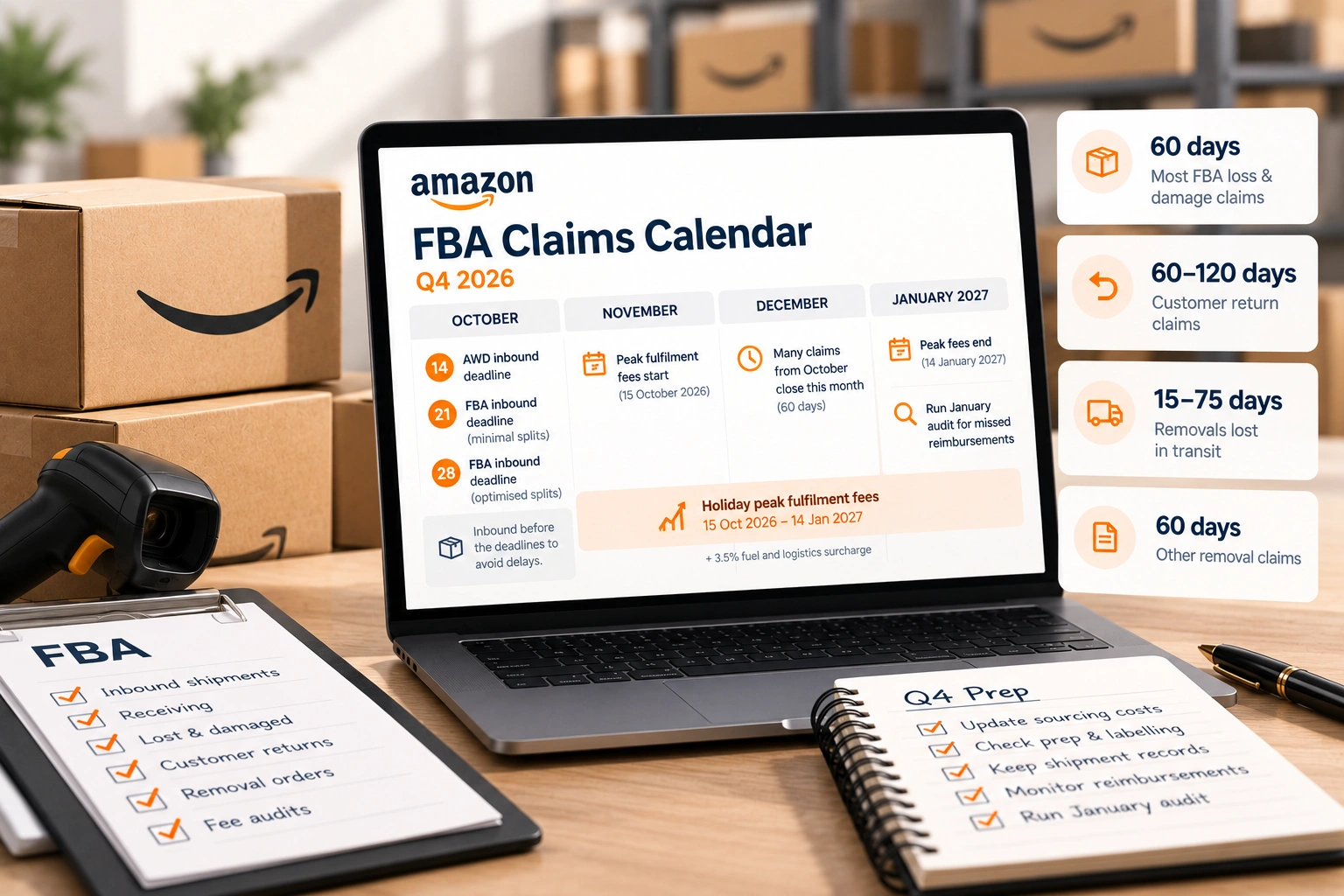
Amazon's announcement of October 2024 set the eligibility windows for manual claims, effective 23 October 2024. For items lost or damaged in a fulfilment centre: 60 days after the item is reported lost or damaged. For customer returns: between 60 and 120 days after the refund or replacement date, with a minimum 60-day wait before the claim can be made. For removals lost in transit: between 15 and 75 days from the shipment's creation, with a minimum 15-day wait. For other removal claims: 60 days after delivery back to the seller.
The same announcement introduced automatic reimbursement: from 1 November 2024, Amazon said it would "proactively reimburse you for Fulfillment by Amazon (FBA) items that are lost in our fulfillment centers", with most warehouse loss, damage and customer return claims processed automatically. The word to notice is most. A claim that is not processed automatically is still a manual claim with a window, and the windows above are the ones that close.
Where the windows fall this quarter
Amazon's Holiday 2026 announcement gives the dates the quarter runs on. Inbound for Black Friday and Cyber Monday is due by 14 October for AWD, 21 October for FBA with minimal shipment splits and 28 October with optimised splits. Holiday peak fulfilment fees apply from 15 October 2026 to 14 January 2027, at the same per-unit increase as last year, averaging $0.32 a unit, with the 3.5% fuel and logistics surcharge on top. The margin arithmetic of those fees is in Q4 pricing through the deal windows; here the fees matter for a different reason.
Put the windows against that calendar. A shipment received short in the last week of October has a 60-day claim window that closes in the last week of December. A unit damaged in a fulfilment centre in the Black Friday week has a window closing in late January. A customer refunded on 1 December for a return that never arrives becomes claimable on 30 January and stops being claimable on 31 March. A removal order created in December to clear peak stock is claimable for transit loss from mid-January to late February. None of those dates is in the quarter that caused them, which is why a seller who reconciles quarterly files nothing: by the time the quarter is closed, so are the windows.
The peak fee adds a second reason to look. Every unit charged a fulfilment fee from 15 October carries the peak increase and the surcharge, so a unit charged at the wrong size tier or weight in that period is overcharged twice. Fee errors are a reimbursable category, and the peak period is when they are most expensive.
The prep rule that closed a window for good
Since 1 January 2026 Amazon no longer offers prep and item labelling services for FBA shipments in the US store, covering inventory sent directly to FBA and inventory arriving through Amazon Warehousing and Distribution, Amazon Global Logistics, Amazon SEND and the Supply Chain Portal when it goes through FBA. Press reports put the same change in Canada on 1 July 2026. Amazon's staff on the forums quoted the announcement's consequence for claims in one sentence: shipments created after 1 January "that arrive without proper prep and item labeling won't be eligible for reimbursement if damaged or untraceable."
That is a class of claim removed, not narrowed. An unlabelled unit that goes missing between the dock and the shelf used to be an inbound discrepancy with a claim behind it; now it is a loss the seller carries. Amazon's staff described the two routes left: prep and label in-house, or use a service provider, including the vetted FBA prep providers Amazon lists. Products arriving with defective labels are flagged as defects in the Inbound Performance Dashboard, which is the early warning that a shipment's claims are at risk before anything is lost.
For the Q4 calendar the rule has a hard edge. The October inbound deadlines will be met by shipments created in September and October 2026, all of them after the rule took effect, so every one is a shipment whose discrepancies are claimable only if its prep and labels were right. The prep standard itself is in Amazon's FBA shipping requirements; the cost recovery point is that the shipment record, the carrier proof of delivery and the labelled unit count are the evidence a January claim stands on.
Before peak: the two things that decide January
Sourcing cost entered for every ASIN. Lost and damaged stock is reimbursed at manufacturing cost, and where no cost is entered Amazon applies its own estimate. The automatic reimbursements that arrive during peak are valued on whatever is in the Manage Your Sourcing Cost page in October. A seller who enters costs in January has been paid at Amazon's estimate for every automatic reimbursement in between.
A shipment file that can prove what was sent. Per shipment: the packing list by SKU, the box contents, the carrier's proof of delivery, photographs of labelled units and sealed boxes, and the commercial invoice. Amazon's reconciliation for a short shipment asks for exactly this, and the window for raising it runs from the day the shipment is marked received. Amazon inventory management for sellers covers the stock discipline this sits inside.
The January audit
In the first fortnight of January, with the windows from the late-October inbounds still open, work the reports in this order. The inventory ledger for every adjustment coded lost, damaged, disposed or found, matched against the reimbursement report to find what was not paid automatically. The received-versus-sent count for every shipment closed since September. The returns report for every refund older than 60 days with no returned unit. The removal orders of December, for units never delivered back. And the fee preview against measured dimensions for the peak period, for units charged at the wrong tier.
File what is open and in window, oldest first. Record what is out of window, and set the November date for next year.
What we do with it
We run the claims calendar as a monthly job that does not stop for peak: the ledger reconciled against reimbursements, the shipments reconciled against receipts, the returns against refunds, the fees against measurements, every claim filed inside its window with the evidence attached, and the sourcing costs maintained so the automatic reimbursements arrive at the right value. That is the cost recovery work we do for FBA sellers. If nobody in your business has a date in the diary for the first week of January, that is the first thing to fix.
Frequently asked questions
The questions that come up most often on this subject.
Under Amazon's windows effective 23 October 2024: 60 days after an item is reported lost or damaged in a fulfilment centre; between 60 and 120 days after the refund or replacement date for a customer return that never arrived, with a 60-day minimum wait; between 15 and 75 days from shipment creation for a removal lost in transit; and 60 days after delivery back for other removal claims.
Since 1 November 2024 Amazon says it proactively reimburses FBA items lost in its fulfilment centres, and most warehouse loss, damage and customer return claims are processed automatically. Anything not reimbursed automatically still needs a manual claim inside the window, which is why the ledger has to be reconciled against the reimbursement report.
Not since 1 January 2026 in the US store. Amazon ended prep and item labelling services on that date and, in its staff's words, shipments created after it that arrive without proper prep and item labelling are not eligible for reimbursement if damaged or untraceable. Press reports put the same change in Canada on 1 July 2026.
Because the 60-day windows from October and November losses close in December and January, when the team is shipping and counting rather than reconciling, and a quarterly reconciliation finds the losses after the windows have shut. The fix is a monthly reconciliation that runs through peak and a fixed audit date in the first fortnight of January.
Enter a sourcing cost for every ASIN, because lost and damaged stock is reimbursed at manufacturing cost and Amazon applies its own estimate where none is entered. And keep a complete file for every shipment: packing list by SKU, box contents, carrier proof of delivery, photographs of labelled units and the invoice.