Amazon Video Verification Failed: What the Interview Asks, Why Accounts Fail It, and What Is Left to Do
In 2026 the virtual identity verification interview is where many Amazon deactivations are decided, and sellers report a failed call is rarely given a second one. What the notice says as sellers quote it, what the interview asks, the three ways it goes wrong, what happens afterwards, and how to prepare.


Loading Article banner
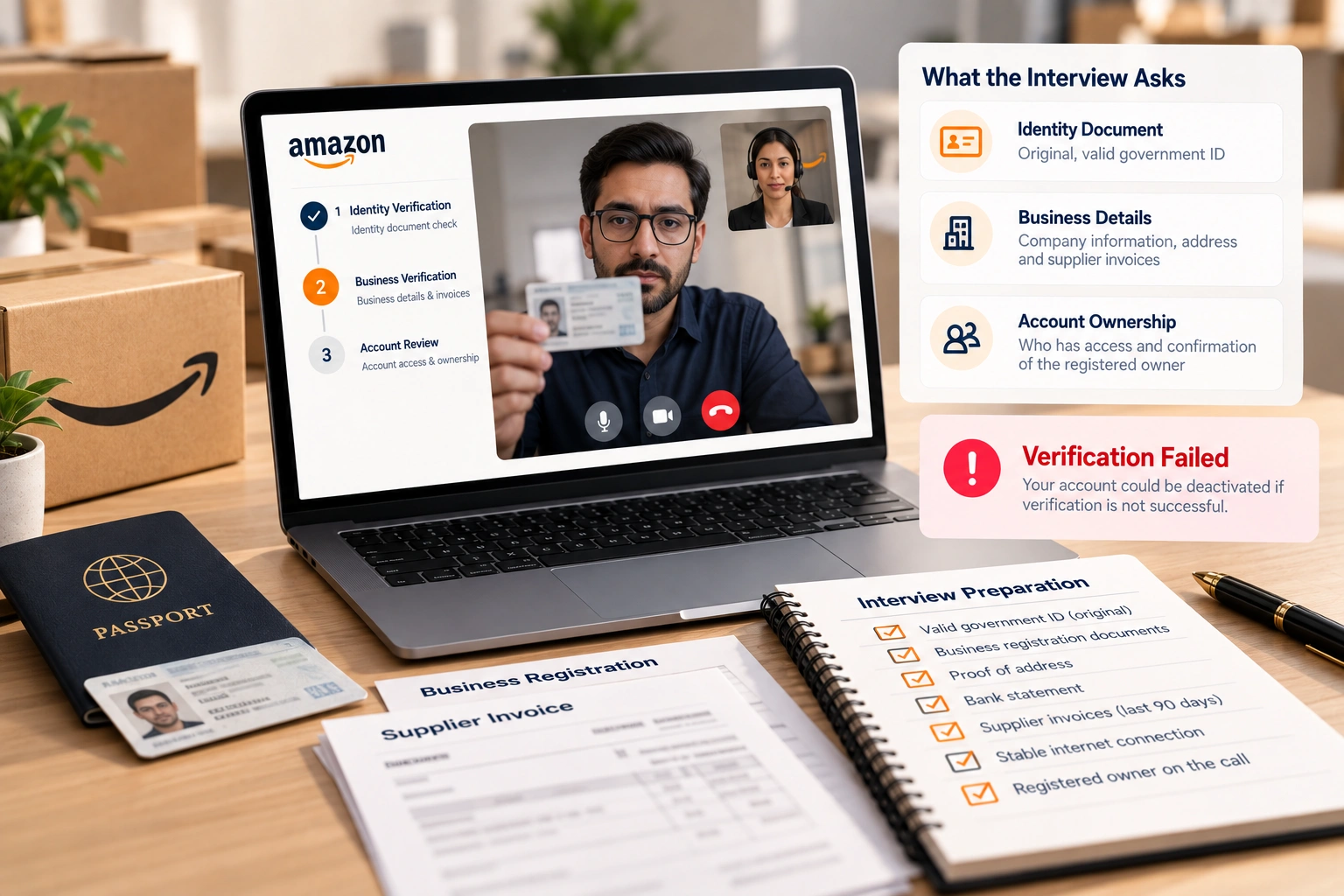
A deactivation used to be a letter and an appeal. In 2026 it is increasingly a video call. Amazon's notice tells a seller to complete a virtual identity verification interview within a fortnight, the call happens, and some days later the account is either back or the seller is reading that the verification was unsuccessful, that no further appointments are available, and that the reason cannot be shared. The forums carry threads from sellers of eight years' standing describing exactly that.
Almost none of this is written on a page Amazon publishes outside Seller Central, so this article is careful about what is Amazon's statement and what is sellers' experience. It sets out the notice as sellers quote it, what the interview asks, the three ways it goes wrong, what sellers report happens after a failure, and the preparation that gives an honest account its best chance on the day.
What Amazon says, and what sellers quote
Amazon's public page for new sellers says identity is verified either from a photograph of the seller holding their identity document or on a video call with an Amazon associate, usually within three business days. That is the whole of Amazon's public statement on the call.
The notice itself is quoted by sellers on the forums, and the wording is consistent across threads. It says Amazon believes or its controls identify that the account "has been used for deceptive, fraudulent, or illegal activity", cites Section 3 of the Business Solutions Agreement, and continues: "If you do not complete your virtual video verification interview using the link provided within 14 days of this notification, or if your verification is not successful, your account will be deactivated." It says Amazon will review the results and respond "within 5 business days". It does not mention a second attempt.
One seller, deactivated after a call despite eight years of selling, reported that an Account Health Specialist later described the fraudulent-and-illegal wording as "generic template language automatically included in certain notifications". That is a reported remark, not a policy, but it matches what the threads show: the notice reads as an accusation and functions as a request for a conversation.
What the interview asks
From sellers' accounts, the call covers three things. The identity document, shown to the camera and compared with the account. The people on the account: who else has access, and whether the person on the call is the person Amazon has on file as the owner. And the business: where the inventory comes from, with the invoices to show for it. Experienced sellers on the forums add the obvious consequence: the person on the call must be the legal owner, the documents must be originals, and the answers must match what the account already says.
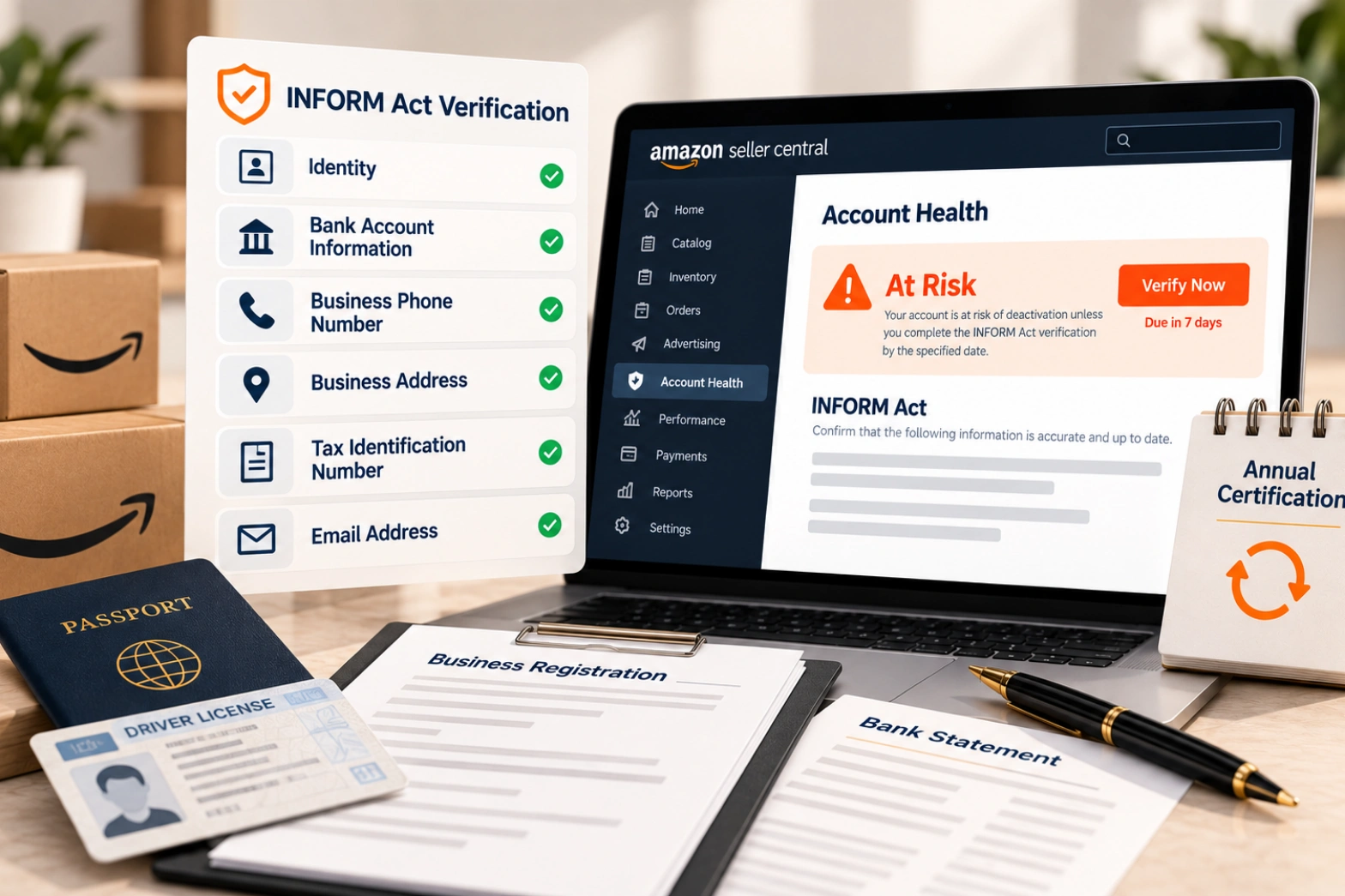
That last point is the one that decides most calls. The interviewer has the account's registration, its address, its bank details, its tax information and its supplier history in front of them, and the call is a check that a human being can confirm all of it without contradiction. The INFORM Act register described in account health and getting reinstated is, in effect, the interview's answer sheet.
The three ways it fails, as sellers report them
The connection. A seller whose interview took place on 21 July 2026 reported internet problems during the call, completed it, and was told days later that the verification was unsuccessful, that "there are no more video verification appointments available", that the reason could not be shared, and that the chances of reinstatement were "very limited". Another seller reported a call in which the connection dropped repeatedly, earphones came out, and a bank statement could not be found before the line went. A call that cannot be completed cleanly is, on the evidence of the threads, treated as a call that failed.
The documents. A statement that is not to hand, an invoice that does not name the business as registered, an identity document that has expired or that belongs to somebody other than the registered owner. The interview is short and it does not wait.
The answers. A sourcing explanation that does not match the invoices on file, a second user the account never declared, an address that differs from the registration by a building. Nothing said on the call should be news to the account.
What happens after a failure
Sellers report the same sequence. The outcome notice says the verification was unsuccessful and the account stays deactivated. Account Health Support says the result has been reviewed and no further appointments are available. Appeals through the Account Health dashboard draw an automated reply. One seller reported submitting over a hundred appeals and receiving the same response to each; another replied that only a certain number of appeals are allowed, a seller's understanding rather than a published rule.
Nothing Amazon publishes outside Seller Central says whether a second interview can be requested or on what grounds. What the threads show is that a different appeal, one that supplies what the call could not, is the only move with any record of being read: the complete document set, an explanation of the specific discrepancy the seller believes the call turned on, and a request for a new interview with an interpreter where language was the problem. Amazon's policy warnings and what they mean explains why an appeal that restates innocence is read as no appeal at all; the same applies here, and more so.
How to prepare, which is the part that works
Before the call: the registered owner takes it, from a wired connection in a quiet room, with the originals on the desk. The identity document on the account, in date. The company registration and the proof of address, matching the account to the letter. The bank statement for the account on file. The supplier invoices for the last ninety days, in the business's registered name, with the supplier's details complete, which is the standard where to source products to sell describes for any invoice Amazon will accept. A written note of everybody with access to the account and why.
Read the account's own registration before the call and reconcile anything that has drifted: an address, a trading name, a bank account changed since the last certification. If something cannot be reconciled in time, say so on the call rather than hope it is not asked. Keep the documents in the order they will be requested. Then answer the questions asked, briefly, and nothing else.
If the call cannot proceed, because the link fails or the connection drops before it starts, open a case immediately with the time, the fault and a request to reschedule within the fourteen days, so the record shows the seller tried; seller support cases that actually get resolved is the form such a case should take.
How we handle it
We prepare sellers for the interview the way the interview is run: the register reconciled, the documents assembled and checked against the account, the owner briefed on what will be asked, the connection tested. Where a call has already failed, we build the appeal around the discrepancy rather than around the deactivation, with the full document set and, where it applies, a request for a new interview. That is the account reinstatement work we do, and the honest summary of it is that preparation before the call is worth more than any appeal after it. If the notice is in front of you now, the fourteen days are the time to get the preparation right.
Frequently asked questions
The questions that come up most often on this subject.
A video call with an Amazon associate in which the registered owner shows their identity document, confirms who else uses the account and explains where the inventory comes from. Amazon's public page says identity can be verified by a photograph with the ID or by video call, usually within three business days; after a deactivation, sellers report the notice gives fourteen days to complete the call.
Amazon publishes no rule on this outside Seller Central. Sellers who failed a call in 2026 report being told that no further appointments were available and that the reason could not be shared. The only route with any record of being read is an appeal that supplies what the call could not, with a request for a new interview and, where language was the problem, an interpreter.
From sellers' reports, three ways: a connection that drops or a call that cannot be completed cleanly; documents that are not to hand, expired, or not in the registered business's name; and answers about users, sourcing or addresses that contradict what the account already records.
The identity document on the account, in date; the company registration and proof of address matching the account exactly; the bank statement for the account on file; supplier invoices for recent months in the business's registered name with complete supplier details; and a note of everybody with access to the account.
Not necessarily. One seller reported an Account Health Specialist describing it as generic template language included in certain notifications, and sellers with long clean records receive the same wording. The practical reading is that the notice is a request for a verification conversation, and the conversation decides the account.