Listing Deactivated for a Potential Pricing Error: What Amazon Checks, and How to Get the Offer Back
Amazon deactivates an offer when its price looks like a mistake against the Fair Pricing Policy and the Featured Offer price. What Amazon says it checks, where the deactivated offer and its reference price are shown, the fixes that work, what sellers report when they do not, and what to do before touching the price.


Loading Article banner
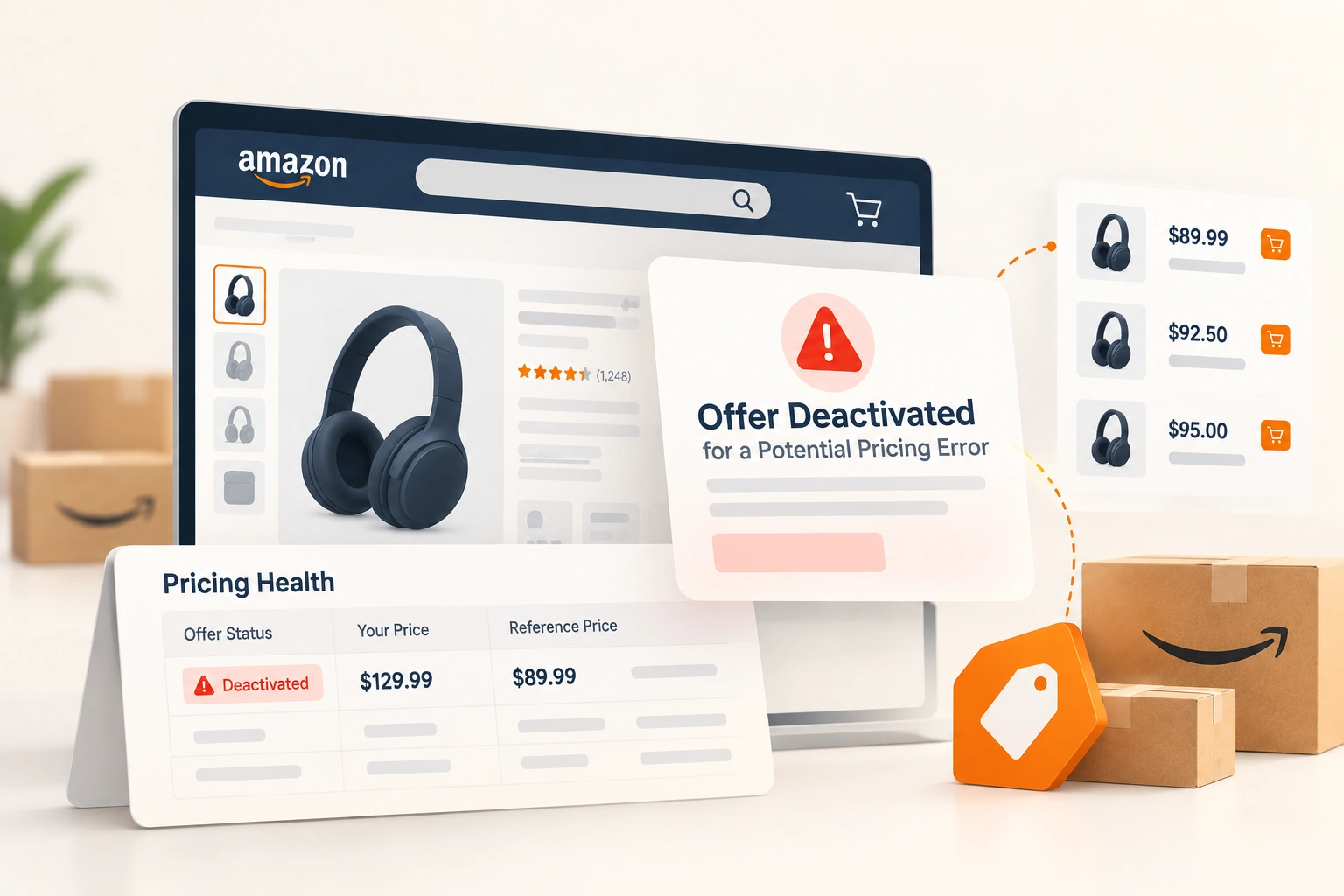
The notification says the offer was deactivated for a potential pricing error, and the first reaction is that the price is what it has always been. Sometimes the price is the problem. Often the problem is what Amazon is comparing it with, and the fix is in a different field from the one the seller keeps changing.
This is what Amazon says the check is, where the deactivated offer and Amazon's reference price are shown, the changes that reactivate most offers, what sellers report when they do not, and the order to do it in so the fix does not create a second problem.
What Amazon says it checks
Amazon's statement of the mechanism, from its announcement of the notification to sellers: "Amazon detects potential pricing errors in your listings based on several factors including the Marketplace Fair Pricing Policy and the Featured Offer price. When we identify these potential errors, we will notify you. In more serious cases, we might deactivate the affected listings to avoid a potentially negative customer experience."
And where to look: "You can review your offers that have been deactivated because of potential pricing errors in Pricing Health. Reconsidering your price inputs in Pricing Health may resolve this pricing issue and reactivate your offer. We have also provided reference prices to help you identify any potential pricing errors."
Two comparisons, then. The Fair Pricing Policy, which is about a price that is out of line with what the product sells for; the policy page itself sits behind the Seller Central sign in, so read it there rather than from a summary. And the Featured Offer price, which is about a price that is out of line with the other offers on the same product. A price can fail either one, and the reference price in Pricing Health is Amazon's way of showing which.
The two kinds of error
A high pricing error is the common one: the price is far above the reference, and Amazon reads it as a mistake rather than a decision. It catches a typo, a currency confusion, a repricer with no ceiling that walked the price up when competition disappeared, and a product whose only offer is yours at a price Amazon's reference does not support.
A low pricing error is the other: a price far below the reference, which Amazon reads as a mistake in the seller's favour that will produce orders the seller cannot honour. A decimal point in the wrong place is the classic cause, and a repricer with no floor is the modern one. Repricing strategy is where the floor and the ceiling belong before the repricer ever runs.
The fix, in order
Open Pricing Health and find the offer. Read the reference price beside it before changing anything, because the reference is the number the offer is being judged against, and a price changed without reading it is a guess.
Check the price itself, then the price inputs Amazon refers to. Amazon's own guidance is that reconsidering the price inputs in Pricing Health may reactivate the offer, and sellers report that the minimum and maximum price on the offer are the inputs that clear most cases: a maximum below the reference band, or a minimum above it, keeps an offer flagged however the list price is set. Set them to the range the product should actually sell in, save, and give the check time to run again.
If the offer has variations, check every child. One child priced wrongly can carry the flag for the family. If a repricer is connected, check what it wrote last, and whether its own limits match the ones just set. A repricer that resets the maximum overnight will reproduce the deactivation overnight.
What sellers report when the fix does not work
The thread under Amazon's announcement, and threads since, describe the same few situations, and they are reported experiences rather than Amazon's policy. Offers deactivated while priced at or below Amazon's own price for the item. Products with a single offer, the seller's, flagged against a reference nobody can see. A price reduced to clear one flag that then raised a low pricing flag. And, most often, no reference price at all: one seller wrote that "there is no reference price available under the reference price column in our pricing health dashboard," so there was nothing to price against.
For that last case, the reply from Amazon's forum staff is worth quoting for what it says about priority: "I would recommend that you stop selling the ASIN until they can determine why your price is not updating." A deactivated offer is already not selling; the advice is not to force it back live with a price the seller does not believe in, but to get the reference resolved through a case. Seller support cases that get resolved sets out how to write that case so it moves.
Why it matters more from July 2026
Amazon has been removing the separate seller eligibility step from the Featured Offer since July 2026, so the offer itself is what competes: Amazon says it will keep choosing the Featured Offer on "competitive pricing, delivery speed, and performance." An offer with a pricing flag is out of that contest entirely, and an offer whose price is set by a repricer with no limits is one flag away from it. How the Featured Offer is won covers the change; pricing for margin and rank covers the price the offer should hold.
Before touching the price
Confirm it is a pricing flag and not something else. A listing can go inactive for a compliance requirement, a restricted product review or a catalogue problem, and each has its own route back; the notification names which, and telling an outage from a listing problem is the first check when sales simply stop. Then write down the price and the limits as they were before the change, so that if the flag returns the comparison is possible.
If the offer stays deactivated after the price and the inputs are right and the reference makes no sense, that is a case, with the ASIN, the reference shown, the price history and the limits, and it belongs in the same account health routine as any other inactive listing: account health and getting reinstated.
How we work on it
Our listing reinstatement service takes an inactive offer from the notification to the reactivation: reading the reference, correcting the price and its limits, checking every variation and the repricer, and, where the reference itself is wrong, writing and pushing the case. No service can promise a reactivation, and we do not; the work is the strongest case that can honestly be made, and the pricing controls that stop the flag coming back.
Frequently asked questions
The questions that come up most often on this subject.
Amazon says it detects potential pricing errors based on factors including the Marketplace Fair Pricing Policy and the Featured Offer price, notifies the seller, and in more serious cases deactivates the offer. The deactivated offers and Amazon's reference prices are shown in Pricing Health.
Open Pricing Health, read the reference price for the offer, correct the price and the price inputs (sellers report the minimum and maximum price are what clear most cases), check every variation and any connected repricer, save, and let the check run again. If the reference is missing or wrong, open a case.
In Pricing Health, beside the deactivated offer. Amazon provides reference prices there to help identify potential pricing errors; some sellers report the column is empty for their product, which is a case to raise rather than a price to guess.
A price far above Amazon's reference, read as a mistake: a typo, a currency confusion, or a repricer with no ceiling. A low pricing error is the reverse, a price far below the reference, often a decimal error or a repricer with no floor.
A deactivated offer cannot be the Featured Offer at all. Since July 2026 Amazon has been removing the separate seller eligibility step, and says it chooses the Featured Offer on competitive pricing, delivery speed and performance, so the offer's price is what competes.