A Google Ads Strategy for Low Conversion Volume: Lead Values, Qualified Enquiries and Bidding for Speakers and Acts
A corporate keynote enquiry and a birthday party request count the same in most Google Ads accounts. How a speaker or act with few, valuable enquiries gives them values, qualifies them, and chooses a bid strategy that works at low volume.


Loading Article banner
A request to keynote a sales conference and a request to perform at a fortieth birthday arrive through the same booking form, and in most Google Ads accounts each counts as one conversion. Bidding cannot tell them apart, so it learns to find more of whichever costs least to produce, and that is rarely the corporate one. Many of the lead generation launches Google announced in May 2026 were about exactly this: lead intent scores, journey mapping, and bidding that learns from what happens after the form.
This is the value half of running Google Ads for bookings. The counting half, getting forms, calls and bookings into the account at all, is in Google Ads conversion tracking for speakers and performers, and everything below assumes it is in place.
Why one enquiry, one conversion is the problem
Smart Bidding works towards whatever the account counts. When every booking request is worth the same, the cheapest request is the best one, and the cheapest tend to come from searches close to the act but not to its market: a private party, a school, somebody collecting prices with no date in mind. They are fine to receive and wrong to optimise for, if the business is corporate events.
Google's guidance gives two ways out. If you can assign different values to your leads, it recommends value-based bidding: Maximize conversion value, with or without a target ROAS. If lead quality matters but you cannot give conversions distinct values, it recommends Target CPA bidding on qualified or converted leads rather than on raw enquiries.
Deciding what an enquiry is worth
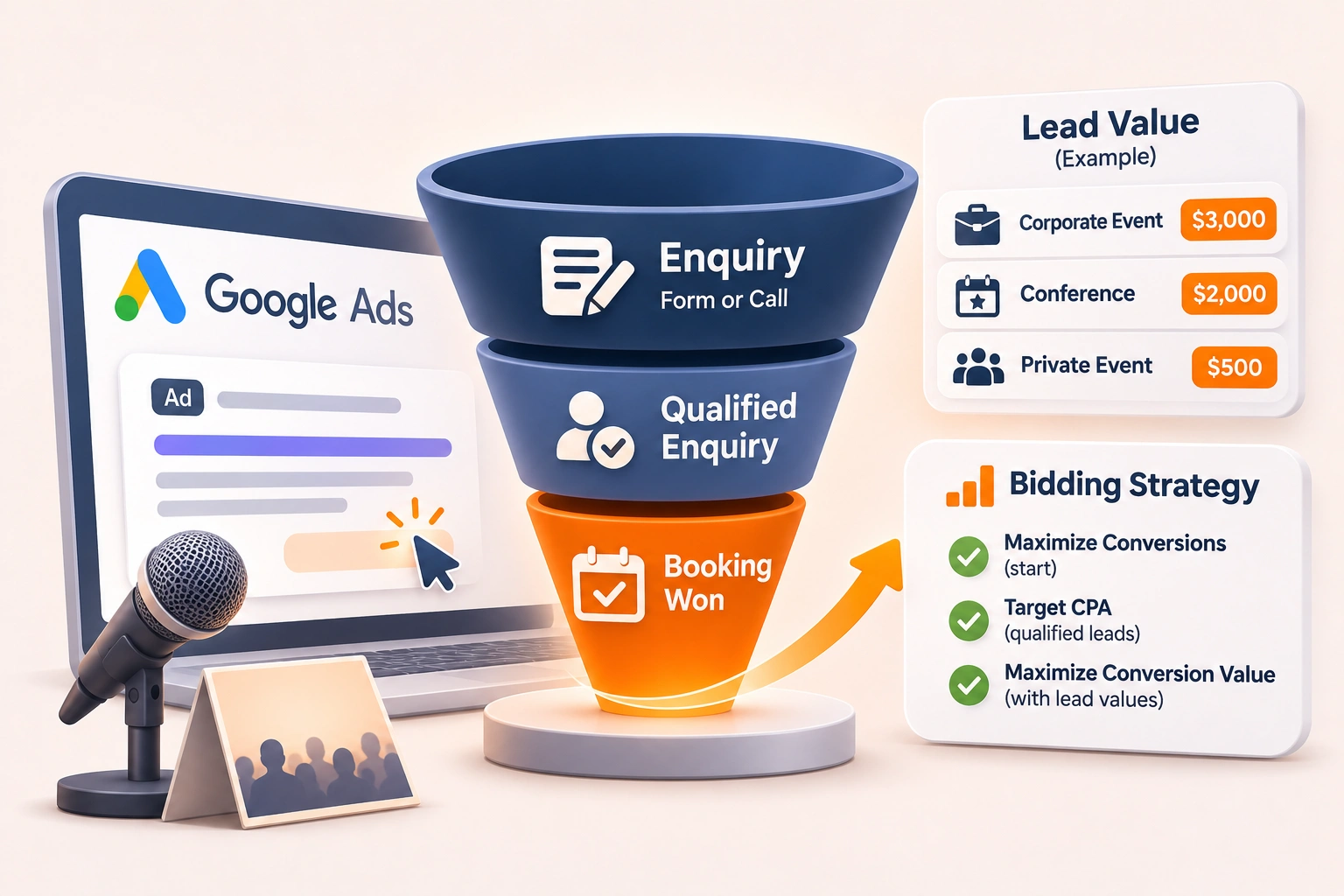
A conversion value does not have to be a fee. Google's value-based bidding guidance says that where exact values are hard to know, advertisers can use proxy values that match their business priorities, and that particular answers on a lead form can indicate a higher quality lead. For an act or a speaker, the booking form already asks most of what matters: the type of event, the country, the date and the size of the audience.
Work the values out from past bookings, not instinct. Group the last year or two of enquiries by the answers that matter, and note what share of each group became a booking and what those bookings were worth to you. A conference enquiry that books one time in four at a full fee is worth several times a private party enquiry that books one time in ten for less. That ratio, entered in the account's currency, is the value: a weight rather than a quote.
Two rules from Google's checklist apply. Track at least two different values, and never zero: a single value tells bidding nothing it can choose between, and Google advises against zero-value conversions with value-based bidding, saying an action with no value should be removed instead.
Values can also move with things the form does not ask. Conversion value rules adjust values by location, device or audience, in real time, for Target ROAS and Maximize conversion value. An act that travels can weight enquiries from the markets it serves most profitably above those where a booking means two flights, without touching the website's tag.
Qualifying an enquiry before it counts
The stronger signal is not a value guessed when the form is sent but a fact learned a few days later: a real event, with a date, in a market you serve, from a planner who replied. Google's lead goals include qualified lead and converted lead alongside book appointment and request quote, and its guidance says those lead-specific goals switch on invalid traffic protections built for lead generation campaigns.
So define a qualified enquiry in one sentence your diary would agree with, and send it to Google as its own stage, through the same upload that carries bookings won. Google asks for uploads ideally daily; even a weekly habit of marking each enquiry as qualified or not gives the account a stage that arrives within days rather than months.
Corrections matter too. Google's conversion adjustments restate a conversion's value or retract it, for example when a booking is cancelled or a qualified enquiry turns out not to be one. Upload one at least 24 hours after the original conversion; it counts for bidding within 7 days of the conversion being recorded, and adjustments can be made for up to 54 days. Each needs the order ID, or the click ID and time, and a retraction cannot be undone directly.
A Google Ads strategy for low conversion volume
Google's thresholds are the honest constraint. For a lead bid goal it asks for at least 15 conversions in the last 30 days at account level, ideally from an action that happens within 7 days of the ad interaction. Before value-based bidding it asks for at least 4 weeks or 3 conversion cycles of value data, then a ramp-up of at least 2 weeks or 3 conversion cycles before the result is judged. And it says to choose one stage of the lead-to-sale journey as the goal, not several.
Most solo acts and speakers are the textbook low traffic, high ticket account: they book nowhere near 15 times a month, and corporate bookings take weeks to confirm. So for a small account the booking won is almost never the bid goal; it is the number the account is judged by, and the strategy runs in three steps as volume allows.
First, bid on the enquiry, meaning the booking form and the qualified call, with Maximize conversions or Target CPA, and record values from the first day so the history value-based bidding needs is already building; an account with fewer than 15 enquiries a month gives bidding less to learn from, so judge it over months rather than weeks. Second, once enquiries pass 15 a month and four weeks of values exist, test Maximize conversion value without a ROAS target, as a campaign experiment rather than a switch; Google suggests setting any later target from history and leaving budgets unconstrained when one is set. Third, where qualified enquiries alone reach that volume, make them the goal: Target CPA while the values are rough, value-based bidding once they are trusted. Bookings won stay imported for reporting throughout.
One feature to hold back on. Google says Smart Bidding Exploration is now available in AI Max and Performance Max campaigns, to win searches a ROAS target would otherwise pass over. It is only as good as the values it chases, so it suits an account whose values have proved themselves; what AI Max itself switches on is in what the AI Max upgrade changes in Search campaigns.
Journey-aware bidding, and what it asks of a small account
Google's newest answer to the same problem is journey-aware bidding. Its announcement page, under New for 2026, says Target CPA and Maximize conversions in Search campaigns now learn from every goal along the lead journey, biddable or not, once the advertiser imports the conversion actions that make it up, and calls it a backend upgrade available in beta. Google's lead generation post of May 2026 also named lead intent scores, lead journey mapping and a leads hub inside Google Ads as features being piloted.
None of these replaces the work above; each depends on it. They need the stages defined and imported, enquiry, qualified and booked, and an account without them gives the new features nothing to learn from.
Reading the result in bookings
In a lead account, ROAS is the conversion value you assigned divided by what you spent, so it is only as meaningful as the values: a check on whether bidding finds the enquiries you weighted most, not a return. The numbers that matter are cost per qualified enquiry and cost per booking won, month by month, and the second is the one the business lives on. Whether those bookings would have come anyway is the question incrementality testing answers, once an account is large enough to test.
Revisit the values about twice a year from the bookings that actually came in, and sooner only if the mix of work changes. The cost side of the same arithmetic, what a click and an enquiry should cost, is in what Google Ads actually costs.
Setting the values, defining the qualified stage and moving an account through those steps is the core of how we run Google Ads for booking-driven businesses, in the client's own account and on the client's billing. If your account still counts every enquiry the same, tell us about the act.
Frequently asked questions
The questions that come up most often on this subject.
Give them different conversion values. Use the answers your booking form already collects, such as the event type, the country and the date, to set a value for each enquiry, worked out from what share of past enquiries of that kind became bookings and what those bookings were worth. Google lists at least two different, non-zero values as a requirement before value-based bidding. Conversion value rules can then adjust the values by location, device or audience without changing the website's tag.
There is no right number, because the value is a weight rather than a price. Google says proxy values aligned with business priorities are acceptable where exact values are hard to know. The practical method is your own history: the booking rate and the typical fee for each kind of enquiry. An enquiry type that books four times as often, for a larger fee, should carry a value several times higher. Revisit the values about twice a year from the bookings that actually came in.
Bid on the enquiry, give it a value, and keep the booking won as the number the account is judged by. Maximize conversion value is not reliable at a few enquiries a month: Google recommends at least 15 conversions in the last 30 days at account level, and at least 4 weeks or 3 conversion cycles of value data before switching to value-based bidding. Below that, bid with Maximize conversions or Target CPA on the enquiry goal and record values anyway, so the history exists when volume allows. If you cannot give enquiries distinct values at all, Google recommends Target CPA on qualified or converted leads instead.
A change to Smart Bidding that Google's announcement page describes as available in beta for Search campaigns. With it, Target CPA and Maximize conversions learn from every goal along the lead journey, biddable or not, provided the advertiser imports the conversion actions that make up that journey. For an act or a speaker, that means enquiries, qualified enquiries and bookings won all reaching the account as separate stages. Without those stages imported, it has nothing extra to learn from.
Upload a conversion adjustment. Google lets you retract a conversion, which removes it from your reports, or restate its value, for example when a booking shrinks. Upload it at least 24 hours after the original conversion; for bidding it counts within 7 days of the conversion being recorded, and adjustments can be made for up to 54 days. Each one needs the order ID, or the click ID and the conversion time, and a retraction cannot simply be undone.