Google Ads Conversion Tracking for Speakers and Performers: Counting Booking Enquiries and Bookings Won
A speaker or act who runs Google Ads is judged by the wrong number if the account counts clicks. What to count, how calls and forms are tracked, and how a booking agreed by email reaches Google.


Loading Article banner
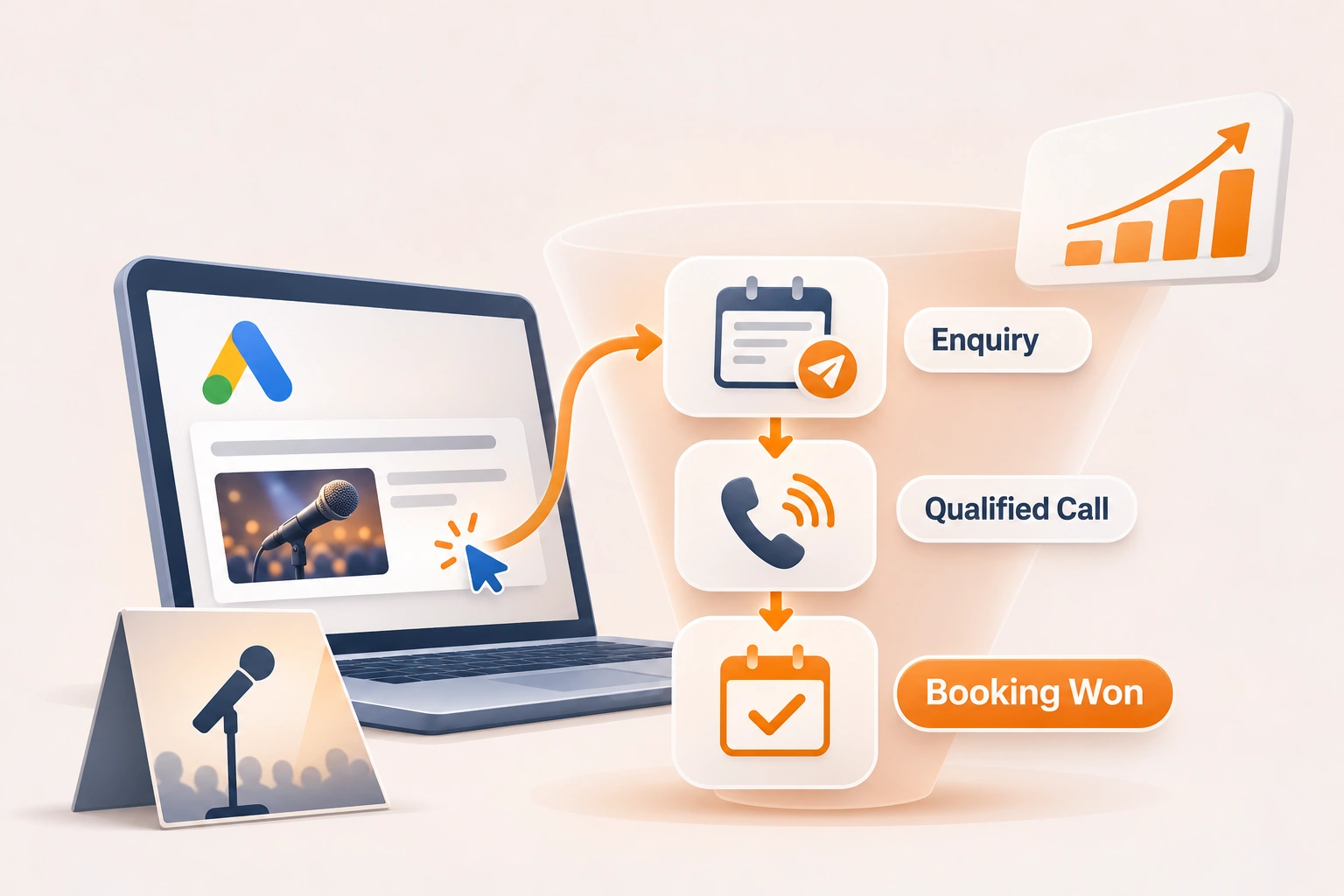
A keynote speaker, a corporate magician or a mentalist who runs Google Ads is not selling a product at a price. A planner sees the ad, looks at the act, and asks for a date, by a form or by phone, and the booking itself is agreed days or weeks later, usually by email. If the account counts clicks, or every visit to the contact page, the spend is judged by the wrong thing, and Google’s bidding learns to buy more of whatever is counted.
This is what Google’s own conversion tools can count for a booking-driven business, how each one works, and the settings that decide whether the numbers mean anything. It is written for the act or speaker who sells through their own website, and it is the measurement half of how we run Google Ads for booking-driven businesses.
What a booking-driven account should count
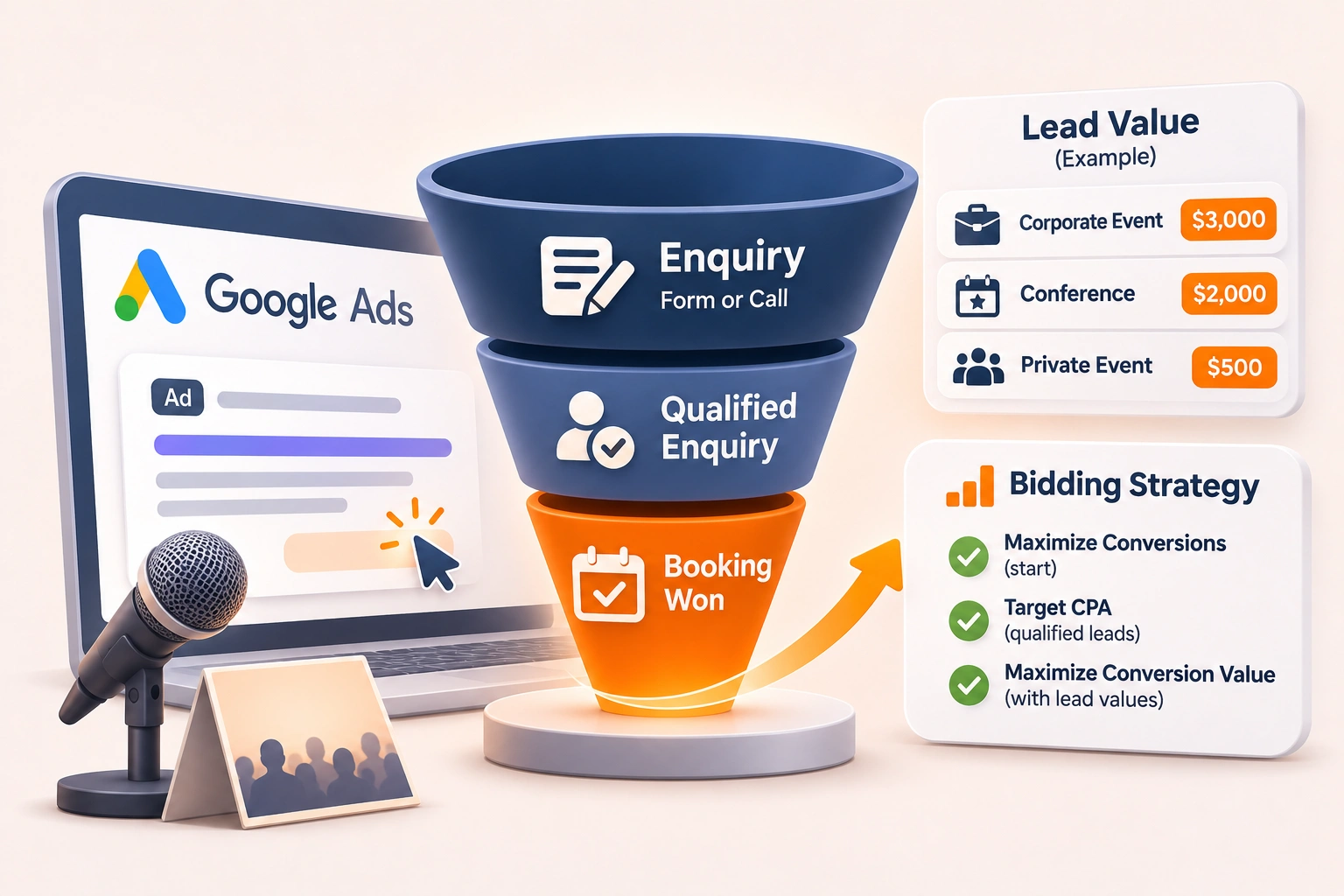
Three events, in order of value: a booking form sent, a call long enough to be a real enquiry, and a booking won. The first two happen on the website, and Google can see them as they happen. The third happens later, off the site, and Google only knows about it if you tell it.
Everything else, from a page view to a play of the showreel, is at most a sign of interest. Google Ads has a place for those signals, covered below, but they should not be what bidding works towards. An account that rewards the showreel being played will find people who enjoy watching showreels.
Booking forms: the conversion that happens on the site
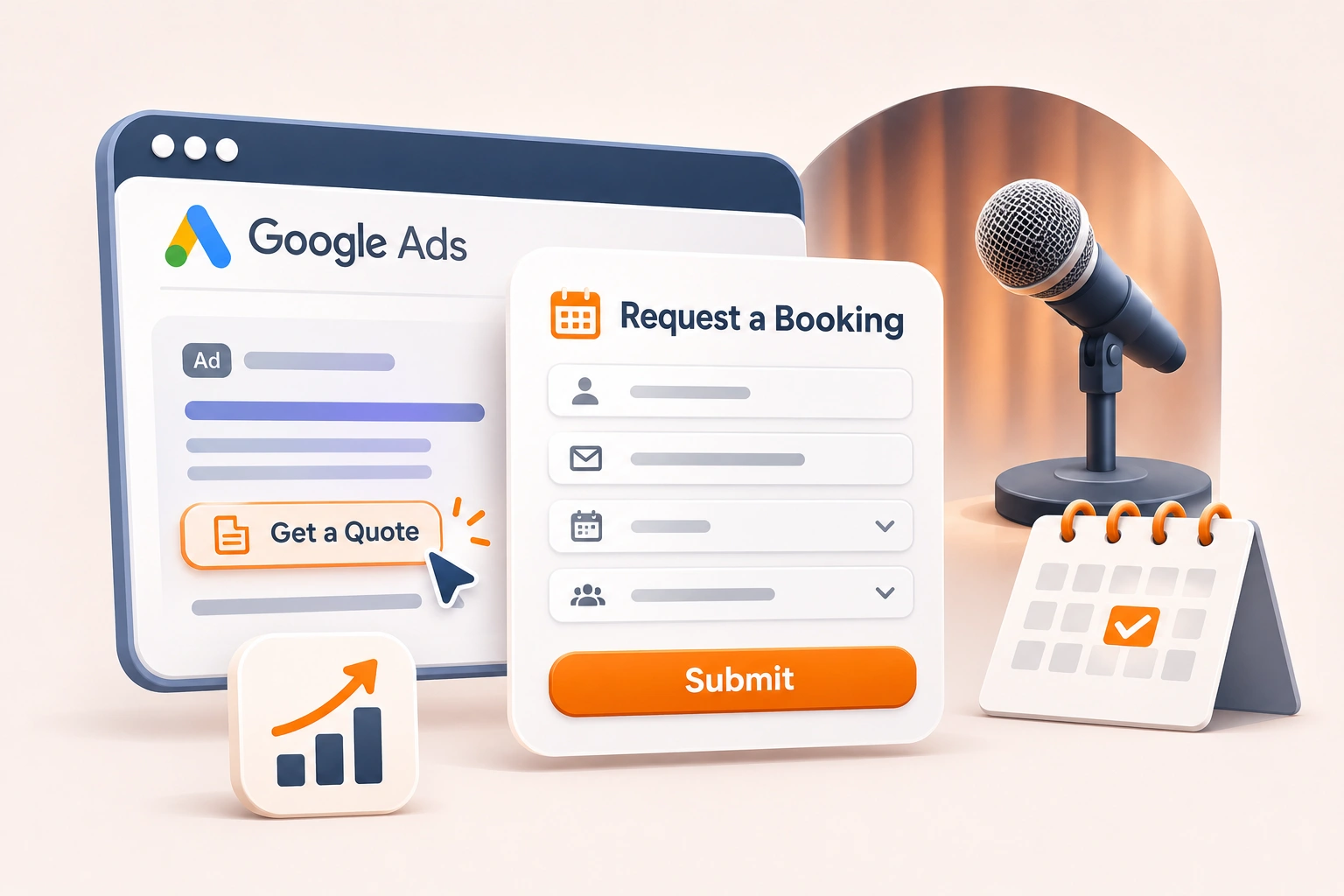
A booking form sent is counted with the Google tag, on the page the form leads to or on the form’s own submission. Google’s guidance for leads goes a step further. With enhanced conversions for leads, the site also sends Google a hashed copy of what the planner typed, such as an email address, so that the booking which follows can later be matched to the ad click that started it. Google describes it as an upgraded version of offline conversion import that uses data the visitor provided, and recommends it to advertisers who have not set up offline imports yet.
Two practical points. Google matches the hashed data with signed-in Google accounts to attribute the conversion, and its help page asks advertisers to tell visitors what is collected and to get consent where the law or Google’s policies require it, so the form needs a privacy notice that says so. And a form whose conversion fires before its spam protection runs counts the spam too, so the conversion belongs on a real, accepted submission.
Calls: counted only when they last long enough
Planners phone. Google’s website call conversion tracking replaces the number on your site with a Google forwarding number, at no cost, for visitors who arrived from an ad, and counts a call as a conversion when it lasts longer than a minimum length you set. The forwarding numbers are available only in the countries Google lists, and the setup needs both the Google tag and a phone snippet on every page that shows the number.
The minimum length is the setting that matters. A call that ends in half a minute is usually a wrong number, somebody selling something, or a planner who only wanted your email address. Set it to the length of a real first conversation about a booking, and look at it again after a month of calls. If you already track calls in another system, Google also lets you import call conversions from it instead of using its numbers.
Bookings won: telling Google what happened after the enquiry
The booking is the conversion that pays, and it happens in your inbox or your diary, not on the site. Google’s offline conversion imports exist for exactly this, a lead that starts with an ad and ends offline; Google’s own example is a contract signed. There are two ways to join the two ends.
The older way keeps the Google Click ID, the GCLID that Google adds to every ad click, with the enquiry, and sends it back with the booking. Google now recommends the other way to anybody starting out: enhanced conversions for leads, where the hashed email captured when the form was sent is sent again when the planner confirms, and Google matches the two. Google says advertisers who sent first-party data such as emails and phone numbers alongside click IDs saw a median 10% more conversions recorded than with standard offline imports. That is Google’s figure, from its help page, and it is about measurement, not about more bookings.
Google’s suggested route for setting this up is Data Manager, inside the Google Ads account, where both the click ID and the visitor’s data can be used to match. Two changes matter if somebody built your upload in code. From 15 June 2026, Google says offline conversion and enhanced conversions for leads uploads move to its Data Manager API and are blocked in the Google Ads API. And its help page says enhanced conversions for web and for leads are being combined into one on or off setting, with Google Ads accepting visitor data from website tags, Data Manager and API connections at once from April 2026, and existing accounts moved over automatically.
Which actions bidding should chase
Google Ads separates primary conversion actions, which fill the Conversions column and are used for bidding, from secondary ones, which appear in All conversions and are for observation only. For a booking act, the primary actions are the booking form, the qualified call and, once imports are running, the booking won. A visit to the fees page or a play of the showreel can be tracked as secondary: visible in the reports, and never what the budget is spent to find.
Change this deliberately. Google’s guidance is that Smart Bidding needs a learning phase of 7 to 14 days, and that frequent changes to budgets, targets or conversion goals reset it. Decide the primary actions, set them, and leave them for the weeks it takes to see a result.
A conversion window as long as planning takes
Corporate events are booked weeks and often months ahead. Google’s default click-through conversion window is 30 days, so a booking that arrives on day 45 after the click is not counted against the ad at all. Each conversion action has its own window and you can change it, but a change applies only from that day forward: Google does not go back and count what the old window missed.
The time lag report in the attribution reports shows how long your enquiries and bookings actually take. Set the window for the booking won to cover that lag with room to spare, and keep the window for the form shorter, since a form is sent close to the visit that produced it.
What changes when the counting is right
Cost per booking request and cost per booking won become the two numbers that matter, and they are different numbers. A campaign that produces cheap requests for the wrong events can lose to one whose requests cost more and book. With bookings imported, bidding can be pointed at the second number, and search terms that bring requests but never bookings show up as exactly that. Those are where negative keywords earn their keep, and an act whose name is also a television show needs them most; the matching side is covered in what the AI Max upgrade changes in Search campaigns.
If the account is yours, so is the data. We work in the client’s own Google Ads account, on the client’s billing, through manager access the client can remove. The same discipline applies to Google Ads for online stores, where the conversion is a sale rather than a request, and to what a click should be worth, covered in what Google Ads actually costs. If you want the counting right before the next season of event planning, tell us about the act.
Frequently asked questions
The questions that come up most often on this subject.
Three things: a booking form sent, a call that lasts long enough to be a real enquiry, and a booking won, imported once the planner confirms. Make those the primary conversion actions, which Google uses for bidding. A visit to the fees page or a play of the showreel can be tracked as a secondary action, which Google reports but does not bid towards, so the budget is spent finding planners who ask for dates rather than visitors who watch.
Use website call conversion tracking. Google replaces the number on your site with a Google forwarding number, at no cost, for visitors who came from an ad, and counts a call as a conversion when it lasts longer than a minimum length you set. It needs the Google tag and a phone snippet on every page showing the number, and the forwarding numbers exist only in the countries Google lists. If you track calls in another system, you can import those call conversions instead.
Only if you tell it. A booking agreed by email is offline, so it is sent back with an offline conversion import. The older method keeps the Google Click ID with the enquiry and returns it with the booking; Google now recommends enhanced conversions for leads, where the hashed email from the booking form is sent again when the planner confirms and Google matches the two. Google suggests setting it up in Data Manager, inside the Google Ads account.
Long enough to cover how long your bookings actually take. Google’s default click-through window is 30 days, which misses a booking confirmed six weeks after the click. Each conversion action has its own window, so the booking won can have a long one and the form a shorter one. Check the time lag report in attribution first, and remember that a change applies only from that day forward; Google does not recount what the old window missed.
Primary. Primary actions fill the Conversions column and are used for bidding; secondary actions appear only in All conversions, for observation. Once bookings won are imported, they belong among the primary actions too. Set them deliberately and then leave them: Google says Smart Bidding needs a learning phase of 7 to 14 days, and frequent changes to conversion goals, budgets or targets reset it.