What Google Ads Actually Costs an eCommerce Brand
Cost per click is the number everybody asks for and the least useful one. What decides the bill is conversion rate and what you are willing to pay for an order.


Loading Article banner
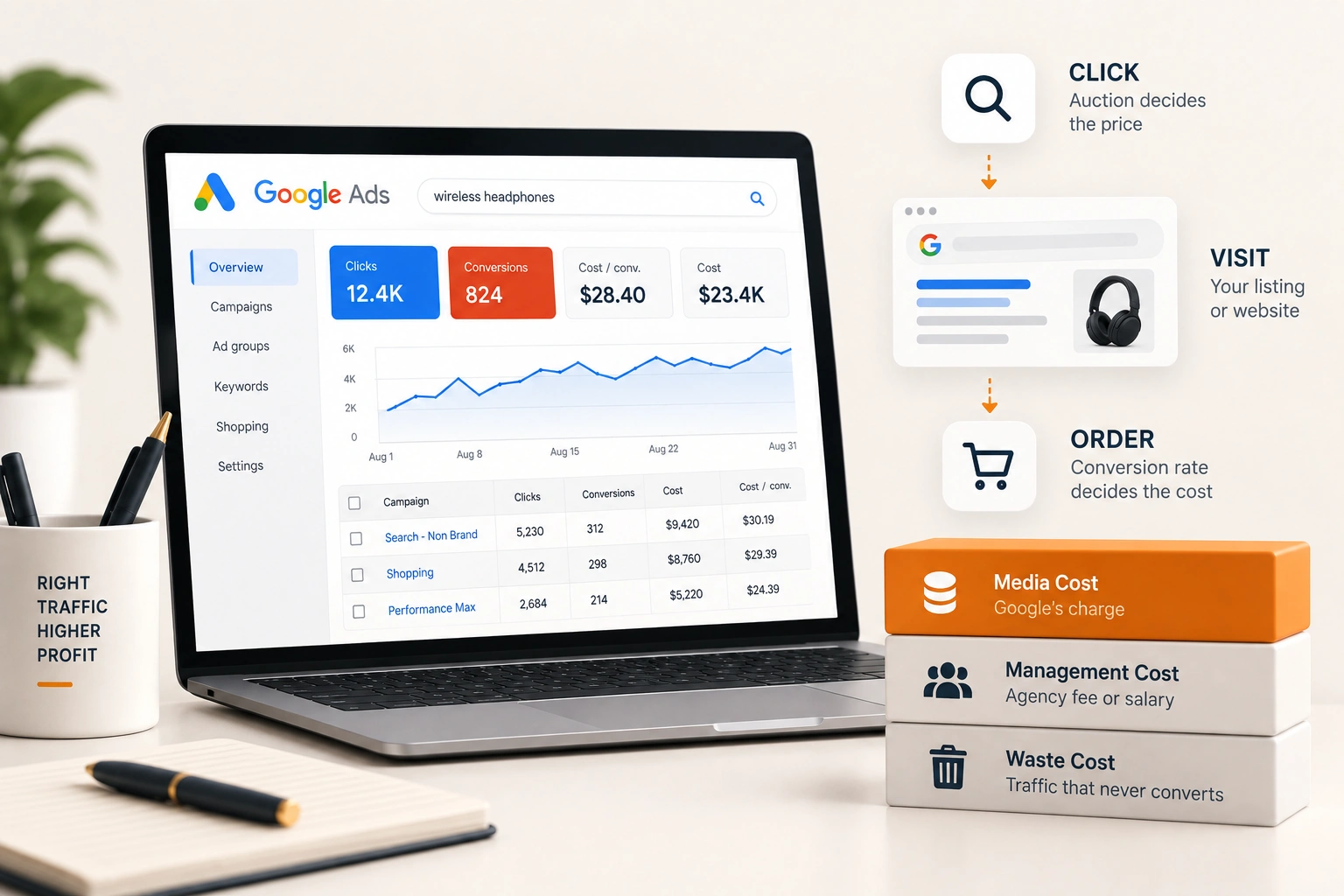
The question is always some version of what does a click cost, and the honest answer is that it does not matter much. A cheap click on traffic that never converts is more expensive than a dear one that does.
What decides the bill is the cost of an order, and that is cost per click divided by conversion rate. Only one of those two is set by the auction.
The three costs, in order of size
The media. What Google charges, which is what everybody means by the cost. It is the largest and the most visible.
The management. An agency fee or somebody's salary. Real, and small against the media on any account of size.
The waste. The half of the media buying traffic that was never going to buy. Invisible in every quote and, on an unmanaged account, frequently the largest of the three.
Why the cost per click varies so much
It is an auction, so it is set by what competitors are willing to pay and by how relevant Google thinks your ad is to the search. Two brands bidding on the same term pay different prices for the same position.
Category matters more than anything you control. Terms where a customer is worth thousands cost accordingly, and terms where a customer is worth twenty do not. Comparing your cost per click against a published average across categories tells you nothing.
The number that decides the budget
Contribution margin per order. Take the price, subtract the cost of goods, the fees, the shipping and the share of returns. What is left is what an order can spend on being won.
Divide that by the conversion rate on the traffic and you have the most you can pay per click. That is the ceiling, and it is a fact about your business rather than an opinion about advertising.
Everything else follows from it, including whether the channel is viable at all. Some catalogues cannot afford search at the price the auction charges, and finding that out from the arithmetic is cheaper than finding it out from a quarter of spend.
Where the waste hides
Broad match terms nobody read. Brand traffic bought that was already arriving free. Shopping spending on products that cannot be profitable at any conversion rate. Campaigns competing with each other for the same query.
None of those show up as a line item. They show up as an average that looks acceptable while half the budget does nothing, which is the pattern behind campaigns that spend without converting on any platform.
The account structures that waste least
Search campaigns split by intent rather than by product range, so a term somebody types when they know exactly what they want is not funded from the same budget as one they type while browsing.
Shopping segmented by margin rather than by category, because the products that can afford a click are not always the ones with the most searches. A single campaign holding the whole catalogue spends where volume is, which is rarely where the profit is.
Brand kept separate and measured on its own, so the decision about whether to pay for your own name is a decision somebody makes rather than an accident inside a larger number.
And Performance Max given boundaries. It will find conversions wherever they are cheapest, which frequently means the customers who were going to buy anyway, so it needs exclusions and a structure around it rather than a budget and hope.
What a sensible starting budget looks like
Enough for the conversion event to happen often enough to learn from. Below that, results swing so much that no decision can be read out of them and the money buys noise.
Practically, that means starting narrow rather than shallow: one campaign covering the products that convert best, funded properly, beats five campaigns funded by a fifth each.
What we do with this
Google Ads management is run against contribution margin rather than against a ROAS target somebody inherited, and the first month is usually spent removing waste rather than adding spend.
For brands selling on marketplaces as well, the two interact: search frequently converts on Amazon rather than on the site, and judging the campaign on last click alone is how the spend that was working gets cut.
Keep reading
If you want the ceiling worked out from your own margins, that is the first conversation.
Frequently asked questions
The questions that come up most often on this subject.
Whatever you set, plus whatever the auction charges per click. The useful number is not the click price but the cost per order, which is the click price divided by your conversion rate. A cheap click on traffic that never buys is more expensive than a dear one that does.
There is no answer across categories, because the auction price follows what a customer is worth. The only meaningful ceiling is your own: contribution margin per order multiplied by conversion rate. Above that you are buying revenue at a loss, however good the number looks against an industry average.
Enough for the conversion event to happen often enough to learn from, concentrated on the products that already convert. Five campaigns funded at a fifth each produce five inconclusive results; one funded properly produces a decision.
Usually competition, seasonality or a relevance change on your side. It is an auction, so a competitor raising bids moves your price without you changing anything. What matters is whether the cost per order moved with it.
Where the margin can carry the auction price for the terms that matter, yes. Where it cannot, the arithmetic says so before any money is spent, and the honest answer is to work on the channels where demand already exists rather than to spend a quarter proving it.
Sometimes, and it is worth measuring rather than assuming. If nobody is bidding against you and your organic result is first, brand clicks are frequently traffic you were getting free. If competitors are bidding on your name, the calculation changes.
Usually a percentage of spend or a flat retainer, and it should be quoted after an audit rather than from a rate card. The fee matters far less than the waste: on an unmanaged account the money lost to irrelevant traffic is routinely larger than any management fee.
Waste comes out in the first month and shows immediately. Structural changes need a fortnight of stable spend to read, because every significant edit costs the campaign its learning. A fair verdict on the channel is about ninety days.
Google, directly, from your own account. The management fee is separate. Keeping the account in your own name matters more than the billing arrangement: it is your data, your history and your asset if the relationship ends.
Read the search terms report and add negatives. On most accounts that have not had it done recently, it removes a material share of the spend in an afternoon without touching a single bid.