Meta Ads vs Google Ads: Demand Made or Captured
Google captures demand that exists. Meta creates it. Judging the second on the first's attribution is how brands cut the spend that was filling the funnel.


Loading Article banner
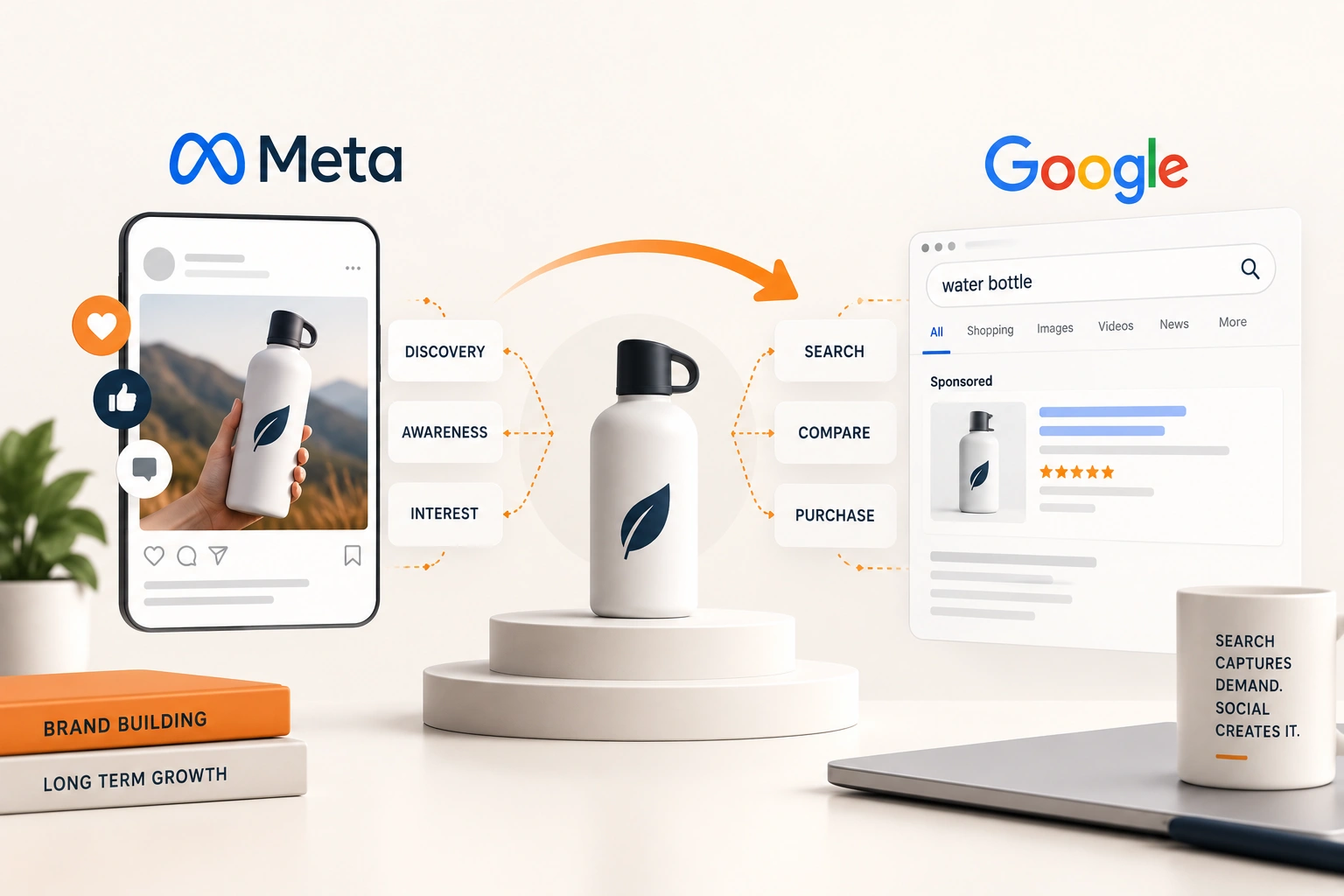
Google shows an ad to somebody who typed something. Meta shows one to somebody who did not ask. That is the whole difference and everything else follows from it.
A brand with a product people search for has a Google problem to solve. A brand with a product people do not know exists has a Meta problem, and no amount of search budget fixes it.
What each is actually buying
Google buys the end of a decision. Someone has a need, has words for it, and is choosing where to buy. The intent is given and the competition is for the position.
Meta buys the beginning. Someone is scrolling, and the job is to be interesting enough to interrupt them and relevant enough to matter. The intent has to be created, and creative does most of the work.
Why last click flatters Google
The customer who saw a Meta ad on Tuesday and searched the brand on Thursday is recorded by search. That is not an error in either platform, it is what last click means.
The consequence is predictable: a brand judging channels on last click cuts Meta, then watches branded search fall a month later and cannot explain it. This is the commonest expensive mistake in eCommerce measurement.
The answers are blended reporting, a look at branded search volume as a demand signal, and incrementality tests when the question is genuinely open.
What each rewards
Google rewards structure and discipline: keyword and match type control, negatives, feed quality, and a landing page that matches the promise.
Meta rewards creative volume and signal quality. Targeting is largely automated now, so the account with more distinct angles to test beats the account with cleverer audiences.
That is why the same team can be excellent at one and poor at the other. They are not the same craft.
What each costs to run properly
Google's cost is mostly attention: search terms read, negatives added, the feed maintained, bids and budgets kept honest. It rewards a weekly rhythm and punishes neglect slowly, which is why neglected accounts look fine for months.
Meta's cost is mostly production. An account needs a steady flow of genuinely different angles, not ten crops of one idea, and that is a creative pipeline rather than an optimisation task. A brand unwilling to fund the making of things will get less from Meta whatever the targeting looks like.
That difference decides staffing more than budget. Search can be run well by one careful person; Meta needs somebody making things, and the account performs at the pace that person can produce.
Splitting a budget
If demand exists and you are not capturing it, search first. Being absent from searches for your own category is the most expensive gap available.
If demand is captured and growth has stalled, Meta, because the constraint is the number of people who know the product exists.
In practice most brands run both with the split moving by season and by launch, and the ratio matters less than reading them together rather than against each other.
The signal both depend on
Neither platform can optimise towards something it cannot see, and browser tracking alone misses a material share of what happens. Server side events fix most of that on both, and the work is ordinary maintenance rather than a project.
It is worth doing before any budget argument. An account optimising towards a conversion that fires on the wrong page, or counts one order twice, will produce numbers that make the wrong channel look like the winner, and no amount of budget reallocation corrects a measurement fault.
Check the purchase values, the currency and the deduplication against the store's own orders. If those three agree, the rest of the comparison is worth having; if they do not, fix them first.
What we do with this
Meta ads management and Google Ads management under one plan, reported on contribution margin, so neither gets cut because the other took the credit.
For brands selling on marketplaces too, both frequently convert on Amazon rather than on the site, which is a third place the credit disappears to.
If the channels are being defended separately in your business, that is worth an hour of somebody's time.
Frequently asked questions
The questions that come up most often on this subject.
They do different jobs. Google captures demand that already exists and Meta creates it. A product people search for needs Google; a product nobody knows about needs Meta, and no amount of search budget fixes an awareness problem.
Usually Google on last click, because it is credited with the purchase that ends a decision Meta may have started. On blended numbers the gap narrows considerably, which is why the comparison is worth doing across the business rather than platform by platform.
Largely attribution. Someone who saw a Meta ad and later searched your brand is recorded by search. That is what last click means rather than a fault in either platform, and it is the commonest reason brands cut the spend that was filling their funnel.
Watch blended acquisition cost, branded search volume and total revenue rather than platform ROAS alone. When the answer genuinely matters, run a holdout: turn it off in one region or for one audience and measure what happens to the total.
One, funded properly. Two half-funded accounts produce two inconclusive results. Which one depends on whether the demand exists: if people search for the category, start with search; if they do not, start with Meta.
By constraint rather than by ratio. If searches for your category are going to competitors, that gap is the most expensive one. If search is captured and growth has stalled, the constraint is how many people know the product exists, which is Meta's job.
On Meta it is the main lever, because targeting is largely automated and the auction rewards the account with more distinct angles. On Google creative matters and structure matters more: keywords, match types, negatives and the feed.
They can, and being good at one does not imply the other. Search is a discipline of structure and exclusion; Meta is a discipline of creative volume and signal quality. The best accounts we take over are usually strong at one and neglected on the other.
It is a third auction with the highest intent of the three, and it frequently takes the credit for purchases the other two started. Any brand selling on a marketplace should read all three together, because judging each in isolation guarantees at least one of them is being undervalued.
Long enough for the conversion event to happen often enough to be read, and stable enough not to reset learning halfway through. For most eCommerce accounts that is a fortnight minimum per meaningful change, and ninety days before judging a channel.