How to Read an Agency Spotter Listing Before You Hire
What Agency Spotter's Verified badge, client reviews and top reports actually prove, what an agency's plan changes in what you see, why there is no marketplace category, and the five checks to run before a shortlist.


Loading Article banner
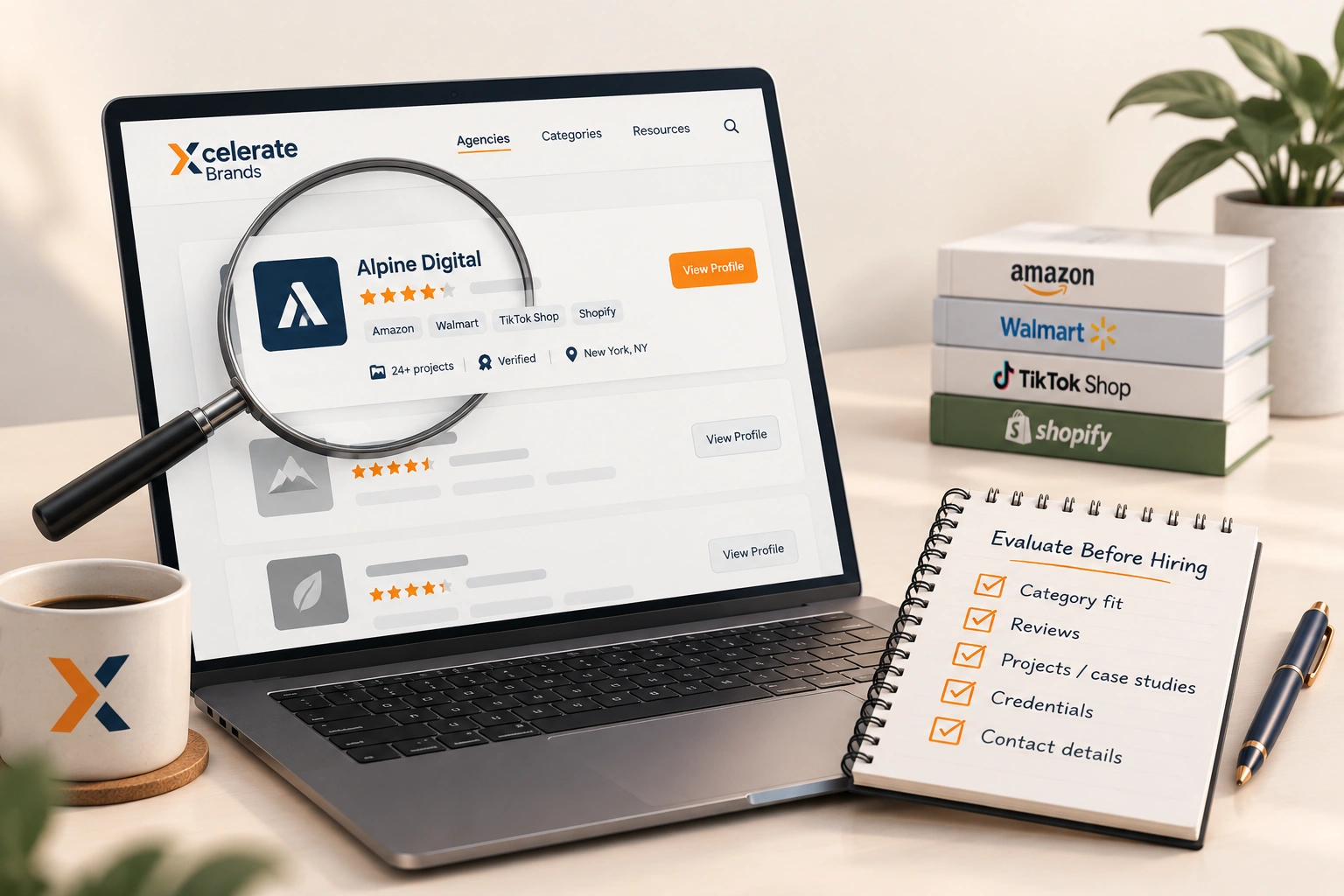
A shortlist of marketplace agencies often starts on a directory, and Agency Spotter is one built for business buyers. It says it covers more than 19,000 agencies across 56 service areas, and its listings share the same parts: a Verified badge, client reviews, a portfolio of projects, and sometimes an award from a top agency report.
Each part proves something narrower than it appears to, and some are shaped by what the agency pays for. What follows comes from Agency Spotter's own FAQ, pricing, badge and report pages, read on 8 October 2026, for a brand choosing who should run its Amazon, Walmart, TikTok Shop or Shopify operation.
Start with the category, because yours is not on the list
Agency Spotter's service list has no category for marketplace management, and none for Amazon, Walmart or TikTok Shop. The nearest it offers are eCommerce under digital marketing, PPC, paid search and paid social advertising, shopper marketing, eCommerce development and Shopify developers. An agency that runs marketplace accounts has to choose which of those rooms to stand in, and a brand looking for one has to search several.
Two of the platform's own rules make that matter. Its FAQ says no agency can claim more than five service areas, and its pricing page shows a free listing is searchable under one service. So an agency doing exactly your work can be missing from the category you searched, while a studio that has built a few Shopify stores sits beside a team that works in Seller Central every day.
The answer is to search two or three neighbouring categories and sort the results yourself, by reading. The category label says where an agency chose to be found; the projects and reviews say what it does. Look for Seller Central, Walmart Marketplace, TikTok Shop, marketplace advertising and account health, named as the work itself rather than mentioned in passing.
What the Verified badge says, and what it does not
The Verified badge sits beside an agency's name on its profile. Agency Spotter's pricing page lists it on every plan, the free one included, and describes it in two ways: "Claimed by the agency" on the free plan and "Claimed and verified by the agency" on the paid ones.
Read it for what those words say. The badge is about who controls the listing: the agency has taken ownership of its page, so the services and description are its own. That is worth knowing, but it says nothing about the quality of the work, and it is a different thing from a verified review, which is about the person who wrote it.
Two other badges travel further. The badge page offers agencies a Reviewed Agency badge for their own website if they have "a 5-star client review", so the bar is a single five star review. And the pricing page says the award badges marking agencies featured on a top report appear on a listing's tile only for upgraded agencies. A badge on an agency's website is a reason to open its profile and count, and a missing award badge is not proof there was no award.
How the reviews get there
Agency Spotter's FAQ page describes both routes in: "Former clients of agencies can post reviews and the agencies also request clients to post reviews." Once a review is submitted, "the Agency Spotter team verifies the identity and credibility of each reviewer, and only allows those that meet strict criteria to remain published." Only clients can review an agency, former or current, and former employees and contractors are excluded.
That verification answers one question well: was this written by a real client? It cannot answer the second, which is how the clients were chosen. An agency asks the clients it expects to be happy, and every platform built on invited reviews has that shape, which is why reading a Clutch profile also starts with the details under each review rather than the stars.
So read every review rather than the average. Each carries the reviewer's name and company, and usually a role: a founder or a head of eCommerce saw the commercial result, and a company that sells on a marketplace had your problem. Expect small numbers. On the eCommerce development report published on 23 September 2026, the eight agencies ranked had between one and twenty reviews each, so one review is a large share of any profile's evidence.
What a top agency report is built on
Agency Spotter's FAQ describes the method behind its ranked reports in one line: "We rank agencies using a combination of objective scoring as well as expert curation." The reports name their inputs. The eCommerce development report says its firms are "ranked based on verified client reviews, agency credentials, and case studies". The branding report names credentials, expertise, client feedback and project work.
Two things follow. First, a report is not a sort by stars. On that eCommerce development report, the agency in first place had a 4.0 average from three reviews and sat above seven agencies rated 5.0: case studies, credentials and curation doing their work. A high position is real information, but it measures evidence supplied as much as work done.
Second, every report has a date and a category. The three read here were published in September 2026. A report on eCommerce development ranks firms that build online stores, which is a different job from running a marketplace account once the store exists, so check the category matches the work you are hiring for before treating a place on it as a reference.
What an agency's plan changes in what you see
Agency Spotter is plain that listing is free and that money buys reach. Its FAQ says "We are not a pay to play site" and, in the same answer, that "Agencies can pay to gain more exposure to a point". Elsewhere it says upgraded agencies have been getting 10 to 25 times more exposure than agencies on the limited plan.
The pricing page shows where that exposure comes from. A free listing has no promoted placement; the paid plans buy a place in "promoted search results", each tier above the one below, and promotion under more services. A free profile shows four projects and the paid plans up to eight. A paid add-on, Portfolio Concierge, has Agency Spotter's own team "update and optimize your portfolio within about 48 hours", and the top plan includes a concierge who updates it several times a year.
None of this is hidden or improper. It does mean three things on a listing are partly a plan: where an agency appears in a search, how many projects you can see, and how polished the writing is. A sparse profile can belong to a capable agency that has not paid or not finished it; a polished one may have had the directory's help. The substance is what a plan cannot buy: projects that name the channel, the period and the result, and reviewers who can be identified.
Your visit is part of the product
The FAQ tells agencies they can do "just-in-time business development by seeing who has been checking you out", and says Agency Spotter ranks "every registered user on the platform in order to help our agency partners identify a verified lead". The pricing page gives the paid plans a report of verified leads who clicked through a portfolio, and an allowance of emails to contact leads every 30 days.
So if you are signed in, expect agencies whose profiles you opened to know, and some to write. That is the directory working as designed. If you would rather research quietly, read profiles before you register and sign in when you are ready to be contacted. And the counts on a profile, how many lists it has been added to and how often it has been shared, measure attention from other buyers, not results for them.
Five checks before an agency makes your shortlist
One: search two or three neighbouring categories and keep the agencies whose projects name marketplace work. Two: open every review and note the role, the company and the date before looking at the average. Three: read the projects for a channel, a period and a number; a project with all three is evidence, one with none is a brochure. Four: treat placement, badges and polish as signs of a plan, not a verdict. Five: take the two strongest listings to a call and ask what no listing holds: who will run your account day to day, and what happened on an account the agency lost.
That last check is where every directory ends. The full guide to choosing an agency covers what to ask on that call and the answers that should worry you.
Where a listing stops
Agency Spotter is a useful way to build a list, treated as several rooms rather than one. Each directory asks for its own reading: a DesignRush ranking is built from factors an agency mostly supplies itself, a GoodFirms listing is scored against five published criteria, and Agency Spotter adds a commercial layer of placement and lead data worth knowing is there.
When the brief is someone to run the marketplace operation itself, across Amazon, Walmart, eBay, TikTok Shop and Shopify, that is the work of our marketplace management team. The useful first conversation is about an account like yours, and a listing can start it but never replace it.
Frequently asked questions
The questions that come up most often on this subject.
Agency Spotter says its team verifies the identity and credibility of each reviewer once a review is submitted, and keeps published only the reviews that meet its criteria. Only current or former clients may review an agency; former employees and contractors may not. Agencies also ask clients to post reviews, so verification confirms the reviewer is a real client without showing how the agency chose whom to ask. Read each review's role, company and date rather than the average.
That the agency has claimed its listing. Agency Spotter's pricing page lists the badge on every plan, the free one included, and describes it as claimed by the agency on the free plan and claimed and verified by the agency on the paid plans. It tells you the profile is maintained by the agency itself. It says nothing about the quality of the work, and it is separate from the verification of individual reviews.
Its FAQ says it ranks agencies using a combination of objective scoring and expert curation, and each report names its inputs: verified client reviews, agency credentials and case studies for eCommerce development, for example. Because case studies and curation count, a report is not a sort by star rating. Each report also carries a published date and a service category, and both are worth checking against the work you are hiring for.
It can pay for placement. Agency Spotter's FAQ says agencies can pay to gain more exposure to a point, and its pricing page shows the paid plans buying a place in promoted search results, each tier above the one below, with more promoted services and more visible projects. Read the order of a search as partly a plan, and judge each agency on its projects and its reviews.
If you are signed in, it can. Agency Spotter tells agencies they can see who has been checking them out, and its paid plans include data on leads who interacted with a portfolio and an allowance of emails to contact them. It says it ranks every registered user to help agencies identify a verified lead, so if you want to research before being contacted, read profiles before you register.