Shopify Tax on Return Shipping Fees: What Changes on 23 October 2026 and What to Check
From 23 October 2026, Shopify Tax and Tax Platform charge tax on return shipping fees for US orders. Which stores it touches, which fees stay untaxed, the manual workarounds that would now count tax twice, and the checks to make before the date.


Loading Article banner
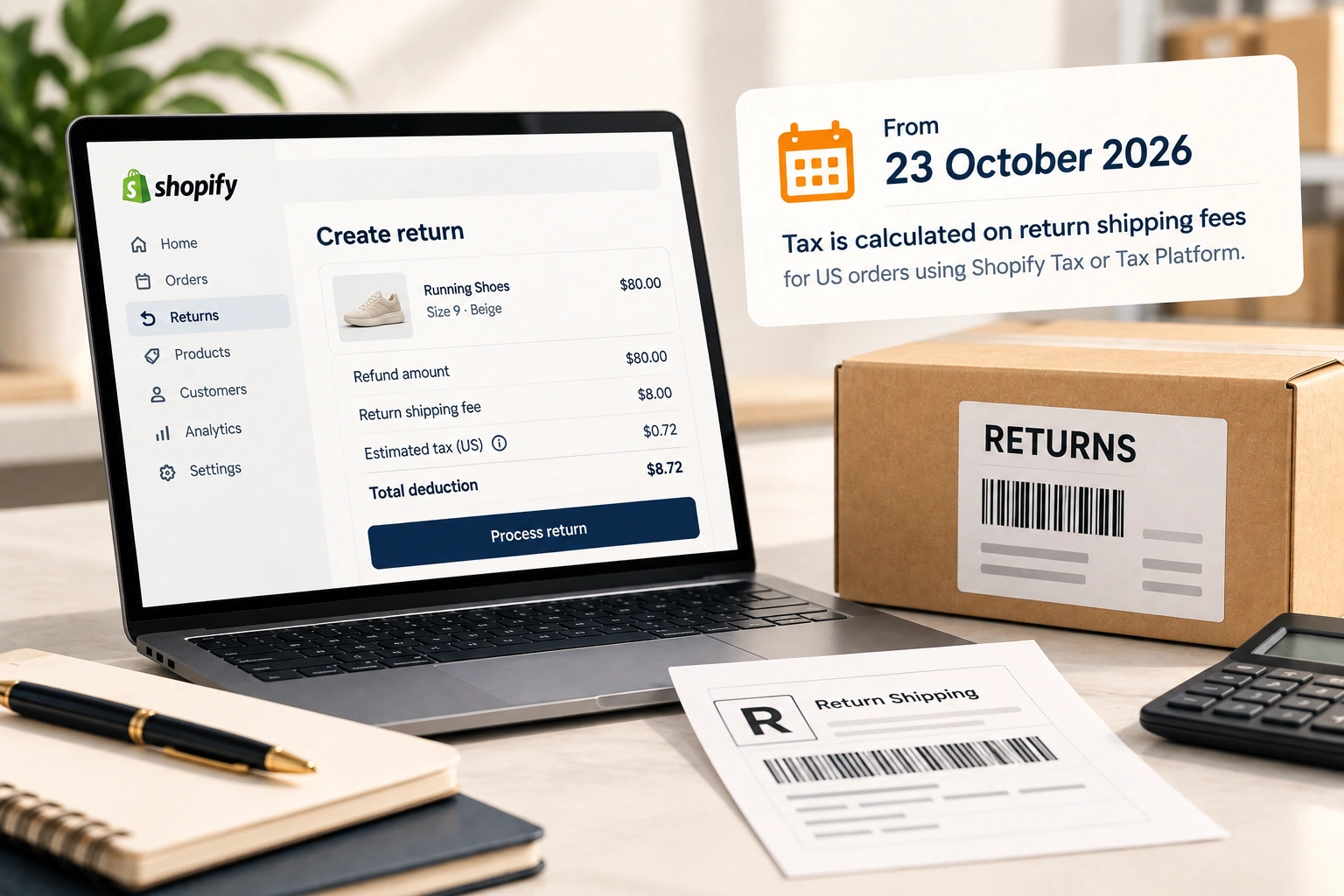
On 25 September 2026 Shopify announced a change to how return fees are taxed, and it takes effect four weeks later. The Help Center puts it in one sentence: "Starting October 23, 2026, tax is calculated on return shipping fees if the order was shipped to an address in the United States and you use one of the following tax services: Shopify Tax or Tax Platform."
For a store that offers free returns, nothing changes. For a store that charges a return shipping fee, collects tax through Shopify Tax, and has been handling the tax on that fee some other way, something does, and the date falls just before the busiest returns season of the year. This is what the change covers, what it leaves alone, and what to check before 23 October.
What changes on 23 October
Shopify's changelog says return shipping fees will be taxed like any other shipping charge. When a return is created, Shopify shows the estimated tax on the fee; when the return is processed, it records the final tax, and that tax flows into your tax reports automatically.
Your existing shipping tax settings still decide the outcome. If you have set shipping to be untaxed in a state, return shipping fees in that state remain untaxed. And Shopify's return rules page adds the underlying rule: "Tax is calculated only if the fee is taxable in the tax jurisdiction that the order was shipped to." The change does not make a fee taxable where the law does not; it makes Shopify calculate the tax where it does.
In practice that means two customers returning the same product under the same policy can see different totals. One, in a state that taxes shipping, sees the return fee with a tax line on it; the other, in a state that does not, sees the fee alone. Both are correct, and a line on the returns page saying that tax may apply to the return fee where the law requires it saves the support team explaining it one customer at a time.
When it does not apply
Shopify lists the cases where no tax is calculated on return fees: the order was shipped to an address outside the United States; you use another tax service, such as Manual Tax or Basic Tax; or the order is tax exempt. Separately, "Tax isn't calculated on restocking fees", whichever service you use.
So the stores this touches are US stores on Shopify Tax or Tax Platform that charge a return shipping fee on domestic orders. International orders follow their own rules, and for those the questions that matter are the ones about duties at checkout and who pays them, not this one.
Which return fees this touches
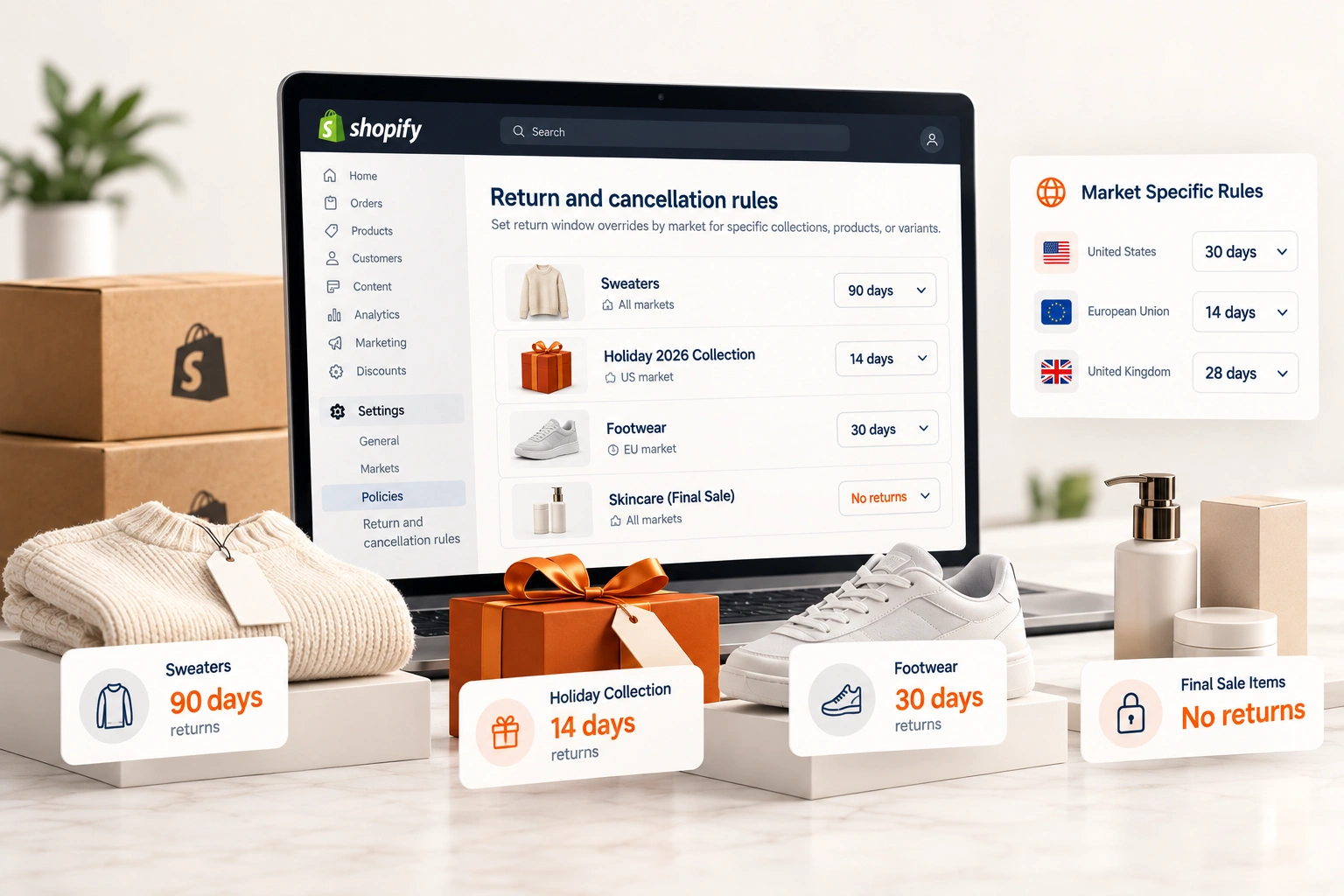
Shopify's return rules give three choices for return shipping: "Offer free return shipping," "Add a flat rate return shipping fee that's charged one time per return," or "Have your customers buy their own return shipping label." Separately, you can charge a restocking fee "that is a percentage of the return."
Read against the change, only the second choice produces a fee for Shopify to tax. Free returns carry no fee. A customer who buys their own label pays the carrier, not you. A restocking fee is a fee, but Shopify does not tax it. The flat rate return shipping fee is the one that will carry a tax line from 23 October in the states where shipping is taxable.
That fee is usually set by the same arithmetic as outbound shipping: what the carrier charges, what the customer will accept, and what it does to conversion. If you worked yours out alongside a free shipping threshold, the tax does not change what you receive, but it does change what the customer sees deducted, and that is worth knowing before they ask.
The workarounds that would now count tax twice
Shopify's changelog tells merchants who have been handling this manually to review their process before 23 October, to avoid duplicate tax calculations. Manual handling tends to take a few forms: a return fee set higher to cover the tax, tax on return fees added in a spreadsheet at filing time, or an app or accounting rule that records it separately. After the change, each of those would count the tax a second time.
One thing does not change, and it catches people. "Return fees aren't automatically deducted from refunds. When you create a refund, you need to manually deduct any applicable return fees." A refund process written months ago as deduct the flat fee is worth rereading with whoever processes refunds, so they deduct what the return actually shows now that the fee can carry tax.
Before 23 October: a short list
Confirm which tax service the store uses. If it is Manual Tax or Basic Tax, this change does not reach you.
Open your return rules and note which return shipping option is set. If it is free returns or customer-bought labels, you are done with the fee itself.
If you charge a flat rate return fee, check your state shipping tax settings, since they decide where the fee is taxed.
Find and remove any manual step that already adds tax to return fees, and tell whoever files your sales tax that return shipping will appear in Shopify's tax reports from 23 October.
Brief whoever answers customer emails. A shopper who sees tax on a return fee for the first time will ask why, usually in January, when the gifts come back. If your BFCM checklist includes the returns policy, add this line to it.
And while the return rules are open, it is worth looking at what returns actually cost you. The arithmetic in what a return rate costs was written for Walmart, but the sums work the same way on a Shopify store.
What we do with it
For the Shopify stores we run, a change like this is a settings check and a process check, done once before the date: the tax service, the return rules, the state settings, the refund steps, and the note to the accountant. None of it is complicated, and all of it is easy to miss in the weeks before Black Friday, which is why it goes on the same list as the rest of Shopify store management.
Frequently asked questions
The questions that come up most often on this subject.
From 23 October 2026, for orders shipped to US addresses on stores that use Shopify Tax or Tax Platform. Shopify announced the change in its changelog on 25 September 2026.
No. Shopify's return rules page says tax isn't calculated on restocking fees. The change on 23 October applies to return shipping fees only.
No. Shopify says tax is not calculated on return fees if you use another tax service, such as Manual Tax or Basic Tax, if the order was shipped outside the United States, or if the order is tax exempt.
No. Your existing shipping tax settings still apply, so if shipping is set to untaxed in a state, return shipping fees in that state remain untaxed. Shopify also only calculates the tax where the fee is taxable in the jurisdiction the order was shipped to.
No. Shopify says return fees aren't automatically deducted from refunds, and you need to deduct any applicable return fees manually when you create the refund. That does not change on 23 October.