Shopify Duties and Import Taxes at Checkout: DDP, HS Codes and the 2026 Tariffs
The customer paid, the parcel reached the border, and the carrier is now asking them for more money. Why that happens, how Shopify collects duties at checkout instead, what every product needs before it can, which carriers will ship it, and what the new US and Canada tariffs change for a store shipping either way.


Loading Article banner
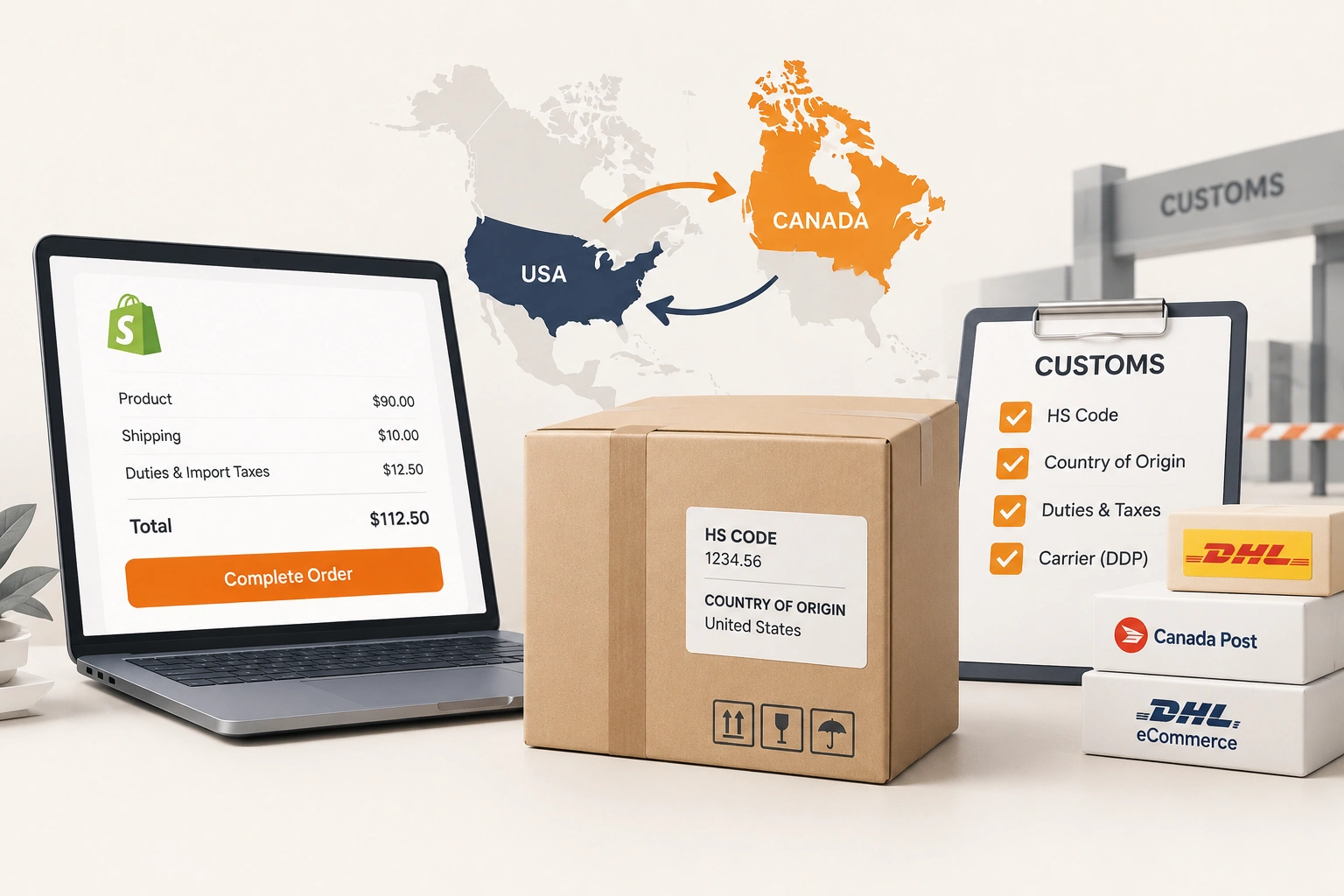
A store ships a $90 order from the United States to Canada. The customer paid $90 and shipping. A week later the carrier asks them for duty, tax and a brokerage fee before handing over the box, and the customer, who thought they had paid, refuses it. The parcel comes back, the refund goes out, and the store has paid shipping both ways for nothing. Every cross border seller has that story, and the confusion threads on the Shopify Community this month are the same story told in the present tense.
This is how duties work at the border, how Shopify collects them at checkout so the surprise never happens, what a product needs before it can, which carriers will carry a duty paid parcel, and what the tariff changes announced in August and September 2026 mean for a store shipping between the United States and Canada.
DDP and DAP: who pays at the border
Shopify's help defines the two terms a store has to choose between. Delivered Duty Paid: the seller assumes responsibility for the import costs, and can collect payment for them during checkout. Delivered at Place: the seller is only responsible for shipping the product, and the customer is responsible for paying the import costs on delivery. The $90 order above was DAP, whether or not the store knew the term.
DDP is the customer's experience of a domestic purchase: one price, one payment, the parcel handed over. It costs the store the work of collecting the right amount and shipping with a carrier that settles it. DAP is simpler for the store and worse for the customer, and the refusals and returns it produces are a cost that never appears on the shipping invoice.
What every product needs before duties can be collected
An HS code and a country of origin, on every product. Shopify's help is direct: before setting up the collection of duties and import taxes at checkout, verify that HS codes and country of origin have been added to the products. Where a product has no HS code, the estimate falls back to the product's description and category; where it has none of those either, duties and import taxes are not calculated at all, and the customer pays at the door as if the store had never set anything up.
The Harmonized System code is the six digit customs classification of what the product is, extended by each country; it is on the supplier's commercial invoice, and where it is not, the supplier can give it. Entering it once on each product is an afternoon's work for most catalogues and the difference between an estimate that matches the border and one that does not. The same product data discipline that the supplier feeds article describes for descriptions applies to the code and the origin: they come from the supplier and they go on the record.
The carriers that ship duty paid
Collecting duties at checkout is half the job; the parcel then has to travel with a carrier that pays the duty at the border on the store's behalf. Through Shopify's own carrier accounts, DDP labels are available for Canada Post to the United States, DHL Express, DHL Express Canada and DHL eCommerce. Shopify's help states the consequence for everything else: with any other carrier through Shopify's accounts, a label cannot be bought for an order on which duties have been collected. A store using its own carrier account, or a third party logistics provider, needs that provider's DDP service instead.
The practical shape is one of two: DDP through DHL or Canada Post for the lanes that matter, or DAP with the duties stated on the product page and at checkout so the customer is told before they buy, which is the honest version of the DAP order at the top of this article.
De minimis, and why the United States no longer has one
Many countries have a de minimis, a maximum order value below which duties and import taxes do not apply, and for years a store shipping into the United States relied on it: low value parcels cleared without duty. Shopify's help records the change: as of 29 August 2025, de minimis does not apply to shipments to the United States. Every parcel entering the US is now assessed, which is why a Canadian or British store shipping small orders south met duties in the autumn of 2025 that it had never seen, and why DDP became the norm for that lane rather than the exception.
The 2026 US and Canada tariffs
As eBay reported to its sellers in September, the United States applied an additional 50% tariff on certain Canadian goods from 22 August 2026, with motor vehicles and parts that had cleared duty free under the trade agreement among them, and Canada answered from 8 September 2026 with tariffs of 15%, 25% and 50% on a list of American products that includes beauty products, apparel, household goods such as tableware, cutlery and appliances, textiles, and lighting. The categories in that list are the categories most Shopify stores sell.
For a US store shipping to Canadian customers, the duty a Canadian buyer pays on a beauty or apparel order changed in September, and a DDP estimate built on last year's rate is now wrong at the border, which is where the carrier makes up the difference or the customer does. For a Canadian store shipping to the US, the August change and the end of de minimis a year earlier together mean every parcel south is assessed at rates that moved. In both directions the answer is the same: the HS codes right, the duties collected at checkout, and the estimates checked against a real shipment each month while the rates are moving. The seller who sells the same goods on a marketplace meets the same border with the marketplace's tools, which the Amazon import duties article covers for that channel.
For the stores we run under Shopify management, cross border is set up once, as a system: codes and origins on every product, DDP on the lanes with a carrier that supports it, DAP declared plainly everywhere else, and the border checked against a test order whenever the rates change. The cost of not doing it is the parcel that comes back, and the shipping promise, duties included, belongs on the list of things a store settles before the season, beside the speed work in the site speed article.
Related reading: Shopify SEO: The Complete Guide for a Store That Has to Rank.
Frequently asked questions
The questions that come up most often on this subject.
In Shopify's terms, Delivered Duty Paid means the seller takes responsibility for the import costs and can collect them at checkout; Delivered at Place means the seller is responsible only for shipping and the customer pays the import costs on delivery, usually to the carrier before the parcel is handed over.
An HS code and a country of origin on each product. Without an HS code the estimate falls back to the product's description and category, and without those there is no estimate at all and the customer pays at the door.
Through Shopify's own carrier accounts, DDP labels are available for Canada Post to the United States, DHL Express, DHL Express Canada and DHL eCommerce. With any other carrier on Shopify's accounts a label cannot be bought for an order where duties were collected; a store's own carrier account or 3PL needs its own DDP service.
No. Shopify's help records that as of 29 August 2025 de minimis does not apply to shipments to the United States, so every parcel entering the US is assessed for duty regardless of value.
As eBay reported to sellers: an additional 50% US tariff on certain Canadian goods from 22 August 2026, and Canadian tariffs of 15%, 25% and 50% from 8 September 2026 on listed American products including beauty, apparel, household goods, textiles and lighting. Duty estimates for those categories need checking against a real shipment.