Shopify Return Window Overrides: Different Return Periods by Product, Collection and Market
Shopify now lets a store set its own return window for particular collections, products or variants, market by market. How overrides work, which one wins, what final sale does, where to set them, and the legal floor in the EU that no override can go below.


Loading Article banner
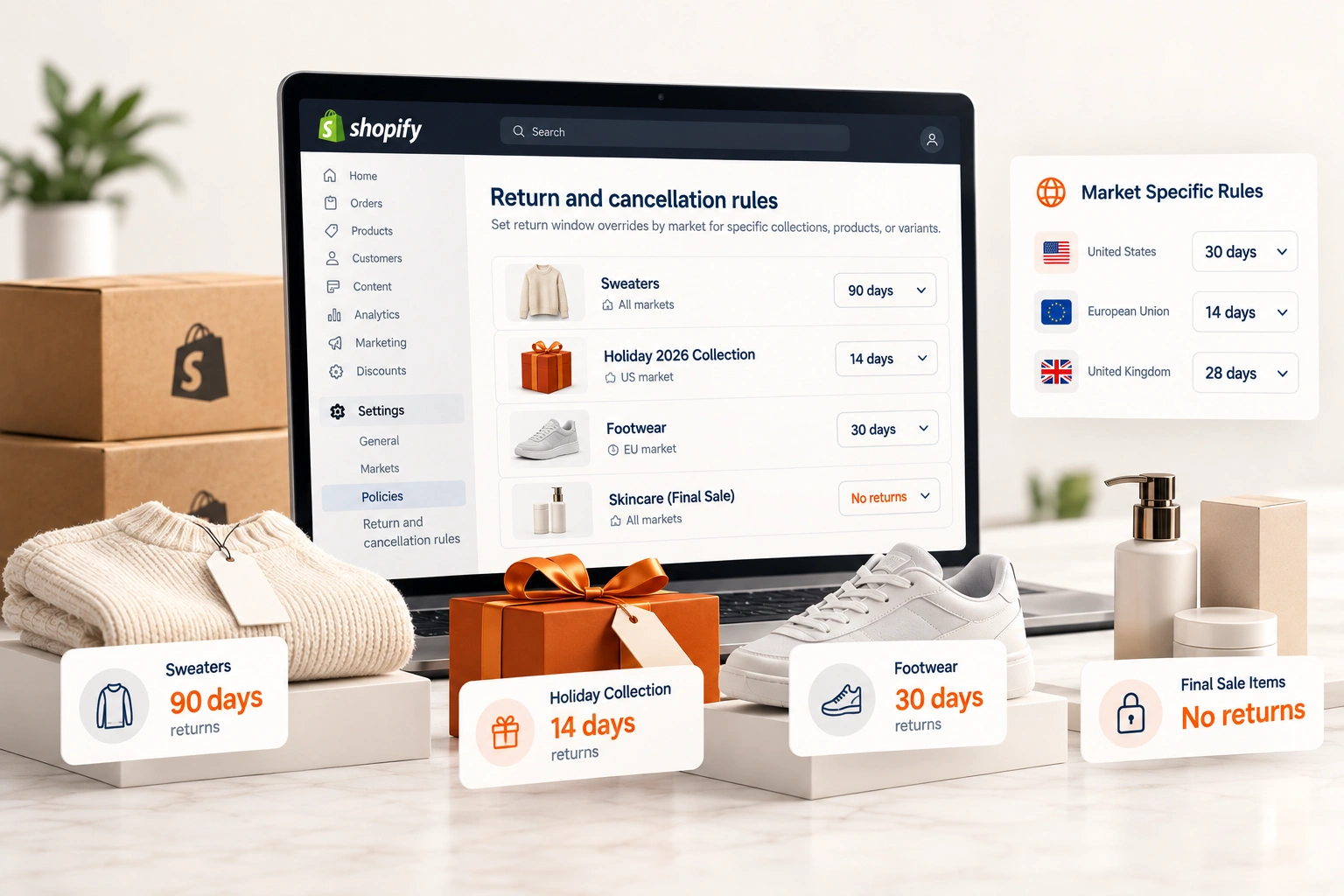
Until now a Shopify store had one return window, or one per market, and every product lived with it. A 90 day window that suits a winter coat is the wrong window for a holiday collection that will be worth half as much in January. On 29 September 2026 Shopify changed that: a store can now set a different return window for chosen collections, products or variants, market by market.
This is how overrides work, which window wins when rules overlap, what final sale does, where the setting lives, and the one limit no override can go below in the EU.
What Shopify released
In Shopify's words, a store can now "set return window overrides by market for specific collections, products, or variants." Its own example: "Set a 14-day window for your 'Holiday 2026' collection while keeping your storewide default at 90 days."
An override replaces the default for the items it covers, and it is set per market, so the same collection can have one window for customers in one country and another elsewhere. The setting lives at Settings, then Policies, then Return and cancellation rules, where you "select specific market rules to modify" and choose the collection, product or variant the override applies to.
Which window wins
Two rules decide it. First, overlap: "If an item matches more than one override, the shortest matching return window applies." A product in both a 30 day collection and a 14 day collection gets 14 days. Plan collections with that in mind, because an item added to a short-window collection for a promotion takes the short window with it.
Second, final sale beats everything: "Items marked as final sale can't be returned (or cancelled), even if they also match a return window override." Final sale is the stronger tool, and the one to use sparingly, for the reason in the section on the EU below.
Return rules are not only an online setting. Since 2024 Shopify has applied them "whether the return happens in store or is a self serve return online," and in point of sale the return window and final sale are "evaluated on each item in an order." A store with shops and a website gets the same answer at the counter as on the returns page.
When a shorter window makes sense
Seasonal stock, where the product loses value fast after its season. A shorter window gets returns back while they can still be sold at something like full price, instead of in February at a discount.
Limited runs and drops, where a returned unit may not be sellable again at all once the moment has passed. Clearance lines, where the margin left cannot carry a long return period. And products that are expensive to take back: bulky items, items that need inspection or refurbishment before resale.
When a longer one does
Gifts. A product bought in November for someone who opens it in late December needs a window that reaches January, or the gift receipt is worth nothing. A store that extends returns over the holidays can now apply the longer window to the gift-heavy collections rather than to the whole store.
Considered purchases, where a longer window lowers the risk of buying. For a high-value product with a low real return rate, the longer promise can do more for conversion than it costs in returns. That is a judgement to test, not assume, and the return rate by product is the number to watch while testing it. What a return rate costs sets out how to put a price on it.
The EU floor
A return window is a store's policy. The right to withdraw from a distance sale is the law, and the law comes first. For customers in the EU, the European Commission's own guidance is plain: "you have the right to withdraw. This means you can cancel the contract within 14 days without providing any justification," and "For goods this means 14 days from the date of delivery."
So an override for an EU market should not set a window shorter than that for goods the right covers, and final sale does not remove it either. The same page lists exceptions, among them perishable goods, customised or personalised items, and sealed media once unsealed, and it says the customer pays the return postage and packaging unless the seller offers to or did not tell them beforehand. Other countries have their own rules. This is not legal advice: check each market's law before setting its windows, and take advice where the stakes are real.
Setting them up without surprises
Start from the default and write down the exceptions: which collections should be shorter, which longer, and why. Keep the overrides few. Each one is a rule a customer can run into, and a store with a dozen overlapping windows is a store whose customer service has to work out the answer every time.
Then say it where customers look. The product page for an item with a different window should say so, and so should the returns policy page. A 14 day window a customer discovers only when they try to return is a complaint; the same window stated on the product page is a policy. Check the holiday collections before the season starts, since that is where overrides will matter most this year, alongside the rest of the BFCM checklist.
How we work on it
Returns sit between conversion and margin, and the right window is different for different products. Our Shopify service sets the default and the exceptions with a store from its return data, and keeps the policy pages saying the same thing as the settings. How returns work on the marketplaces, where the platform sets more of the rules, is in TikTok Shop's 2026 returns changes, and the rest of running a store is in the Shopify guide.
Frequently asked questions
The questions that come up most often on this subject.
Yes. Since 29 September 2026 Shopify lets you set return window overrides by market for specific collections, products or variants, under Settings, Policies, Return and cancellation rules.
Shopify applies the shortest matching return window. A product in both a 30 day and a 14 day collection gets 14 days.
No. Shopify says items marked as final sale can't be returned or cancelled, even if they also match a return window override. In the EU, check the legal right to withdraw before marking goods final sale.
Yes. Shopify's return rules apply whether a return happens in store or through self-serve returns online, and in point of sale the return window and final sale rules are evaluated on each item in an order.
EU consumers have the right to withdraw from an online purchase within 14 days of delivery without giving a reason, with exceptions such as perishable, personalised and unsealed media goods. This is not legal advice; check each market's law.