Customer Service by Amazon or Your Own Team: Who Should Answer Self-Ship Buyer Messages
Amazon now measures the customer service of sellers who ship their own orders, changed how buyer dissatisfaction is counted in April, and changed the terms of Customer Service by Amazon in May. What each measure means, what Amazon's service covers, and when your own team is the better answer.


Loading Article banner
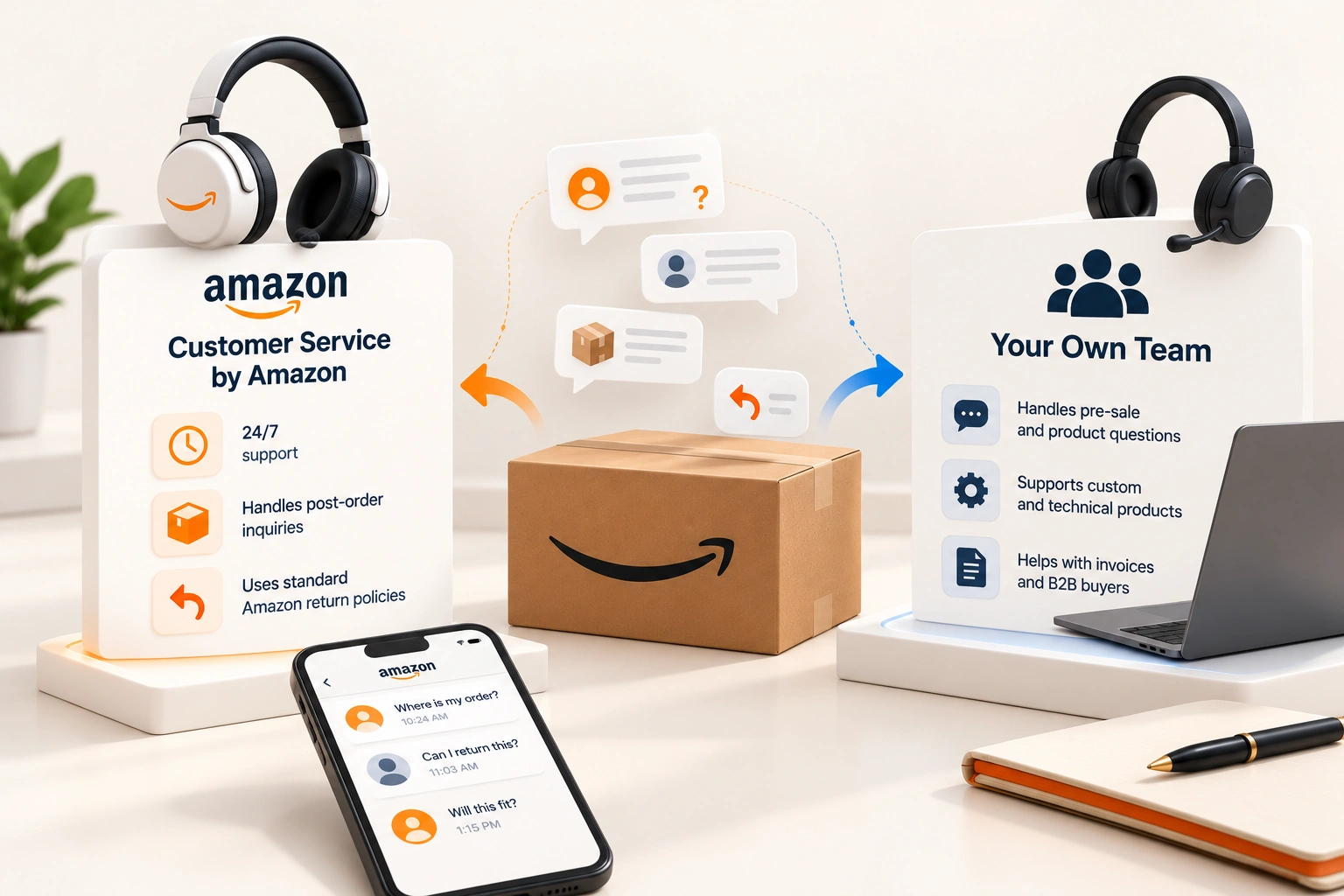
On an order fulfilled by Amazon, Amazon handles the customer service. On an order the seller ships, the seller does, and Amazon now measures how well. Feedback Manager shows a self-ship seller three customer service measures and, since earlier this year, how the top-performing sellers in the same store score on them.
So a question many operators settle by habit is worth settling on purpose before the holiday: who answers the buyer messages? There are three answers. The team you have, a team you bring in, or Amazon itself, through Customer Service by Amazon, whose terms changed in May. This is what Amazon measures, what its own service now covers, and how to choose.
The three numbers Amazon shows a self-ship seller
Amazon's Seller Forums announcement describes Customer Service Quality Insights as a dashboard "to help sellers who self-ship and provide their own customer service to track three key metrics: Buyer Contact Rate, Average Contact Response Time, and Buyer Dissatisfaction Rate." It sits in Feedback Manager and covers seller-fulfilled orders only, which is one of the differences behind the choice between FBA and FBM.
Amazon began showing these measures from 30 October 2024, when the first was called preventable contact rate, and says it launched the dashboard in its current form in December 2025. Read plainly, the three answer different questions.
Buyer contact rate. How often an order makes a buyer get in touch at all. Most contacts are a question the listing, the packaging or the delivery promise should have answered, so this one measures the operation more than the replies.
Average contact response time. How long buyers wait. Amazon's help pages sit behind the Seller Central sign in, and sellers widely report that they ask for a reply within 24 hours, weekends and holidays included.
Buyer dissatisfaction rate. In Amazon's words, it "measures buyer opinion on your customer service quality and indicates how well you resolved buyer issues." This is the one that changed this year.
Amazon gives no target for any of them. The comparison with top-performing sellers in the same store is the nearest thing to one, and it is the right benchmark to hold any team to, in-house or outsourced.
How dissatisfaction has been counted since 17 April
Amazon set out the change in a Seller Central news post that sits behind the sign in; we quote it as a seller reproduced it on the Sellers Ask Sellers community on 12 May 2026. The old survey asked "Did this solve your problem?", and the rate was the No answers divided by the total number of surveys sent.
"Starting April 17, 2026, buyers will rate their experience from 1 to 5", answering "How satisfied are you with your recent customer service experience?" Ratings of 1 and 2 count as dissatisfied and 4 and 5 as satisfied, while "A rating of 3 is neutral and won't be included". The rate is the dissatisfied ratings divided by "the total number of surveys sent after your cases are resolved", and Amazon said it "will yield the same percentage as before."
Two things follow, on our reading. The question is about the experience, so a fast reply that does not solve the problem scores as badly as a slow one. And the rate is counted against surveys sent, so a seller with a handful of messages a month can see it jump on one unhappy buyer. Read it over a quarter, not a week.
What Customer Service by Amazon takes over
Amazon calls it "a paid program where Amazon takes care of customer service" on self-ship orders. Its programme page says it handles "all post-order inquiries for your seller-fulfilled orders, except queries related to invoice and product customization", answers "24/7, via phone, chat, or email", and "uses the standard Amazon return policies". It is "currently available for Amazon stores in the United States, Germany and Japan", and sellers new to it get a 90-day free trial.
Amazon's announcement of 22 May 2026 changed the terms in four ways that bear on the decision.
Who uses it free. It "is now free if you are a low-volume seller with fewer than 30 orders per quarter", and "continues to be free if you maintain a contacts-per-unit below 3%." Amazon also dropped the requirement to maintain a 95% valid tracking rate.
Fewer refunds without a return. Return-less refunds now "only occur when the customer has not received the product by the promised timeline", or when the product arrived damaged or defective and cannot be returned, or is unsafe to return.
Fewer claims to file. A refund for a delivery issue no longer needs a SAFE-T claim when the label was a claims-protected one bought through Amazon Buy Shipping or Veeqo, and Amazon now reimburses its own goodwill refunds automatically. That is one more reason to buy labels through Amazon Buy Shipping, though its carrier adjustments still need watching.
Requests in the inbox. When Amazon needs the seller on a case, it now asks through Buyer-Seller Messages rather than email, and the programme page asks sellers to "Respond to requests in your Case Log within 24 hours."
Where Amazon's service fits, and where it does not
It fits a catalogue of standard products whose questions are mostly about delivery and returns. It fits a small seller best of all, now that fewer than 30 orders a quarter costs nothing, and it takes the weekend clock off a team that cannot staff one.
It does not answer pre-sale questions: "Customer Service by Amazon does not provide customer service for pre-order customer inquiries." It does not handle invoices, which matters to anyone selling to business buyers, or customised products. It applies Amazon's return policies, not the brand's. And one rule catches people out: "if you initiate contact with a customer, Customer Service by Amazon can no longer support you or the customer." The conversation is handed over completely or not at all.
Notice what keeps it free: contacts-per-unit below 3%. That is the work the buyer contact rate measures, fixing why buyers write in. Amazon answers the messages. It does not rewrite the listing that caused them.
When your own team is the better answer
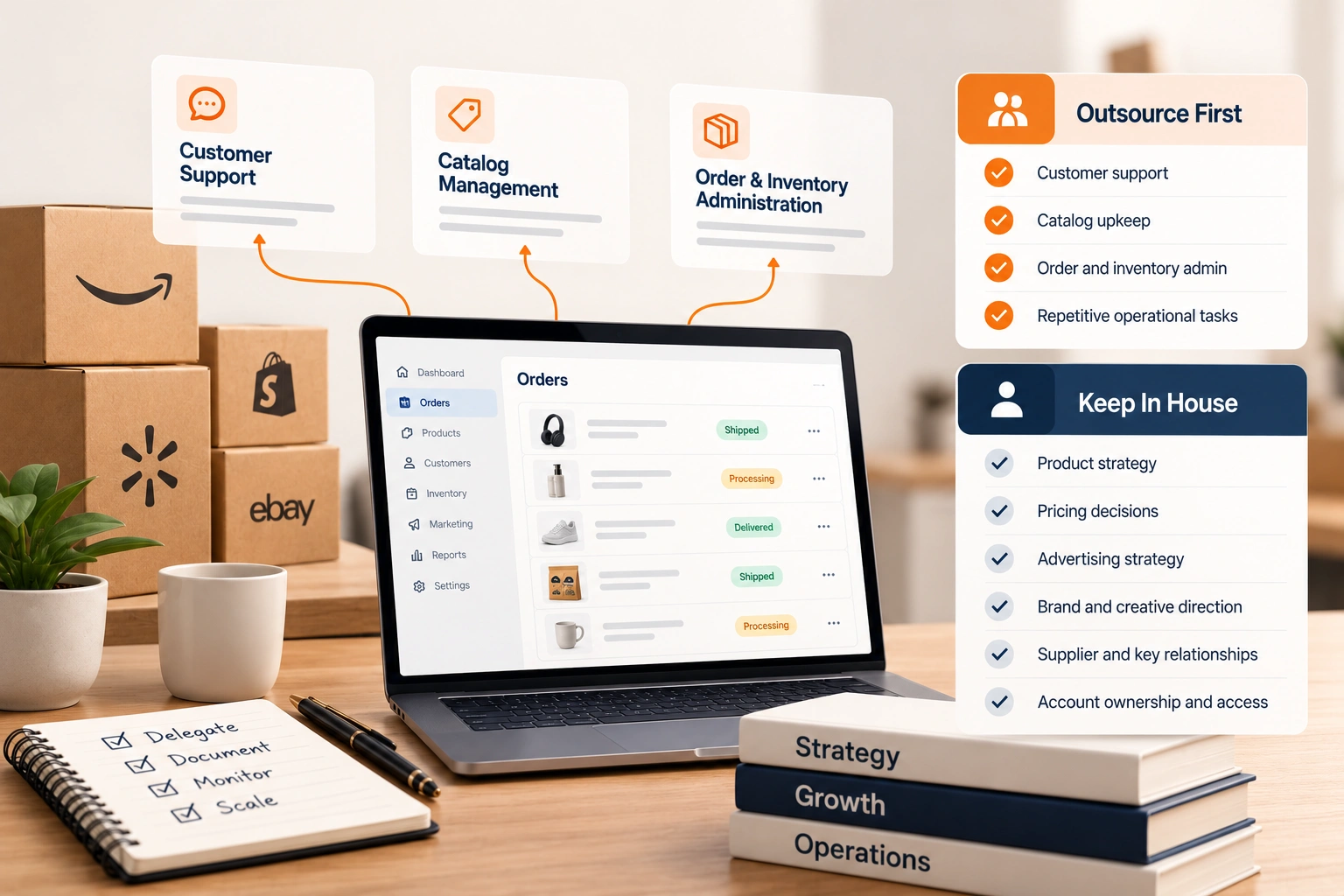
A team the brand controls, in-house or outsourced, earns its cost where Amazon's service stops: pre-sale questions that decide a purchase, customised or technical products, business buyers who need invoices, and a brand whose customers write in on several marketplaces. Order management across marketplaces is simpler when one team sees every channel's messages.
It also earns its cost through what it learns. Every message has a reason, and a team that tags the reasons can tell the catalogue owner which listing, box or delivery promise keeps producing them. That feedback loop is why messages are usually the first work worth outsourcing.
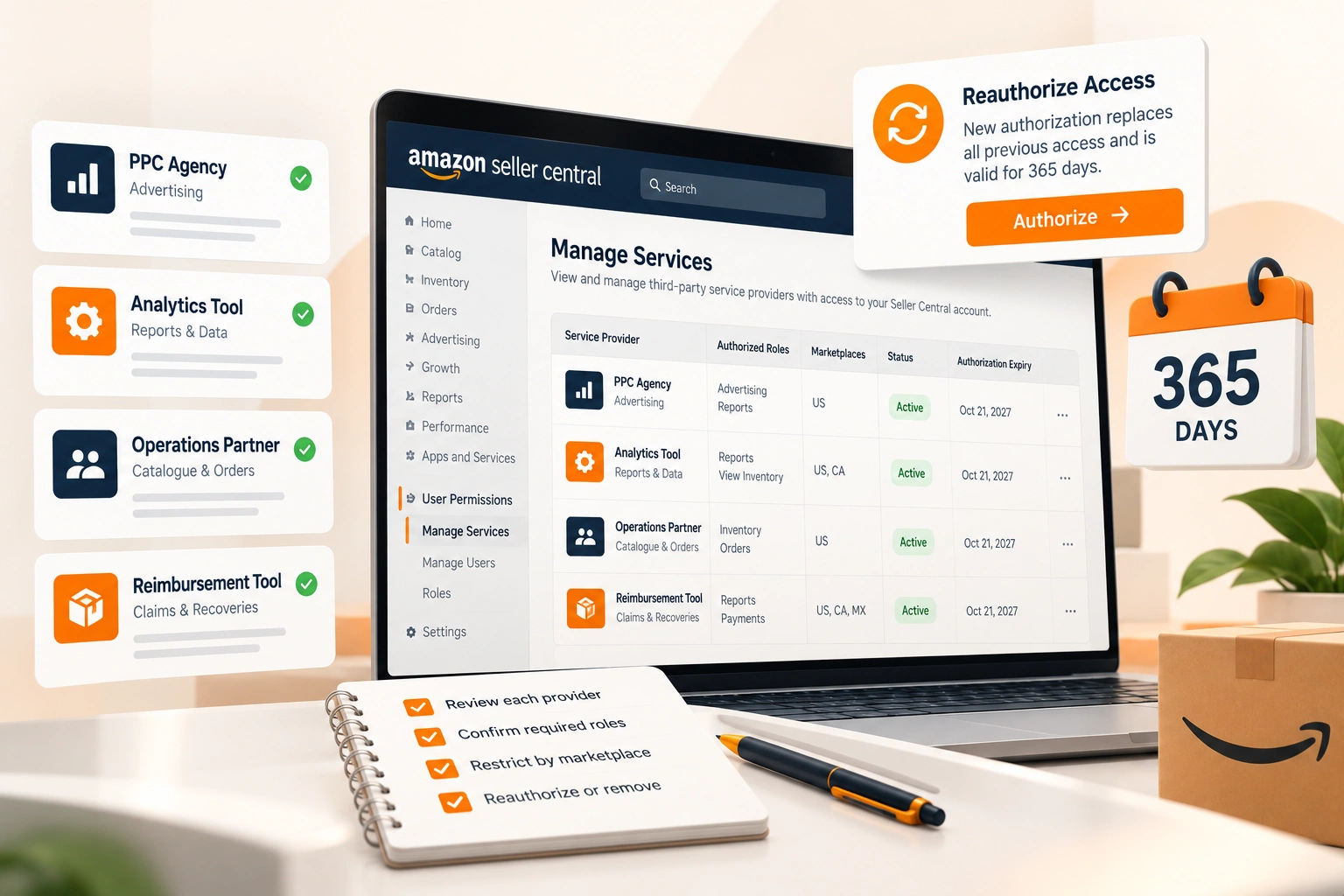
An outside team needs its own login with the right permissions, never a shared password, and giving an outsourced team access to Seller Central covers how Amazon wants that done.
Choosing, in order
Read the dashboard first. The three numbers against the top performers in your store, over the last quarter.
Sort the messages by reason. Delivery and returns, product questions, pre-sale, invoices, customisation. The mix decides more than the volume does.
Price the options honestly. Contacts-per-unit decides whether Amazon's service is free; the share of pre-sale and business questions decides whether it is enough.
Decide before the holiday. A trial or a new team started in late November learns on the busiest weeks of the year.
Keep the cause work either way. Whoever answers, somebody has to bring the contact rate down.
Where we fit
Answering buyer messages on self-ship orders, reporting their reasons back and bringing the contact rate down is part of our BPO services. If you are weighing Amazon's service against a team, the reasons your buyers write in are where we would start.
Frequently asked questions
The questions that come up most often on this subject.
Amazon publishes no target. Customer Service Quality Insights in Feedback Manager compares your rate with the top-performing sellers in the same store, and that comparison is the benchmark to use. The rate divides dissatisfied ratings by surveys sent, so read it over a quarter: at low volume, one unhappy buyer moves it a long way.
No. Since 17 April 2026 buyers rate their customer service experience from 1 to 5. Ratings of 1 and 2 count as dissatisfied, 4 and 5 as satisfied, and Amazon treats a 3 as neutral and leaves it out of the calculation.
For some sellers. Sellers new to it get a 90-day free trial. Since May 2026 it is free for sellers with fewer than 30 orders a quarter, and it stays free for sellers who keep contacts-per-unit below 3%. Otherwise it is paid, and Amazon reports the month's fee in a monthly email.
No. It covers post-order inquiries on seller-fulfilled orders, except invoices and product customisation, and it does not take pre-order questions or contacts from people who have not ordered. If the seller contacts the customer directly, Amazon's service can no longer support that customer.
No. The dashboard covers seller-fulfilled orders, for sellers who provide their own customer service. On orders fulfilled by Amazon, Amazon handles the customer service.