Amazon Purchase Orders Down or Stopped? What Vendor Central's Own Numbers Show
Smaller purchase orders, late ones and none at all look the same on the order screen and mean different things. How Amazon's own forecast, inventory and margin reports for vendors tell them apart, in Amazon's definitions, and what a vendor can change in each case.


Loading Article banner
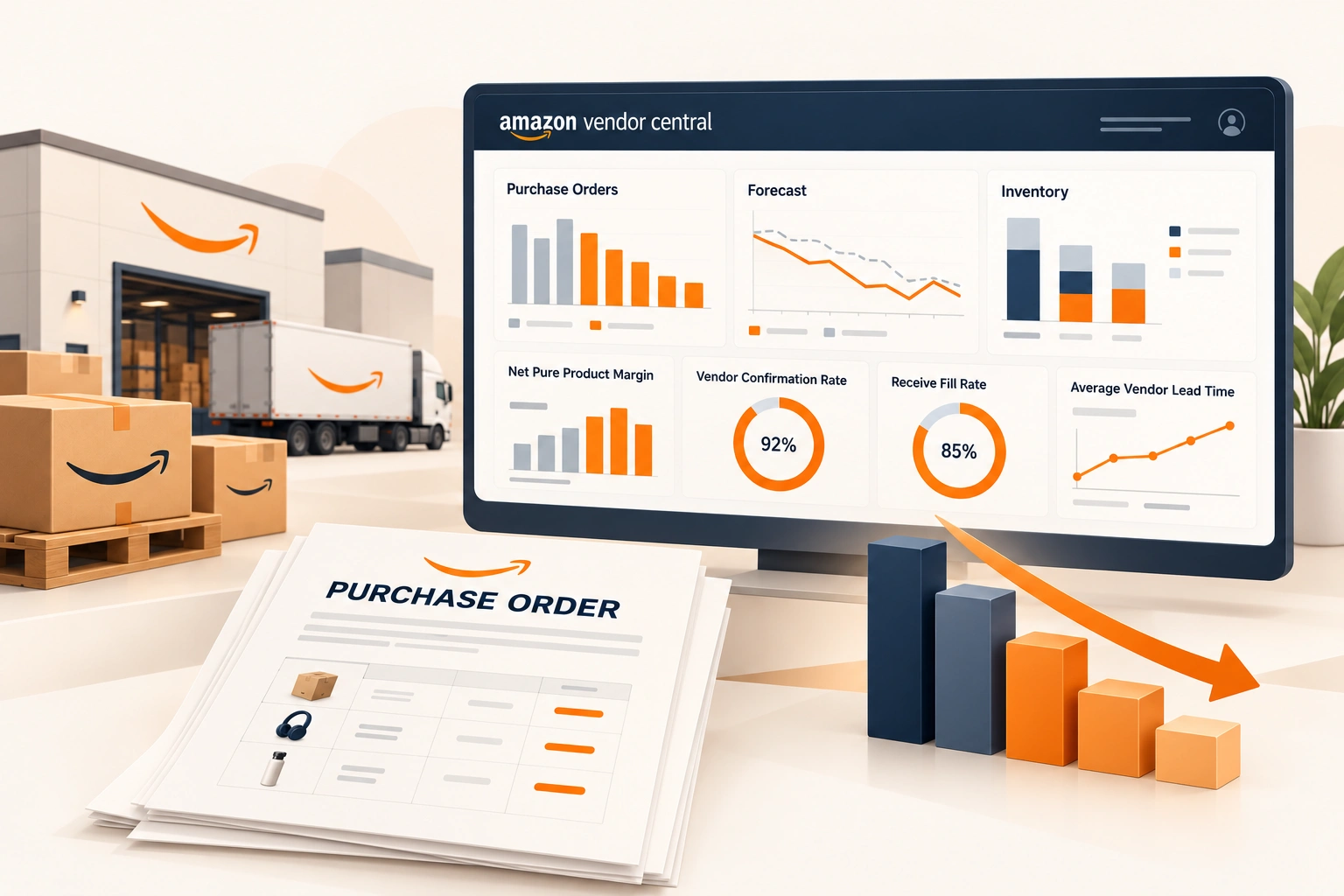
The question arrives in the same words every time: Amazon used to order every week, and now the purchase orders are smaller, or late, or have stopped. On the order screen, three different situations look the same. Amazon may already hold enough of the product. Amazon may be earning too little on it at the current terms. Or Amazon may be ending the vendor relationship altogether.
Each has a different answer, and Amazon's own reports for vendors say which one applies, if they are read in the right order. This is that order, with every metric in Amazon's definitions, for a brand that sells to Amazon rather than through it. If that is still a choice rather than a fact, Vendor Central and Seller Central compares the two.
What a purchase order is, in Amazon's terms
Amazon's documentation for vendors gives a purchase order three states. New is one that "is newly created and needs to be acknowledged by vendor." Acknowledged means the vendor has answered. Closed covers the rest, and Amazon lists the reasons together: a purchase order "can be in closed state for many reasons such as order is rejected by vendor, order is cancelled by Amazon or order is fully received by Amazon." There are four types: regular, consigned, new product introduction and rush.
Each line is answered one of three ways. Accepted. Backordered, with a ship or delivery date different from the one Amazon asked for. Or rejected, for one of three reasons Amazon names: "Items are currently not available", "Item cannot be found with the provided identifier", or "Item is no longer sold."
Two details cause more trouble than their length suggests. The cost on the acknowledgement "must match the cost on the invoice", so a cost price agreed by email and missing from the order becomes a payment problem later. And Amazon can change an order after placing it: "vendors are required to fulfill the updated PO. The PO changes can be related to Item Quantity, Ship to Location, Ship Window etc." A vendor shipping against the first version is shipping against an order that no longer exists.
How Amazon decides how much to order
Amazon does not publish its ordering method. It does publish the forecast it orders against. The forecasting report holds a mean forecast and three higher ones, P70, P80 and P90, for each product by week. Amazon defines P80 as "an 80% probability that the ASIN will not run out of stock during the date range if this many units of inventory are present at the start of the date range."
One line in the documentation matters more than it looks: "Only the most recent forecast data is available. Historical forecast data cannot be requested." A vendor who wants to know whether the forecast is falling has to keep each week's copy, because Amazon keeps only the latest.
The inventory report shows the other side. Sellable on hand units are what Amazon holds in sellable condition. Open purchase order units are the "units contained in Amazon's confirmed purchase orders that are not yet received by Amazon." Unhealthy inventory is "the amount of inventory beyond the forecasted demand", and Amazon adds that its forecast "may have already included some amount of excess inventory that makes economic sense to hold."
Our reading, not a method Amazon has stated: an order is roughly the stock Amazon wants for the forecast over the time the goods take to arrive, less what it holds and what is already on order. So a smaller order against a steady forecast usually means Amazon is covered. The answer to that is demand, through the listing and advertising, which vendors buy in the same auction as sellers. Amazon's Sponsored Products page lists "vendors" among those it is available to, and which ad type earns its budget applies on both sides of the line.
The three numbers a vendor controls
Three fields in the same report measure the vendor rather than the shopper, and Amazon defines each one.
Vendor confirmation rate: "The number of units that were confirmed by the vendor, divided by the number of units Amazon asked for." It is 1 when every unit requested was confirmed, and every rejected or reduced line lowers it.
Receive fill rate: "the received quantity divided by the confirmed quantity." Confirming a thousand units and delivering nine hundred shows here, whatever the reason.
Average vendor lead time: the "Average number of days between the submission of each purchase order unit and the time of receipt in Amazon's fulfillment centers."
Amazon does not say how these feed its ordering. The arithmetic is visible all the same. A longer lead time means Amazon has to hold more stock to cover the wait, the same lead time arithmetic any seller does, done by Amazon on the vendor's behalf. A fill rate below 1 means a confirmation cannot be relied on. And the shortage claims vendors dispute are, as vendors and the dispute tools describe them, made from the gap between the units invoiced and the units Amazon records as received, so a vendor fighting shortages usually has a fill rate to read first.
When the problem is margin
The Net Pure Product Margin report, Net PPM, "Contains data on Amazon's net pure product margins for selling a vendor's items." Amazon describes the figure as "A measure of Amazon's profitability considering Amazon's wholesale cost and vendor-funded cooperative marketing funds", given as a fraction between 0 and 1, by product and for the catalogue.
It is Amazon's margin, not the vendor's, and it moves for reasons the vendor does not control. Amazon sets the retail price, so when it matches a lower price elsewhere, the margin falls on Amazon's side while the vendor's cost price stays where it was. Amazon publishes no threshold for it.
Our reading, from the accounts we have run: when the forecast is steady, Amazon is not overstocked, the vendor's own rates are sound, and the orders still shrink, Net PPM is where to look next. The conversation that follows is about terms: the cost price, the co-op agreed, and the price the product carries elsewhere, because that is often the price Amazon is matching.
When somebody else is supplying it
The sales and inventory reports can be read in two views. Manufacturing "provides data for ASINs of items manufactured by you, regardless of who sourced the products to Amazon." Sourcing "provides data for ASINs of items sourced directly from your vendor group."
A product that keeps selling in the manufacturing view while its orders to you fall in the sourcing view may be one Amazon is buying from somebody else, such as a distributor. That is a question about the brand's distribution, and no forecast will answer it.
When the relationship is ending
The last case is not about any one product. In September 2024, eComCatalyst published the notice vendors were reporting. In it Amazon said it had "decided to stop sourcing products from your company as part of our ongoing review of product offerings", that the relationship would end on 9 November 2024, and "We will not engage in any new agreements or extend existing ones after this date." The notice pointed vendors to listing as an independent seller instead.
Goat Consulting reports later notices in the same form with an effective date of 2 August 2026. We have not found either notice on Amazon's own pages, so both are reported, not confirmed. What marks this case is that orders stop on every product at once, whatever the forecast says, and the reason arrives in writing.
A vendor in that position is choosing how to keep selling, and the first two jobs are the ones with lead time: a Seller Central account, and Brand Registry and its protection tools working on that account before the last order is received.
A weekly read, in this order
We read the reports in this order when purchase orders change, so that the first explanation that fits is the right one.
One: every product, or some? Orders that stop on every product at once, with a notice, are the relationship. Orders that fall on some products are a product question.
Two: the forecast. Compare this week's saved copy with the last few. A falling forecast is a demand problem, and the traffic report's glance views show whether shoppers stopped arriving.
Three: Amazon's position. Sellable on hand and open purchase order units against the forecast, and unhealthy inventory. If Amazon is long, orders come back as the stock sells through.
Four: the vendor's own rates. Confirmation rate, fill rate and lead time, by product. These are fixed at the order desk and in the warehouse, not in a meeting.
Five: margin and supply. Net PPM by product, the prices the product carries elsewhere, and the gap between the manufacturing and sourcing views.
When none of the five explains it, a case with the purchase order history attached is the next step. Support cases that actually get resolved are built the same way on either side of the line: one question, the evidence, and the answer asked for.
Where we fit
Reading these reports every week, answering purchase orders accurately and taking the margin conversation to Amazon with the numbers in hand is the core of our Amazon Vendor Central work. If your orders have changed and the reason is not obvious, the five questions above are where we would start, with your recent inventory and sales reports and every forecast you have saved.
Frequently asked questions
The questions that come up most often on this subject.
Usually for one of three reasons. Amazon already holds enough stock for its forecast, Amazon is earning too little on the product at the current terms, or the vendor relationship is ending, which vendors have reported receiving notice of in writing. The forecasting, inventory and Net PPM reports tell the first two apart; the third stops orders on every product at once.
Amazon defines it as the units a vendor confirmed divided by the units Amazon asked for, so it is 1 when every requested unit was confirmed. Amazon does not publish a target. A rate held at 1 by confirming units that then do not arrive only moves the problem to the receive fill rate, so confirm what will actually ship.
It is the 80th percentile of Amazon's weekly demand forecast for a product. Amazon defines it as the stock that gives an 80% probability the product will not run out during that week if it is on hand at the start. Only the latest forecast can be requested, so save each week's copy to see the trend.
Net Pure Product Margin, Amazon's measure of its own profitability on a vendor's products, taking into account Amazon's wholesale cost and the cooperative marketing funds the vendor pays. It is reported as a fraction between 0 and 1, by product and for the whole catalogue. Amazon publishes no threshold for it.
Yes, line by line. Each line can be accepted, backordered with a new ship or delivery date, or rejected because the item is temporarily unavailable, its identifier cannot be found, or it is no longer sold. A rejection lowers the vendor confirmation rate, which is still better than confirming units that will not ship.