Selling on Amazon Canada and Mexico From US Stock: Remote Fulfillment, Local FBA and What 2026 Changed
Amazon's Remote Fulfillment with FBA sells US inventory to shoppers in Canada and Mexico without moving it across the border. How it works in Amazon's words, who pays the duty now that Canada taxes US-made goods, what the 2026 surcharge touches, and when a market deserves local stock.


Loading Article banner
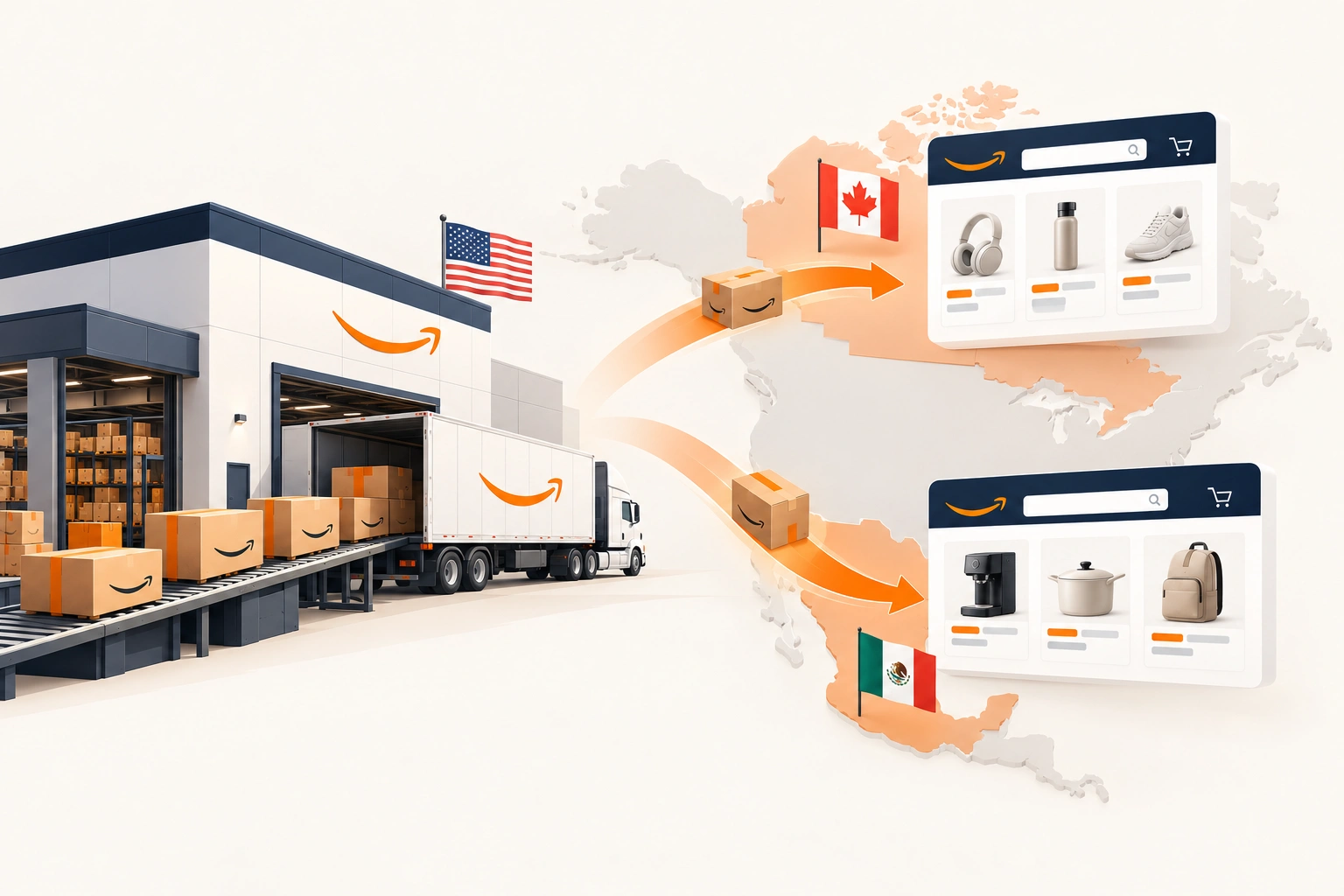
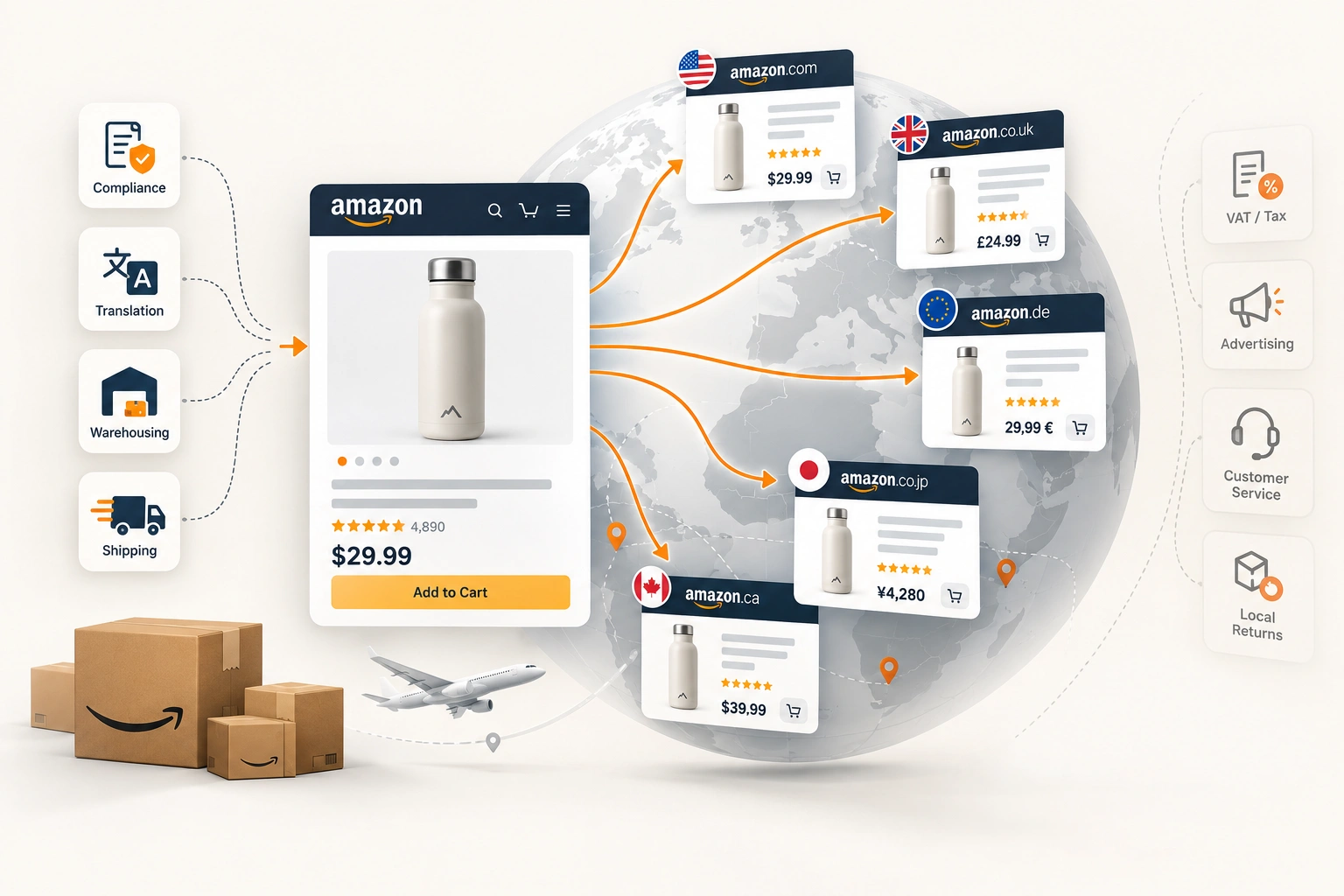
A brand selling well on Amazon.com sooner or later asks the same question about the stores next door: can we sell in Canada and Mexico without shipping stock there and building a second operation? Amazon's answer is yes. Remote Fulfillment with FBA takes orders on Amazon.ca and Amazon.com.mx and ships them from the brand's US inventory.
What changed in 2026 is the cost of the crossing. Canada put counter-tariffs on a list of US-made goods on 8 September, and Amazon added a surcharge to Remote Fulfillment's fees in April. This is how the programme works in Amazon's words, what those two changes mean for it, and how to tell when a market has outgrown it.
Three ways to reach Canada and Mexico from a US account
Amazon's pages start from the account. A seller on Amazon.com with a Professional selling account can "use your existing North America and Brazil unified account to start selling in Canada", and the same account covers Mexico and Brazil. Amazon describes "a single Professional selling plan fee" for it, covering "the US, Mexico, Brazil, and Canada for USD 39.99 per month". A business that wants Canada alone can open a Canada account instead, at CAD 29.99 a month.
Then the stock. Amazon lists three ways to fulfil those orders.
FBA in the country. Export inventory to Amazon's fulfilment centres in Canada or Mexico, and FBA stores, packs and ships it there.
Remote Fulfillment with FBA. The inventory stays in US fulfilment centres, and Amazon ships each order across the border.
Fulfilled by Merchant. The seller ships each order, and Amazon lists vetted providers for global shipping.
The first is a market entry. The second is closer to a test, and it is the subject here, so it is worth knowing exactly what it does.
How Remote Fulfillment works, in Amazon's words
Amazon describes it as "offering them your US FBA inventory with Prime shipping", with the offers created on Amazon.ca, Amazon.com.mx and Amazon.com.br. It needs a Professional plan, the unified account, and FBA in the US "with FBA Export enabled".
A product qualifies when it is "enabled for FBA in the US" with "valid offers in Canada, Mexico, or Brazil", and when it meets "all trade compliance and destination-country regulations". Restricted products, prohibited products and dangerous goods are excluded, and so is anything blocked for importation into Mexico or Brazil.
The listings come from the Build International Listings tool, which copies eligible US offers into the destination stores and, in Amazon's words, "synchronizes your prices to preserve your profit margins while adjusting for differences in fulfillment costs, referral fees, and currency exchange rates." One rule catches people out: "Any manual price adjustments in the destination store will break the connection" to the tool and switch off the automatic pricing rule. Prices are changed through the tool's rules, not on the Canadian or Mexican listing.
Amazon handles "the export logistics, fulfillment, customer inquiries, and returns", and returns "will be sent back to the US" under the FBA returns policy. The seller pays "the Remote Fulfillment with FBA costs and the category referral fee for the store where the sale occurred", in place of the US fees. Amazon's public page gives no rates, so the fee arithmetic for each product is done with the destination store's referral fee and the rates in Seller Central's help, not the US ones.
Who pays at the border, and why it matters more this year
On Remote Fulfillment orders, Amazon says, "Customers pay any import duties, taxes, and fees as the importer of record." The brand does not pay them. The shopper does, and sees them, which makes them part of the price the brand is competing on.
For a US-made product, the crossing changed on 8 September 2026, when Canada's counter-tariffs took effect: 15, 25 or 50 per cent on the listed products, each rate "based on the matching U.S. rate for the same goods". The Department of Finance's list is where to check a product, and it says two things a seller needs to know: "These tariffs only apply to goods originating from the U.S.", and the list "may no longer reflect current tariff measures or rates".
The Canada Border Services Agency's notice adds the part that matters for a parcel. The surtax is a percentage "of the value for duty", it applies "to goods imported for commercial and casual purposes", and it reaches courier, postal and low value shipments too. So origin decides, not where the box ships from. A product made in the US and on the list now reaches a Canadian shopper with a surtax to pay. The same product made elsewhere does not carry this one, though it has its own duty position. Import duties work this way in every direction, and a catalogue headed for Canada is worth sorting by country of origin before anything is enrolled.
The second change is Amazon's own. In a Seller Forums announcement, Amazon said that from 17 April 2026 a 3.5% fuel and logistics surcharge applies to FBA fulfilment fees in the US and Canada "as well as to Remote Fulfillment with FBA from the US into Canada, Mexico, and Brazil". Amazon describes its surcharges as temporary and said it "will continue to evaluate this surcharge as conditions evolve", so the fee preview is where to confirm whether it still applies.
What Remote Fulfillment does not do
It does not make the brand local. The stock is in the US, so every order and every return crosses a border, and Amazon's page states no delivery times.
It does not localise the listing. The tool copies the offer and adjusts the price. Whether the detail page reads well to a shopper in Mexico is the brand's question, and so is whether the product meets the country's rules: "Product requirements vary by country", as Amazon's selling guides put it.
And it does not run the market. Advertising on Amazon.ca or Amazon.com.mx is a separate campaign in a separate store, with its own search terms and budget.
When a market deserves local stock
Our reading, from the accounts we have run: Remote Fulfillment is a good way to find out whether a market wants the product, and a poor way to serve one that does. The signs a market has outgrown it are steady sales across a quarter, returns that cost more than they should because they travel back to the US, and a price that loses to local offers once the shopper's duty is added.
Local stock changes the brand's obligations, not only its delivery times. Amazon says a seller who stores and sells "through FBA in Mexico or Brazil" will be "required to pay taxes and comply with Mexico and Brazil tax obligations", and in Mexico that begins with an RFC, the Mexican tax ID. Canada has its own tax questions once inventory sits there, and Amazon's Canada guide points sellers to its tax guidance and to its Service Provider Network for advice. Amazon's 2026 expansion tools take some of the work out of opening a country; the tax registration, the compliance and the stock decision remain.
Walmart's version, as reported
Walmart is reported to be building the same route. Retail Dive reported on 4 February 2026, from a seller email shared by GeekSeller, that Walmart was preparing Walmart Exports, to deliver eligible Walmart Fulfillment Services items from the US to shoppers in Mexico and Canada, with eligible items enrolled automatically. A Walmart spokesperson told the publication Walmart was "currently testing new marketplace capabilities that leverage our fulfillment and logistics network".
We have not found a Walmart page describing the programme, so treat the details as reported and confirm them in Seller Center. For a brand on both marketplaces, how Walmart and Amazon differ holds across the border too.
A first quarter in Canada and Mexico, in order
We work through it in this order.
Sort by origin. Each product's country of origin against Canada's current list, and its category against the restricted and dangerous goods rules.
Choose the products. The ones whose price survives the destination referral fee, the Remote Fulfillment cost and, in Canada, any surtax the shopper will pay.
Enrol and set the pricing rules in Build International Listings, and leave the destination prices alone so the link holds.
Read it after a quarter, store by store: units, returns, and what the shopper paid in total against local offers.
Decide. Stay remote, move stock into the country, or stop.
Where we fit
Taking a brand from a remote test to a market it runs properly, with local stock, listings written for the market and advertising in each store, is the work of our retail growth partnership. If you sell on Amazon.com and have not opened the stores to the north and south, where your products are made is the first thing we would look at.
Frequently asked questions
The questions that come up most often on this subject.
An Amazon programme that sells a US seller's FBA inventory to shoppers in Canada, Mexico and Brazil without moving it across the border. Offers are created on Amazon.ca, Amazon.com.mx and Amazon.com.br through Build International Listings, Amazon ships each order from its US fulfilment centres, and it handles customer inquiries and returns, which come back to the US.
The customer. Amazon says customers pay any import duties, taxes and fees as the importer of record. Since 8 September 2026 that includes Canada's counter-tariffs of 15, 25 or 50 per cent on listed goods originating from the US, so check where each product is made before enrolling it for Canada.
No. A Professional seller on Amazon.com can use the North America and Brazil unified account, which Amazon prices at a single plan fee of USD 39.99 a month across the US, Canada, Mexico and Brazil. A Canada account, at CAD 29.99 a month, is the alternative for a business selling only in Canada.
The Remote Fulfillment with FBA costs and the referral fee of the store where the sale happens, in place of the US fees. Amazon publishes the rates in Seller Central's help rather than on its public page. From 17 April 2026 Amazon added a 3.5% fuel and logistics surcharge to those fulfilment fees, which it describes as temporary.
Reportedly, through a programme called Walmart Exports. Retail Dive reported in February 2026 that it would deliver eligible Walmart Fulfillment Services items from the US to shoppers in Mexico and Canada, with eligible items enrolled automatically. We have not found a Walmart page describing it, so confirm eligibility and fees in Seller Center.