Amazon's Global Expansion Tools After Accelerate 2026: What They Remove From Entering a New Country, and What Remains
At Accelerate 2026 Amazon announced one listing evaluated for every country, one compliance test for several, and its own warehousing in eight countries by year end. What the tools remove for a brand entering a new market, what they leave, and who does the rest.


Loading Article banner
Amazon's own number is that only 30% of its sellers list in more than one country, and that the ones who do earn 70% more revenue on average. Both figures are Amazon's and both are why, at Accelerate 2026 in the last week of September, it announced a set of tools aimed at the other 70%: a brand that sells well in one Amazon store and has not opened a second because of what the second costs to open.
The tools remove real work. They do not remove the decision, and they do not remove the parts of the job that happen outside Amazon's systems. This article sets out, in Amazon's words, what the tools do; then the list of what entering a country still requires; then the question a brand should answer before it uses either the tools or a partner to get there.
What Amazon announced
An expansion dashboard. One view of the opportunity across the United States, Europe and Japan, with more countries by year end, showing the demand, the economics and the steps that remain before a product can sell in each.
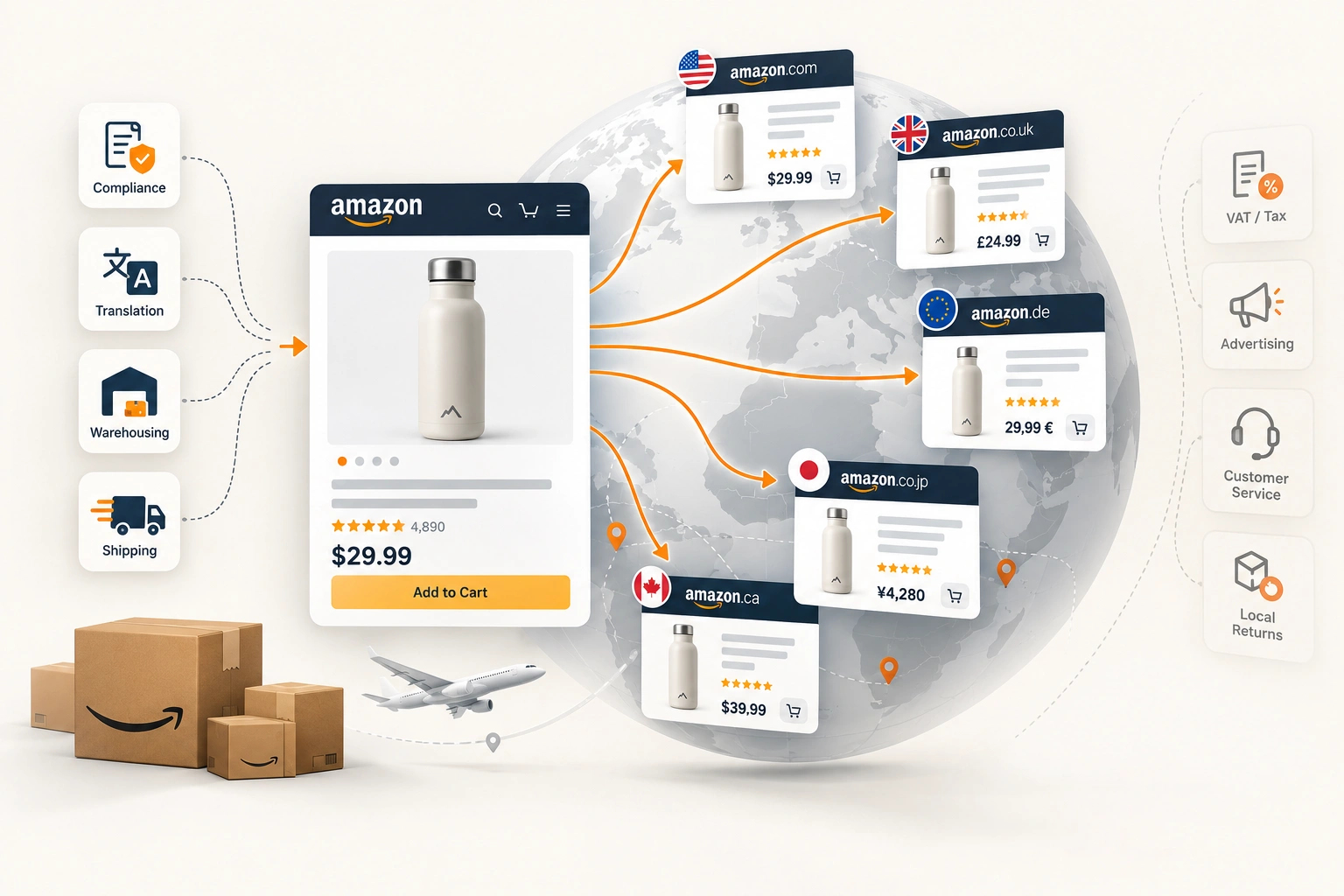
One listing for every destination. Amazon's systems evaluate a product against every destination at once, translate the content, adjust currency and units, and flag the compliance requirements; products that meet the requirements go live with localised listings. The work that used to be done country by country is done once.
One compliance test for several countries. A single testing submission that satisfies several countries' requirements at the same time, rolling out by category: toys now, electronics and baby products by year end, more categories in 2027. Amazon says pilot participants reported compliance cost savings of up to 60%. The domestic version of this process, and why it already runs through an approved provider, is in Amazon's third-party testing requirement.
Warehousing in eight countries. Global Warehousing and Distribution, currently in the US, expands by year end to the United Kingdom, Japan, Germany, France, Italy, Spain and Canada, with storage Amazon says is up to 45% cheaper than US Amazon Warehousing and Distribution and replenishment five days faster than current options. AWD itself now operates in the EU, the UK and Australia.
Supply chain visibility and agents. An end-to-end view of inventory across Amazon-managed fulfilment with a single reconciled unit count, and Seller Assistant agents for aged inventory and inbound planning with alerts. A seller Amazon quotes describes the combination as removing much of the complexity of working out each country's requirements and then moving stock between them.
What entering a country still requires
A demand decision per market. The dashboard shows demand; it does not say whether this brand's product at this brand's price wins it. That is a per-country unit economics exercise (fees, fulfilment, duties, VAT, returns, advertising cost) and it is the brand's to do before anything is listed. Import duties and what to do about them is one line of it.
Tax and legal presence. VAT registration where it is required, an importer of record, a responsible person for product compliance where a market demands one. Amazon flags compliance requirements; it does not register the brand for tax or stand as its importer. Importer of record for marketplace sellers covers the US side of that question, and every destination has its own.
Brand protection per store. Brand Registry, and the trademark beneath it, are per jurisdiction. A brand protected in one store is unprotected in the next until the mark is filed there, and Brand Registry and listing protection is the mechanism that has to be repeated.
A localised listing that sells, not only a translated one. Translation makes a listing legible. The questions a German or Japanese shopper asks, the images that answer them, the reviews that reassure them and the keywords they type are local work the systems cannot do from the source listing.
Advertising, customer service and returns in each market. Each store has its own advertising console, its own performance metrics and its own expectation of a reply in its own language. A warehouse in Germany does not answer a German customer.
The stock decision. Cheaper storage in eight countries is an invitation to hold stock in eight countries, which is eight inventory positions to forecast and eight sets of fees if the forecast is wrong. How Amazon's fulfilment network decides where stock goes is the domestic version of a problem that now spans borders.
The question before the tools: who does the rest
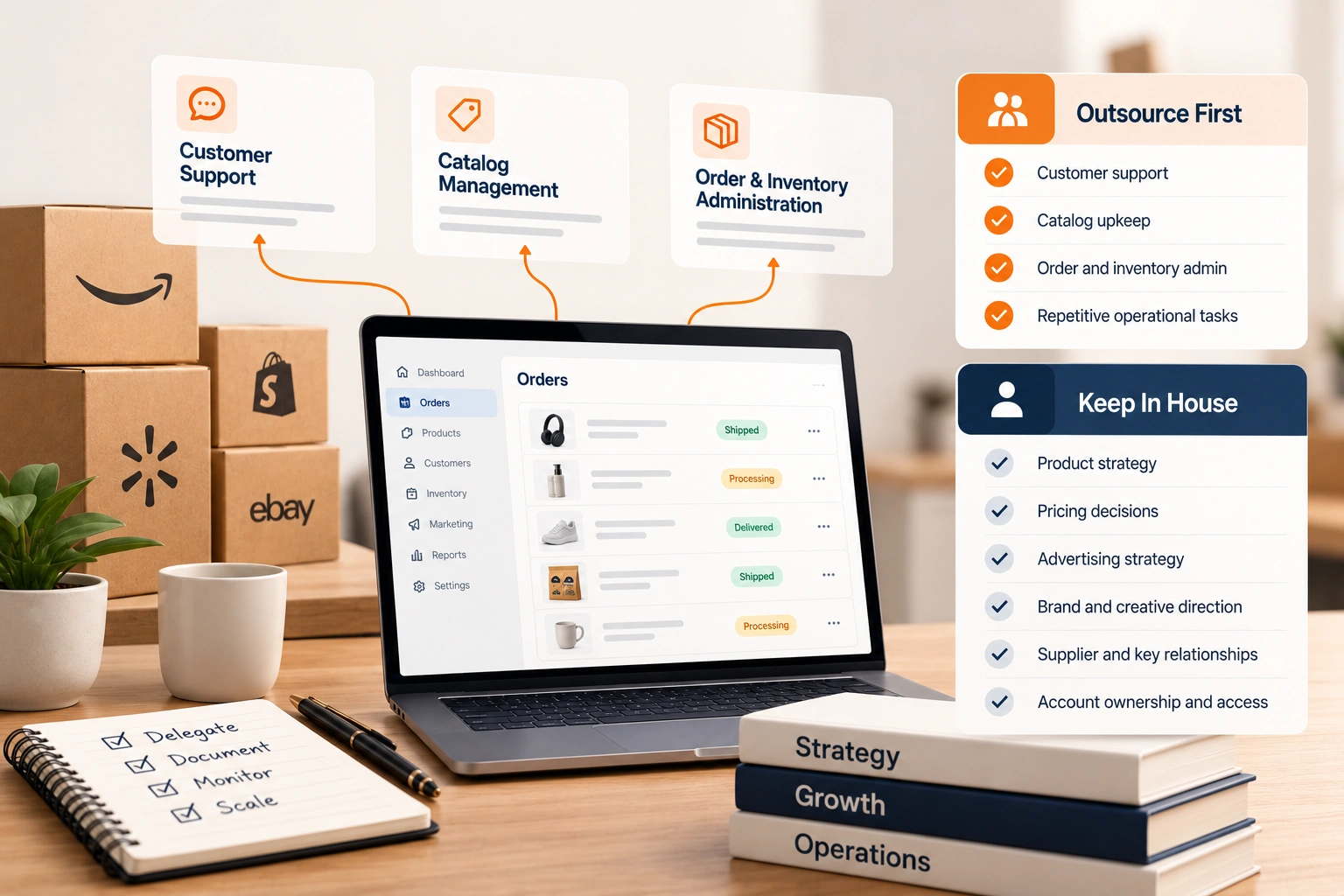
The tools reduce the cost of the Amazon half of expansion. The list above is the other half, and a brand entering a market has three ways to cover it: build it (hire or train people for tax, compliance, localisation, advertising and service in each market), run it thin (the founder and the existing team, with the tools, in the evenings), or partner with somebody who already does it in those markets and takes a share of the growth rather than a retainer for trying.
The honest test is the one in what to outsource first and what to keep: what the business must own (the product, the brand, the margin decision) against what somebody else can run better than it can learn in time. A market entered thin is usually a market entered once; the listing goes live, the first compliance notice or tax question goes unanswered, and the store is quietly abandoned with stock in it. The tools make the listing part fast enough that the rest of the operation is now the only thing that decides whether the second country works.
A growth partnership is the version of partner where the incentives match the brand's: the partner is paid out of the growth it produces in the new market, so it carries the localisation, the advertising and the operating work because it needs them to pay. It suits a brand with a product that already sells, a margin that can share, and no appetite to build an international operation it will only need part-time. It does not suit a brand that wants to own every function from the first month, which is a legitimate choice and a more expensive one.
What to do before year end
Use the dashboard to shortlist, not to decide: the markets where demand, economics and remaining steps look best, then the per-country margin on real numbers. Pick one market, not eight. Put the category's compliance test through the consolidated route if the category is live for it. Decide the tax and importer arrangement before the first unit ships. Decide who owns the market's listing, advertising and service by name. Then let the tools do the part they do.
Where we come in
Our retail growth partnership is built for exactly the brand Amazon's figures describe: strong in one store, not yet in the next, and unwilling to build an international operation to find out. We take the market on, with the localisation, the compliance, the advertising and the operating work, and are paid from what it produces. If the dashboard is showing you a country and the list above is showing you why you have not entered it, that is the conversation to have.
Frequently asked questions
The questions that come up most often on this subject.
An expansion dashboard across the US, Europe and Japan with more countries by year end; one listing evaluated against every destination with translation, currency and unit conversion and compliance flags; a single compliance test covering several countries, starting with toys; Global Warehousing and Distribution expanding to seven more countries by year end; and supply chain visibility with a single reconciled unit count, plus Seller Assistant agents for inventory and inbound planning.
Amazon's figure is that sellers active in more than one country earn 70% more revenue on average, and that only 30% of its sellers currently list in more than one country. Both are Amazon's numbers from its announcement.
Not yet. Amazon says it is rolling out by category: toys now, electronics and baby products by the end of 2026, and additional categories in 2027. Pilot participants reported savings of up to 60% on compliance costs.
Amazon says GWD currently serves the US and expands by the end of 2026 to the United Kingdom, Japan, Germany, France, Italy, Spain and Canada, with storage costs up to 45% lower than US Amazon Warehousing and Distribution and replenishment five days faster than current options.
They do not decide whether the product's economics work in that market, register the brand for VAT or act as its importer, protect the brand under that country's trademark system, write a listing that sells to local shoppers rather than a translated one, or run the market's advertising, customer service and returns. Those are the brand's or a partner's.