Amazon's Service Provider Reauthorization: What Changed, What Lapses, and Who Should Keep Access to Your Account
Amazon is asking sellers to reauthorise every agency, consultant and software provider in Seller Central. The new authorisation replaces all earlier access and lasts 365 days. What Amazon changed in its own words, what lapses if the deadline passes, and the partner review worth running before you confirm.


Loading Article banner
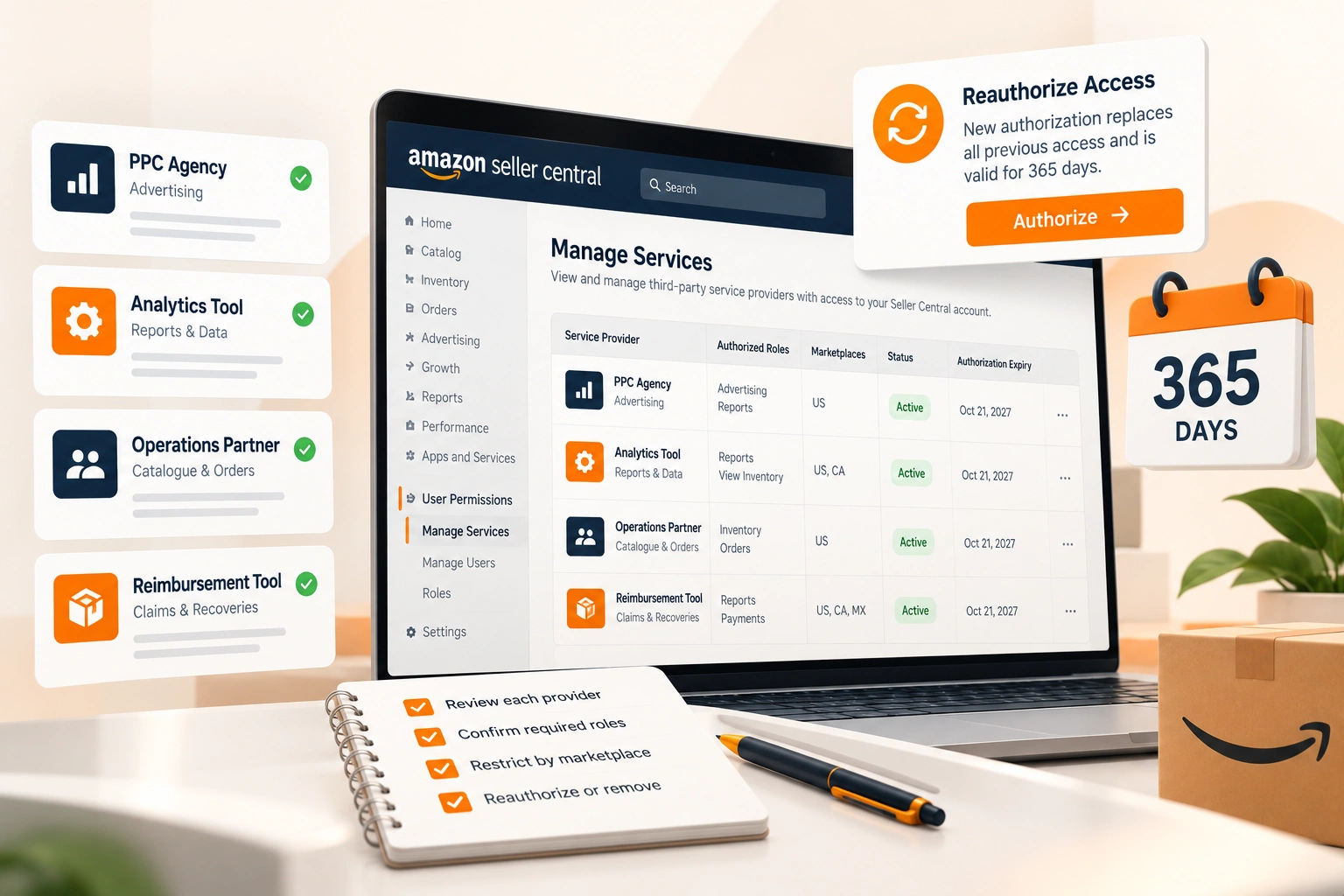
Amazon is asking sellers to do something most will treat as a formality: reauthorise every agency, consultant and software provider that works in their Seller Central account. Its Solution Provider Portal FAQ, last updated on 30 September 2026, sets the terms. Authorisations are now "time-bound (valid for 365 days) and renewable", the new one "replaces all previous access to that seller's account", and a provider whose seller misses the deadline will "lose access to their Seller Central account".
Amazon says the flow "takes less than a minute per service provider". That is the reason to slow down. It is the one moment in the year when Amazon makes a brand list everybody who works in its account, and the natural point to decide which work stays in-house, which a platform tool now covers and which a partner runs.
What Amazon changed, in its own words
On the seller's side, the whole arrangement lives on one page: "In Seller Central, sellers go to User Permissions > Manage Services." The same page is where access ends: "Sellers can revoke access at any time from their Manage Services page."
Amazon's developer guide, updated on 9 September 2026, describes the flow. The seller opens a link the provider shares or, if the provider is listed in Amazon's Service Provider Network, selects Authorize Now on its listing. The seller "sees the roles that you've been approved for based on your service category", can adjust or restrict individual roles, can limit access by country or region, and confirms. A provider cannot be given more than Amazon allows it: "The seller can only select roles for which the service provider was approved by Amazon."
Two more points in the FAQ matter. Roles a provider has not been approved for are not carried into the new authorisation and stop when the seller reauthorises. And "Some Seller Central roles can only be granted to employees within a seller's organization and aren't available to service providers." Each seller's notification "will include a deadline", sent "on a rolling basis".
Amazon's pages give no start date. Trade coverage reported the new flow going live in August 2026 and the requests reaching sellers through September (EcomCrew's report is dated 3 September); those dates are the press's, not Amazon's.
What it changes for a brand
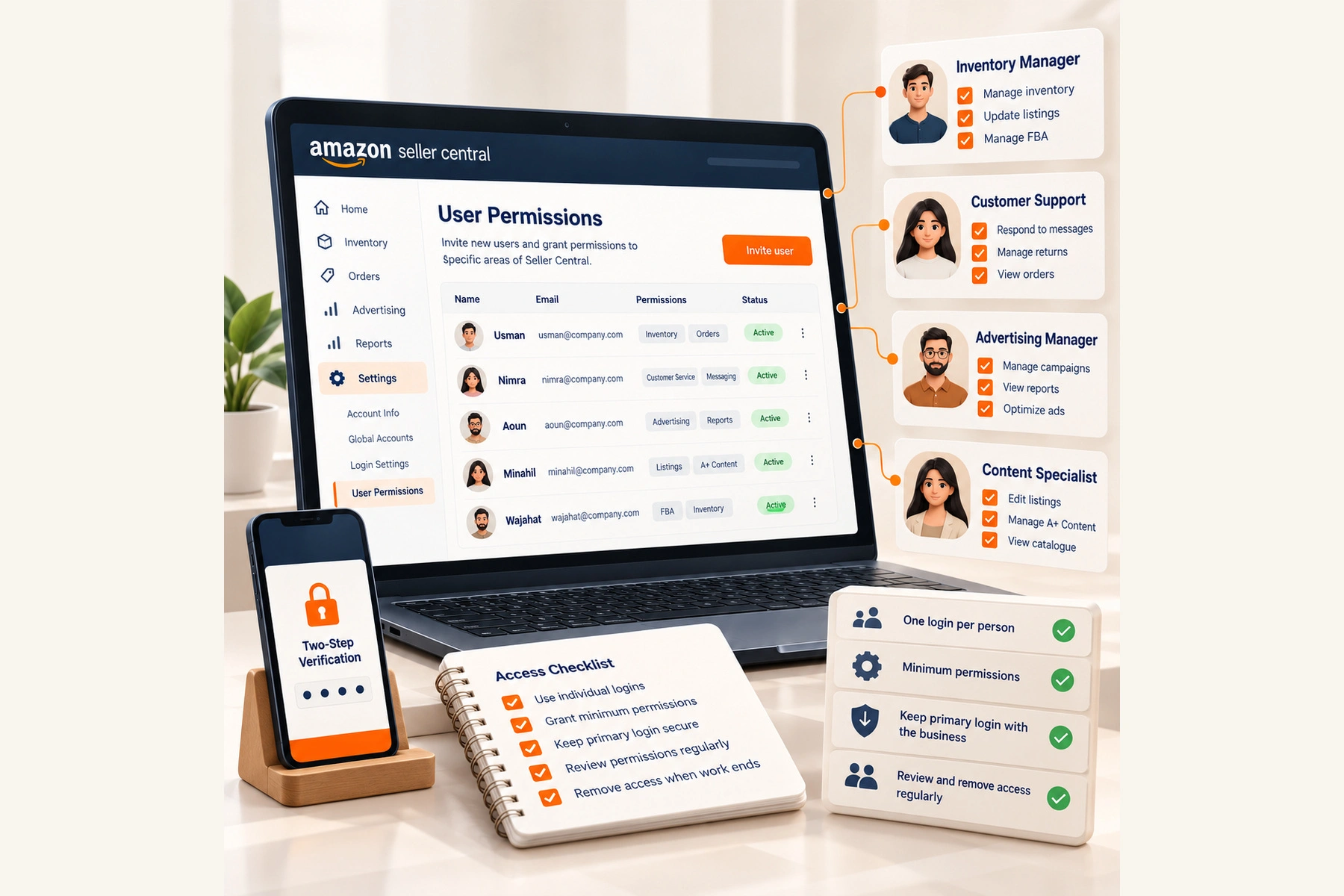
Providers move out of user logins. Some agencies have worked in accounts as secondary users, a login per person, although Amazon's staff had already advised against it, as giving an outsourced team access to Seller Central sets out. The FAQ now tells providers on secondary users that their sellers must reauthorise them through the new flow, so a provider's access becomes the roles Amazon approved for its service, on one page.
Some work cannot be handed over this way. A function that needs an employee-only role is done by somebody inside the business, or redesigned around the roles a provider can hold. Amazon does not list those roles; in the flow, a permission the provider has not been approved for appears greyed out.
Access becomes annual. Amazon says both sides "will be notified before your authorization expires so that the seller can reauthorize again." That makes the renewal a fixed date for reviewing the relationship rather than an interruption.
A missed notice cuts a provider off. Amazon tells providers that without reauthorisation "You won't be able to access the seller's account to provide your services". A notice that lands unread in November is an agency that cannot change a bid in the weeks Amazon's Q4 calendar covers. And because a request to approve access is also what a phishing email looks like, our practice is to open Seller Central directly and check Manage Services, never to follow the emailed link.
The partner review: four questions for every name on the list
Open Manage Services and User Permissions side by side, and ask four questions of every provider, tool and person on them.
What does it do, and is that still needed? A tool connected for a project that ended, an agency kept for a channel the brand no longer advertises on, a consultant from a launch two years ago.
Which roles does it hold, against what the work needs? The minimum rule Amazon's staff give for users applies to providers, and the flow lets a seller remove roles and limit access to the stores where the work happens.
Who in the business owns the result? Every provider needs somebody inside who reads its work and can tell within a month whether it was done well. Without that person, renewing is a habit, not a decision.
What would it cost to run it another way? In-house, in a platform's own tools, or with a different partner. The answer need not change anything, but it should exist.
Each review ends in one of three outcomes: reauthorise as it is, re-scope to fewer roles or fewer stores, or end it and move the work.
Keep, consolidate or partner, function by function
Advertising. Amazon's own examples of provider services include advertising, and it is usually the largest provider relationship in an account. Whether it belongs with a person, an agency or software is the comparison in in-house, agency or software PPC management.
Messages, catalogue upkeep and order administration. The repeatable work, and the first candidates for an outsourced team, in the order what to outsource first describes. A team doing it needs only the roles those tasks touch.
Reimbursements and claims. Often software working on a share of what it recovers, so it falls under the rules for automated tools below as well as under Manage Services. The claim windows in FBA reimbursements are why a lapsed authorisation here costs money.
Other channels. Amazon's own console is now a third option beside building a team or hiring a partner, which Amazon's Multichannel Selling Tools weighs.
New stores and new stock routes. Opening another country, which Amazon's expansion tools simplify without doing for you, or selling refurbished stock through a programme with its own approval such as Amazon Renewed. These are the functions most often run with a partner, because the work is new and the volume is not yet there to hire for.
What never goes on the list. The primary login and its Two-Step Verification, the right to manage other users' permissions, the bank account and the legal entity stay with the business, whoever does the work.
Software and AI agents are partners too
Amazon's rules for software reach beyond Manage Services. Its Business Solutions Agreement update, effective 4 March 2026, added "a new Agent Policy with new requirements for AI usage and automated systems", and Amazon's Seller Forums announcement says every AI agent must "Clearly identify themselves as automated systems", "Comply with the new Agent Policy at all times" and "Cease access if Amazon requests".
Sellers replying to that post asked whether order software and reimbursement services count, and no answer from Amazon appears in the thread. Our reading is that any tool or agent that acts in the account belongs in the same review as the people, with an owner and a reason. Amazon's Seller Assistant plugin is the newest connection that can act on an account, not only read it.
Where we fit
Once a year, the reauthorisation asks a question most brands never put to themselves: who is in the account, and why. Answering it function by function, deciding what the business keeps, what a platform's tools now cover and what a partner runs, is where our strategic partnerships begin, whether the answer is an outsourced team, a partner for a new market or a programme such as Renewed. If your notice has arrived, the list in Manage Services is where we would start.
Frequently asked questions
The questions that come up most often on this subject.
Amazon has moved service provider access to authorisation through its Solution Provider Portal. Each authorisation covers only the roles Amazon has approved for that provider's service, lasts 365 days and replaces all earlier access the provider held, including access as a secondary user. Amazon is contacting sellers on a rolling basis, and each notification carries a deadline.
Under User Permissions, then Manage Services. Amazon says the flow takes less than a minute per provider: review the roles offered, remove any the work does not need, limit access by country or region if the work covers one store, and confirm. Open Seller Central directly rather than following a link in an email.
The provider loses access to your Seller Central account until you start a new authorisation, which Amazon says you can do at any time. Until then it cannot provide its services, so any work it does in the account, such as advertising or reimbursement claims, stops.
365 days. Amazon says authorisations are time-bound and renewable, that the seller and the provider are both notified before one expires, and that a seller can revoke access at any time from the Manage Services page.
No. A seller can grant only the roles Amazon has approved for the provider's service, and Amazon says some roles can only be granted to employees within the seller's own organisation. Work that needs one of those roles has to be done by somebody inside the business.