Every year the same thing happens on the Amazon Seller Forums in September. Somebody asks when the Black Friday inventory has to be in, somebody else answers with last year's date, and a third person points out that the deal submission window closed a week ago. The dates are all published. They are just published in four places.
This is the calendar in one place, in date order, taken from Amazon's own announcements for holiday 2026 as read on 16 September 2026. Where a date has already passed it is still listed, because the plan for the next event is built from the shape of the last one.
Amazon's holiday runs as three overlapping windows. The deal windows decide what is on sale and when it was submitted. The inbound windows decide whether stock is in a fulfilment centre in time to sell. The peak fulfilment period decides what each unit costs to ship. A plan that gets one of them right and the other two wrong is the plan most sellers run.
Amazon's own summary of the year is the title of its announcement: same fees, same eligibility, earlier deadlines. The fees and rules are unchanged from Prime Day 2026. The dates moved forward, and the movement is the whole story.
The deal submission window ran from 8 July to 8 September, with an early submission discount deadline of 5 August that saved $50 on the upfront fee. The event itself falls in early October, on the same timing as 2025. If a deal was not submitted by 8 September it is not in the event; a price discount on the listing still runs, but it is not a Prime Big Deal Days deal and does not carry the badge.
The inbound deadlines for the event were 2 September for AWD, 9 September for FBA shipments with minimal shipment splits, and 16 September for FBA shipments with Amazon-optimised splits. Amazon's wording is worth keeping: inventory arriving after these cutoff dates is not guaranteed to be processed in time. Arrived is not the same as available.
The deal submission window runs from 8 July to 20 October, with the early submission discount deadline on 5 September. That is the one deadline in this calendar most sellers still have in front of them, and it is a month before the inbound cutoff, which is the order Amazon wants: decide the deal, then ship the stock for it.
The inbound deadlines are 14 October for AWD, 21 October for FBA with minimal shipment splits, and 28 October for FBA with Amazon-optimised splits. Amazon adds two scheduling rules that decide whether a shipment actually makes its date: a standard delivery has to be scheduled at least 7 days before the cutoff, and a pickup with an Amazon partnered carrier at least 14 days before. A shipment booked on the cutoff day has missed it.
One more line from the announcement explains why October is tight: fulfilment centres focus on receiving in September and October, then shift to order processing in November and December. Stock that arrives in November is received when receiving is no longer the priority.
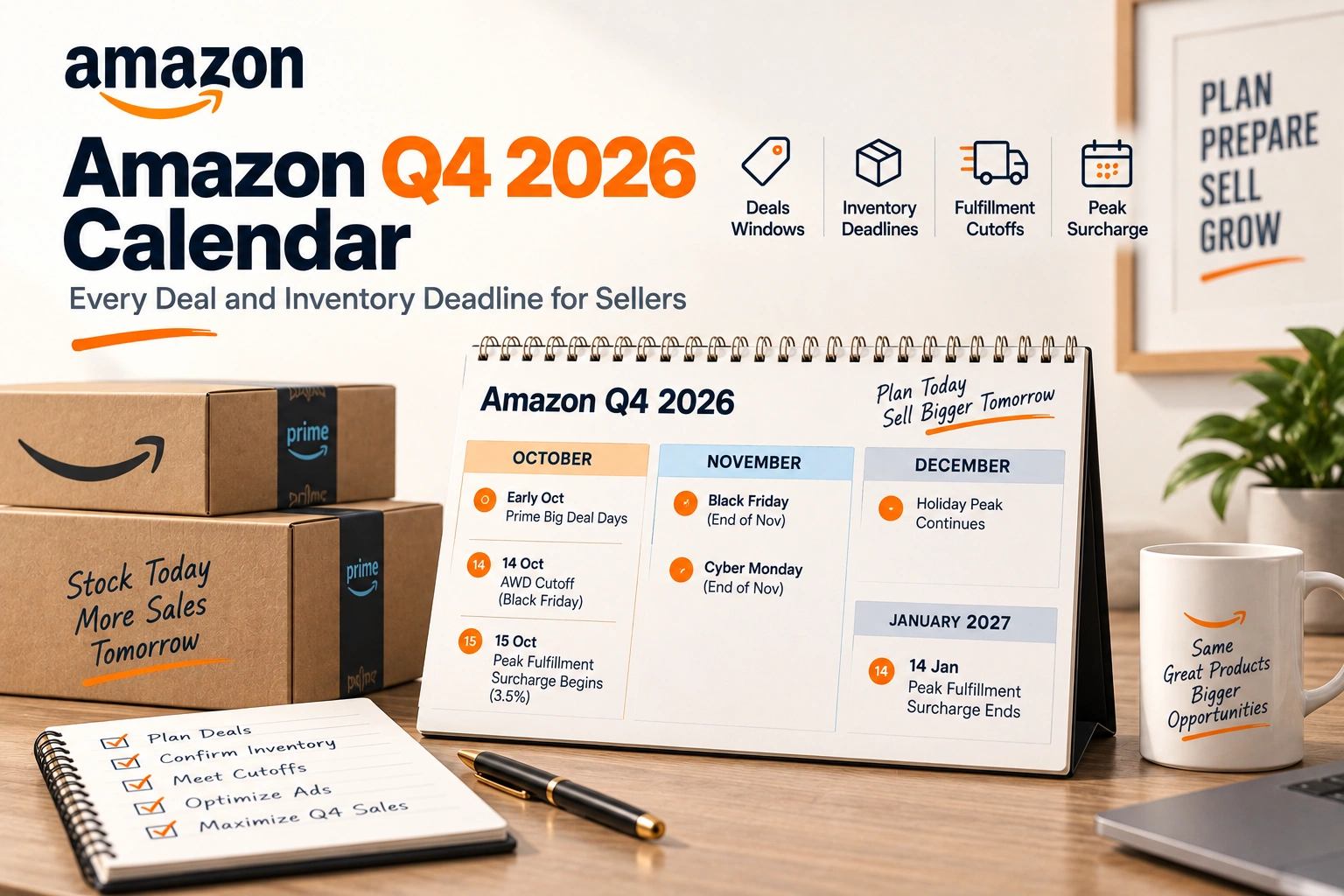
The holiday peak fulfilment fee applies from 15 October 2026 to 14 January 2027. Amazon describes it as a 3.5% fuel and logistics related surcharge, an average of $0.32 per unit. It is not a deal fee and it does not depend on whether a product is in an event; every FBA unit shipped in the window carries it. The margin line for the quarter is drawn with it in, which the article on
Amazon seller fees walks through fee by fee.
A deal in either event carries an upfront promotion fee of $100 per promotion and a variable fee of 1.5% of promotional sales, capped at $5,000. Those are the Prime Day 2026 figures, unchanged. There are no new eligibility requirements.
The rule sellers ask about most is the lookback. A Prime Big Deal Days promotional price is excluded from the 30 day and 60 day lookback windows, so the deal price does not become the reference price for the next one. That is what makes a deal in October and another in November possible without the second being priced against the first. The mechanics of reference prices and what a deal does to margin are in
the repricing strategy article.
5 August: early submission discount deadline, Prime Big Deal Days. 2 September: AWD cutoff, Prime Big Deal Days. 5 September: early submission discount deadline, Black Friday and Cyber Monday. 8 September: deal submissions close, Prime Big Deal Days. 9 September: FBA cutoff with minimal splits, Prime Big Deal Days. 16 September: FBA cutoff with optimised splits, Prime Big Deal Days. Early October: Prime Big Deal Days. 14 October: AWD cutoff, Black Friday and Cyber Monday. 15 October: the peak fulfilment surcharge begins. 20 October: deal submissions close, Black Friday and Cyber Monday. 21 October: FBA cutoff with minimal splits. 28 October: FBA cutoff with optimised splits. 14 January 2027: the peak fulfilment surcharge ends.
Two dates are not in the announcement and belong on the plan anyway. Seven days before each FBA cutoff is the last day to schedule a standard delivery. Fourteen days before is the last day to book a partnered carrier pickup. Written into the calendar, the Black Friday deadlines are 7 and 14 October for a shipment that has to make 21 October.
Work backwards from 21 October. A supplier lead time of four weeks and a freight lead time of two weeks puts the purchase order in the first week of September for stock shipped by sea, which is why the September conversation is always about what was ordered in August. Air freight buys three weeks, at a price that has to fit inside the margin the surcharge has already narrowed.
The capacity limit is the constraint the calendar does not show. A seller with a cutoff on the 21st and a limit that will not take the stock has a different problem, and the Inventory Performance Index that sets the limit is the same score that decides storage fees, which
the fees article covers. The advertising that has to run beside a deal is a week's plan of its own, and
the weekly PPC routine is the shape of it. The stock itself is a year round discipline, covered in
Amazon inventory management, and the quarter is where a weak version of it shows.
For the brands we run, this calendar is the October plan: deals decided in September, stock booked against the 7 and 14 day scheduling rules, and the surcharge priced in before the first promotion goes live. That is the work of
our Amazon marketplace management service, and the quarter is where it earns its place.
Related reading: our The fourth quarter, across marketplaces service page, Amazon FBA Capacity Limits in Q4: What to Do When Yours Is Cut, Prime Big Deal Days and Black Friday 2026: Amazon Deals, Fees and Price Rules, Walmart Marketplace Holiday 2026: WFS Deadlines, Deals Events and the Plan, TikTok Shop Holiday 2026: Campaigns, Creators and the November Plan, eBay Holiday 2026: Shipping Cutoffs, Peak Surcharges and Seller Protections, Shopify BFCM 2026: The September Checklist for a Store That Holds Up, Q4 Advertising Budgets Across Amazon, Walmart, TikTok Shop and eBay, Q4 Pricing for Marketplace Sellers: Deal Windows, Lookbacks and Margin and After Q4: The January Plan for Marketplace Sellers.