Q4 Advertising Budgets Across Amazon, Walmart, TikTok Shop and eBay
The quarter's advertising budget is not a bigger monthly budget. It is a set of weeks with different prices, and the weeks with the highest cost per click are also the ones with the highest conversion. How to split it, where to hold it back, and when to release it.


Loading Article banner
The fourth quarter's advertising question is usually asked as a number: how much more should the budget be. It is the wrong shape of question. The quarter is thirteen weeks with three or four different prices per click, and the weeks that cost the most are the weeks that convert best. A budget set as a monthly figure runs out on the days it was meant for and is spent on the days it was not.
This is the method we use for the brands we run across four marketplaces, written for a seller who advertises on more than one of them and has one budget to divide. The mechanics of each platform are in the articles it links to; this is about the shape of the quarter.
The four kinds of week
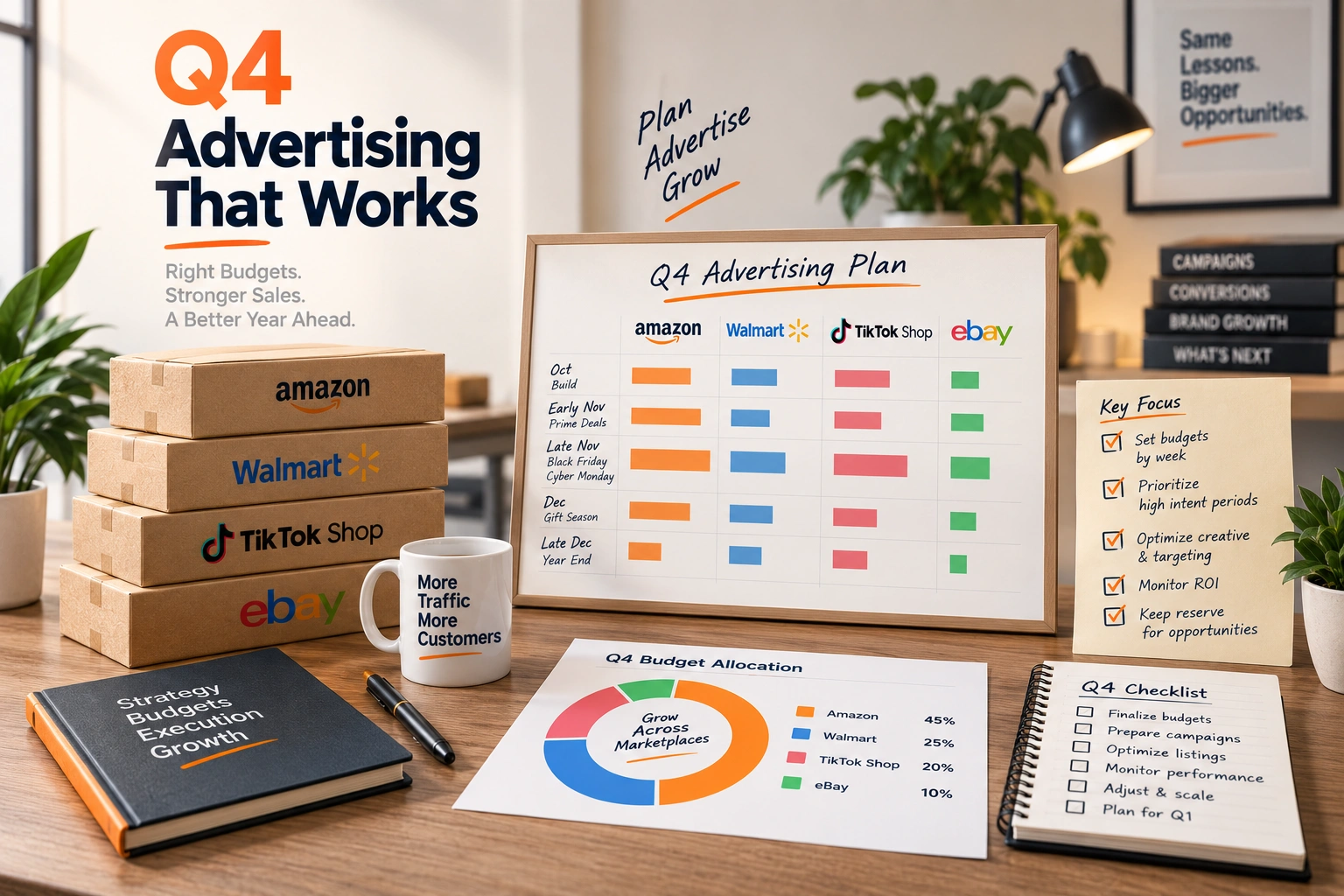
The quarter sorts into four kinds of week. The build weeks, from the start of October to the first event, when clicks cost about what they did in September and every sale adds to the rank a product carries into November. The event weeks, Prime Big Deal Days in early October and Black Friday to Cyber Monday at the end of November, when the auction is at its most expensive and conversion at its highest. The gift weeks, the first two of December, when clicks are still dear and the buyer is still buying but there is no badge to help. And the tail, from the last shipping date to the end of the year, when the auction empties, clicks are cheap, and the buyer is spending gift money on themselves.
Each kind of week has a job. Build weeks buy rank. Event weeks buy volume. Gift weeks buy the sales that the events did not take. The tail buys cheap clicks and clears stock. A budget that treats them as one is paying event prices in the tail and running out in the event.
Splitting the budget by week, then by marketplace
Start from last year's sales by week, by marketplace, if they exist, and from the platform's own pattern if they do not: Amazon's event weeks carry the most volume and the most competition; Walmart's follow Amazon's calendar with a smaller auction; TikTok Shop's are driven by the platform campaigns and by which videos happen to be working; eBay's advertising is a smaller share of the whole and the volume follows the shipping cutoffs rather than a deal badge.
The split is then a table with a row per week and a column per marketplace, and the number in each cell is the share of the quarter's budget that week and marketplace earns. Two rules keep it honest. The event weeks on Amazon get a daily figure, not a weekly one, because a Black Friday budget that is exhausted at noon on Friday is a budget spent at the cheapest hour of the most expensive day. And the tail gets a real allocation rather than the leftovers, because it is the cheapest traffic of the year and the month the January stock position is decided in.
The measure across marketplaces is return on ad spend read against each platform's own figures rather than Amazon's, which is what the ROAS standards article sets out. A TikTok Shop campaign at a ROAS that would be poor on Amazon can be the right spend on TikTok, because the platform's attribution and the creator's commission sit inside the number differently.
Amazon: bids in position before the event, budget on the day
The Amazon plan is the one most sellers get backwards. Bids raised on the morning of the event enter an auction where every other bidder did the same thing, and the campaign spends its budget learning what it could have learned in October. Bids raised in the build weeks, on the product's own terms and its closest competitors', hold the placements when the event arrives; the event day change is the daily budget, released so the campaign does not stop, and withdrawn the day after.
The structure that makes that a two line change rather than a rebuild is in the Amazon PPC strategies article, and the routine for running it through a fortnight of daily changes is the weekly optimisation routine compressed to a daily one. The ad types and which of them earn their place in an event week are in the ad types article: Sponsored Brands video and the deal placements matter more in November than in any other month.
Walmart, TikTok Shop and eBay: three different auctions
Walmart's auction has fewer bidders and November is when most of the year's new ones arrive, so a position held from October costs less to keep than one bought in November. The campaign structure that makes the budget change simple is in the Walmart PPC article.
TikTok Shop's spend follows the creative, not the calendar: the budget goes behind the videos that are converting in the week, through GMV Max or the manual campaigns, and the plan is a daily review of which videos those are. GMV Max: what it does with your budget explains why a fixed daily budget on TikTok is a different instruction from the same figure on Amazon.
eBay's Promoted Listings are a percentage of the sale rather than a click price, so the event weeks do not cost more per click; they cost more because there are more sales. The Q4 change on eBay is the ad rate on the products the season favours, raised in October, and the standard rate everywhere else.
What to hold back
Keep a reserve of about a tenth of the quarter's budget unallocated until the first event has run. Prime Big Deal Days in early October is the rehearsal: it shows which products convert at a deal price, which campaigns run out, and which marketplace surprised. The reserve goes where October said it should, and a plan that was wrong in one place is corrected with six weeks to spare.
For the brands we run, this table is the quarter's work in growth advertising: the weeks priced, the marketplaces weighted, the bids in position in October, the budget released and withdrawn on the days, and the reserve spent on what the first event taught.
Frequently asked questions
The questions that come up most often on this subject.
The better question is how to divide the quarter. Sort the thirteen weeks into build weeks, event weeks, gift weeks and the tail, give each a share by marketplace from last year's sales pattern, set the Amazon event weeks as daily figures, and hold a tenth back until Prime Big Deal Days has shown what converts.
Raise them in October so the campaigns already hold their placements, and change the daily budget on the event day rather than the bids. Bids raised on the morning of the event enter an auction where every other seller did the same, and the budget is spent learning what the build weeks would have taught.
Yes, and it is usually the cheapest traffic of the year. The auction empties after the last shipping date while buyers keep spending gift money on themselves, and the tail is where a January stock position is cleared at a reasonable cost per click.
Against each platform's own return on ad spend norms rather than Amazon's. TikTok Shop's attribution and creator commissions, Walmart's smaller auction and eBay's percentage of sale model each put different things inside the number, so a single target across all four misreads three of them.