The Amazon Ad Types, and When Each One Earns Its Budget
Sponsored Products, Sponsored Brands, Sponsored Display and Sponsored TV do different jobs. Knowing which job you are buying is most of the decision.


Loading Article banner
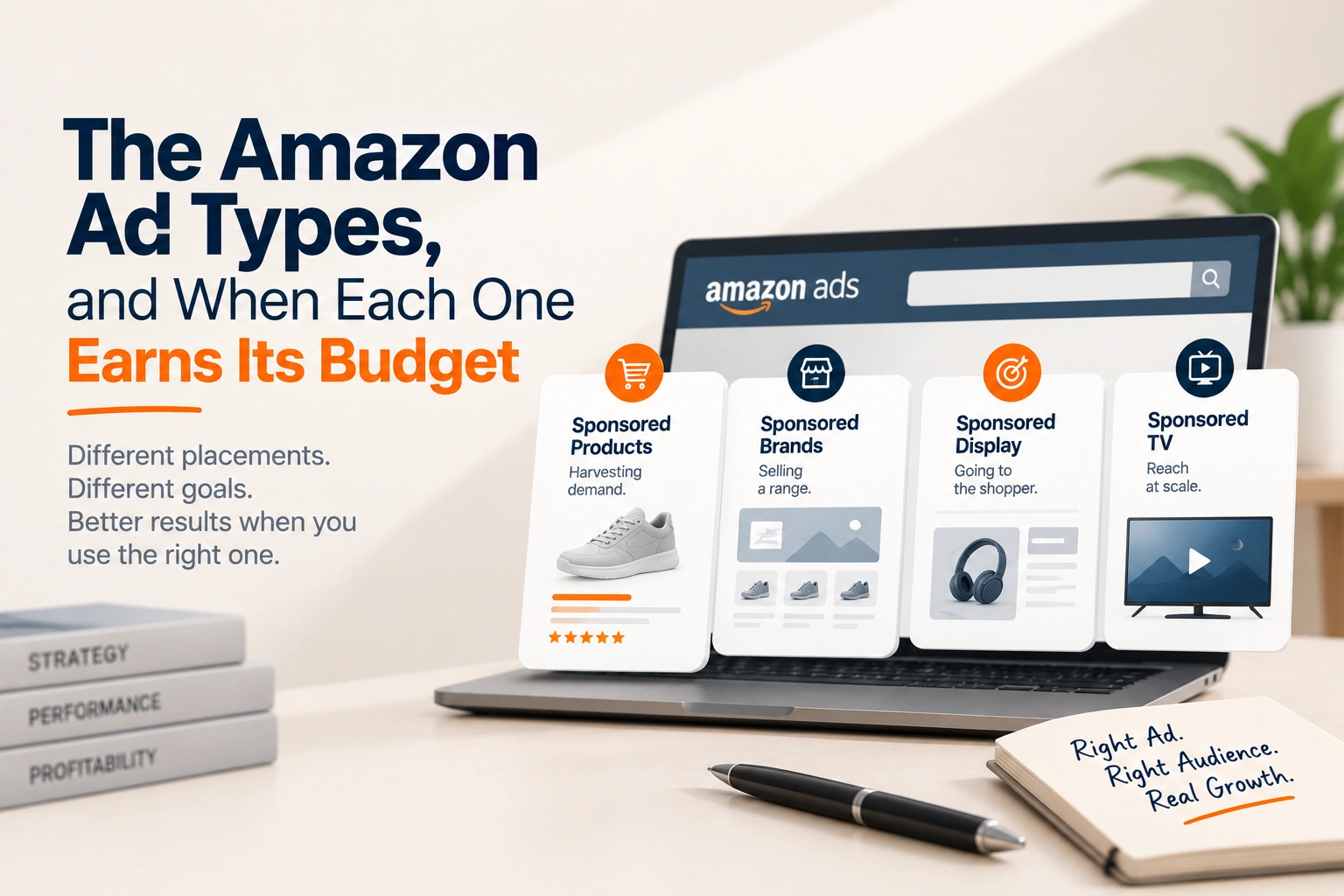
Amazon offers several advertising formats and they are not interchangeable. Each sits at a different distance from the purchase, and buying the wrong one for the job is the most expensive mistake available, because the numbers look plausible for weeks before the shortfall shows.
Sponsored Products: harvesting demand
These are the placements woven through search results and on product pages, and they look almost exactly like an organic listing. A shopper searching for what you sell is shown your product.
This is the closest format to the money and the one nearly every account should start with. It converts best, it is the easiest to attribute, and it produces the search term report that every other decision depends on.
If your advertising budget is small, spend all of it here. The other formats are worth adding once this one is working, not instead of it.
Sponsored Brands: selling a range
The headline banner at the top of search results, carrying a logo, a line of copy and several products, or a video in place of the images.
It is built to sell a range rather than a product. With a catalogue of three items there is little for it to carry, and the click cost is usually higher than Sponsored Products because the placement is prominent.
There is one exception worth taking seriously at any catalogue size, which is defending your own brand name. If somebody searches for you specifically, the top of that page should be yours, and it is usually cheap because your relevance on your own name is unbeatable.
Sponsored Display: going to the shopper
Placements on competitor product pages and off Amazon entirely, plus retargeting for people who viewed your listing and did not buy.
This is prospecting rather than harvesting, and the numbers reflect that. Expect a higher ACoS and judge it over a longer window, because you are reaching people earlier in their decision rather than catching them at the end of it.
It earns its place when you have a genuine advantage to argue: better reviews than the product whose page you appear on, a better price, a meaningful feature difference. Without one, you are paying to advertise on a competitor's listing, which flatters them more than you.
How to decide what to run
Start with Sponsored Products until it is stable and profitable. Add brand defence, because it is cheap and the alternative is letting competitors buy your own name. Add Sponsored Brands when you have a range worth showing together. Add Sponsored Display when you can say in one sentence why a shopper should switch to you.
That order is not arbitrary. Each step depends on data or on catalogue depth that the previous one produces.
Judge each format on its own terms
The most common reporting mistake is holding every campaign to one ACoS target. A brand defence campaign and a display prospecting campaign are buying different things over different time horizons, and a single target will always make one of them look like a failure.
Set a target per job. Our ROAS standards for Amazon, TikTok Shop and Walmart Connect has the benchmarks worth starting from, and our guide to launch campaign structure covers how to keep those jobs apart in the account itself.
Once several formats are running, the weekly work grows quickly. The weekly optimization routine is how to keep it to something a person can actually finish.
What we do with this
Keep reading
We add formats in the order an account can afford to learn them, rather than opening all of them and splitting one budget five ways. What every format shares is the auction underneath, which is in how Amazon pay per click works, and holding a target per job across all of them is part of Amazon advertising management.
Frequently asked questions
The questions that come up most often on this subject.
Sponsored Products, almost always. It is closest to the purchase, easiest to measure, and it produces the search term data every other campaign type depends on.
Usually only for defending your own brand terms. The format is built to sell a range, so with two or three products the headline banner has little to carry.
Reaching shoppers away from the search results: on competitor product pages, and back to people who viewed your listing and did not buy. It is prospecting and retargeting rather than harvesting demand.
No. Sponsored Products catches shoppers at the end of a search; Sponsored Display reaches them earlier, on competitor product pages, off Amazon and after they have viewed your listing without buying. Expect a higher ACoS, judge it over a longer window, and hold it to a target set for that job rather than to the account average.