Amazon PPC Campaign Structure for a Product Launch
A launch campaign has a different job from a profitability campaign, and mixing them is why so many launches stall with a healthy ACoS and no rank.


Loading Article banner
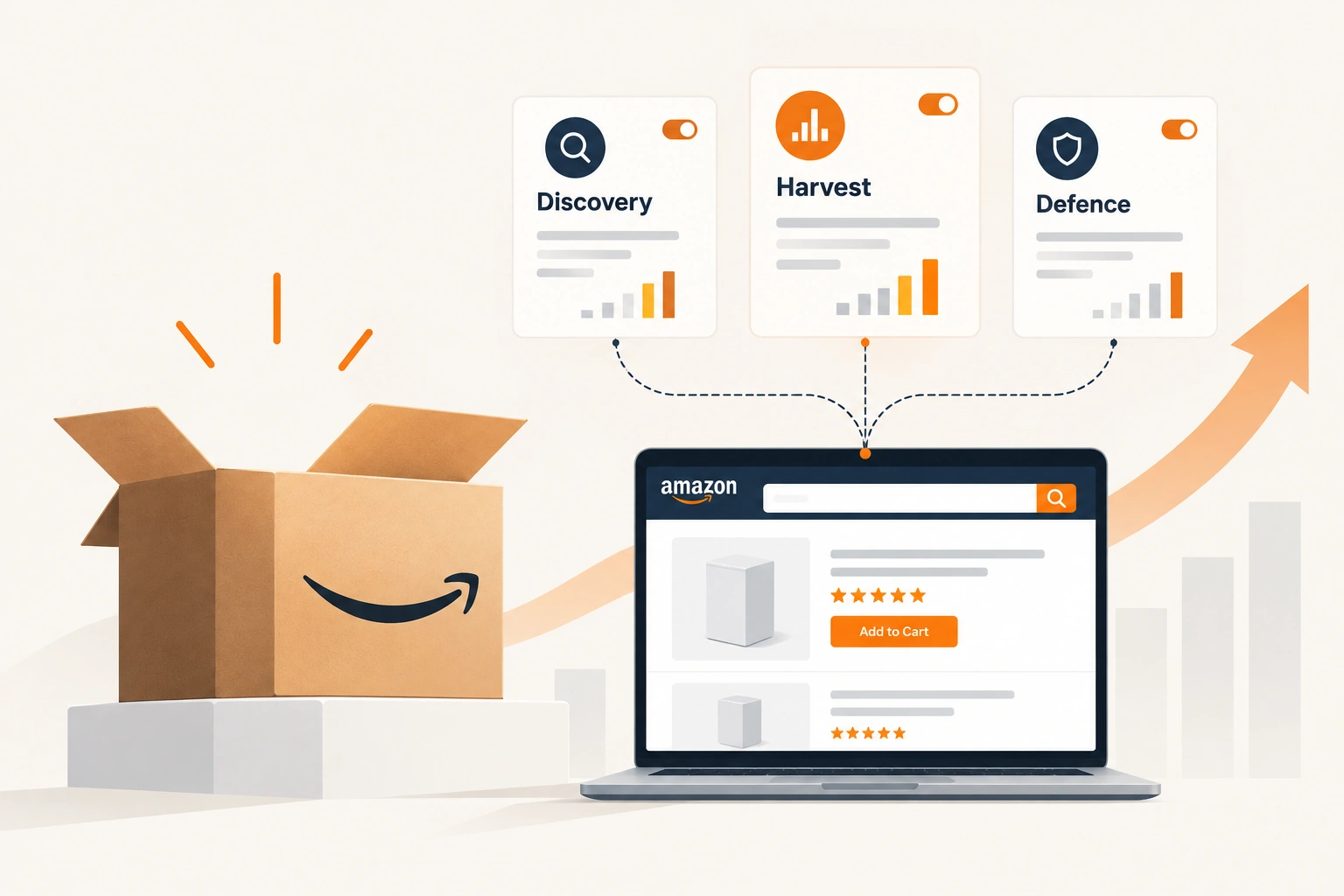
Most launch campaigns fail structurally rather than tactically. The bids are reasonable, the keywords are sensible, and everything is pooled into one campaign that is simultaneously trying to discover new terms, defend the brand name, and hit a profitable ACoS. Those three jobs pull in different directions, and the campaign settles into doing the cheapest of them.
Three campaigns, three jobs
Separate by purpose, not by product. A launch needs at least three campaigns running side by side, each with a budget and a target that reflect what it is actually for.
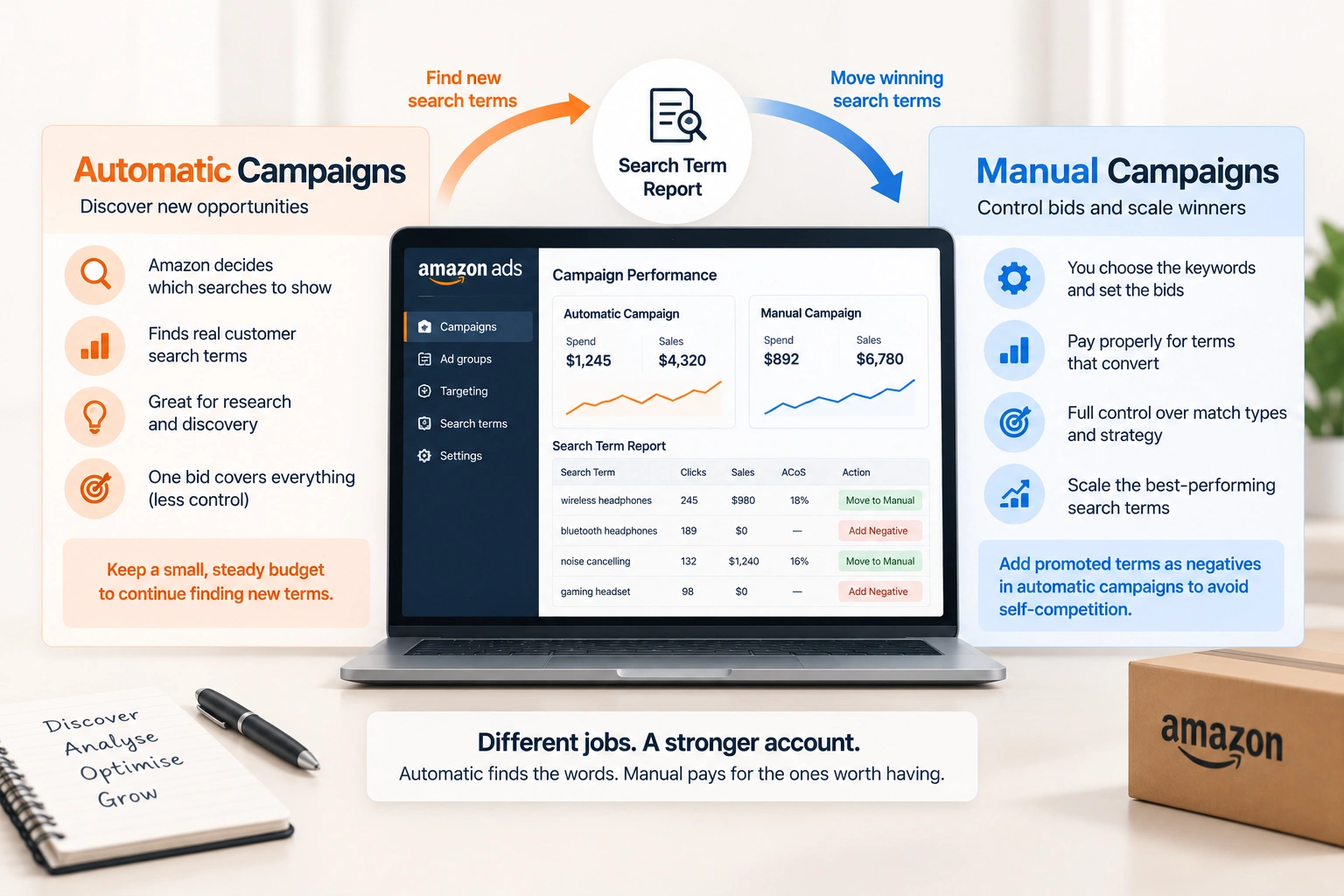
Discovery is an automatic campaign, or a broad match campaign, with a modest budget and a deliberately loose remit. Its output is not sales. Its output is the search term report.
Harvest is exact match keywords promoted out of discovery once they have proved they convert. This campaign carries most of the budget and most of the expectation.
Defence covers your own brand name and your own product terms. It is usually the cheapest traffic in the account and the most commonly forgotten, and it exists so that competitors cannot buy the shopper who was already looking for you.
Set a launch target, and write it down
A launch campaign is buying three things at once: sales, reviews, and organic rank. Only the first shows up in ACoS. If you judge the campaign on ACoS alone you will end it in week three, just as the other two were starting to arrive.
Decide before you start what you are willing to spend to reach a given rank, and treat that number as the budget for a marketing activity rather than as an overspend to be corrected. Write it down, because in week three somebody will ask why the ACoS is high and the honest answer needs to have existed in advance.
Feed the harvest campaign properly
The loop is the whole method. Discovery runs, the search term report fills up, and once a week you move terms across.
A term that converted goes into the harvest campaign as an exact match keyword with its own bid, and is added as a negative in discovery so the two campaigns stop bidding against each other. A term that spent without converting becomes a negative. A term that belongs to a different product becomes a negative immediately.
Skipping the negative step is the most common structural mistake in a launch. Without it, discovery keeps paying for terms that have already graduated, and the two campaigns compete for the same impression with your own money on both sides.
Budget for the campaign that is limited, not the one that is loud
A campaign that spends its budget by midday is not necessarily successful. It may simply be cheap. Check which campaigns are limited by budget and which are limited by bid, because they need opposite responses: one needs more money, the other needs a higher bid or better relevance.
This distinction is easy to see and easy to ignore, and getting it wrong is how brands raise bids on a campaign that was never losing the auction in the first place.
Know when the launch is over
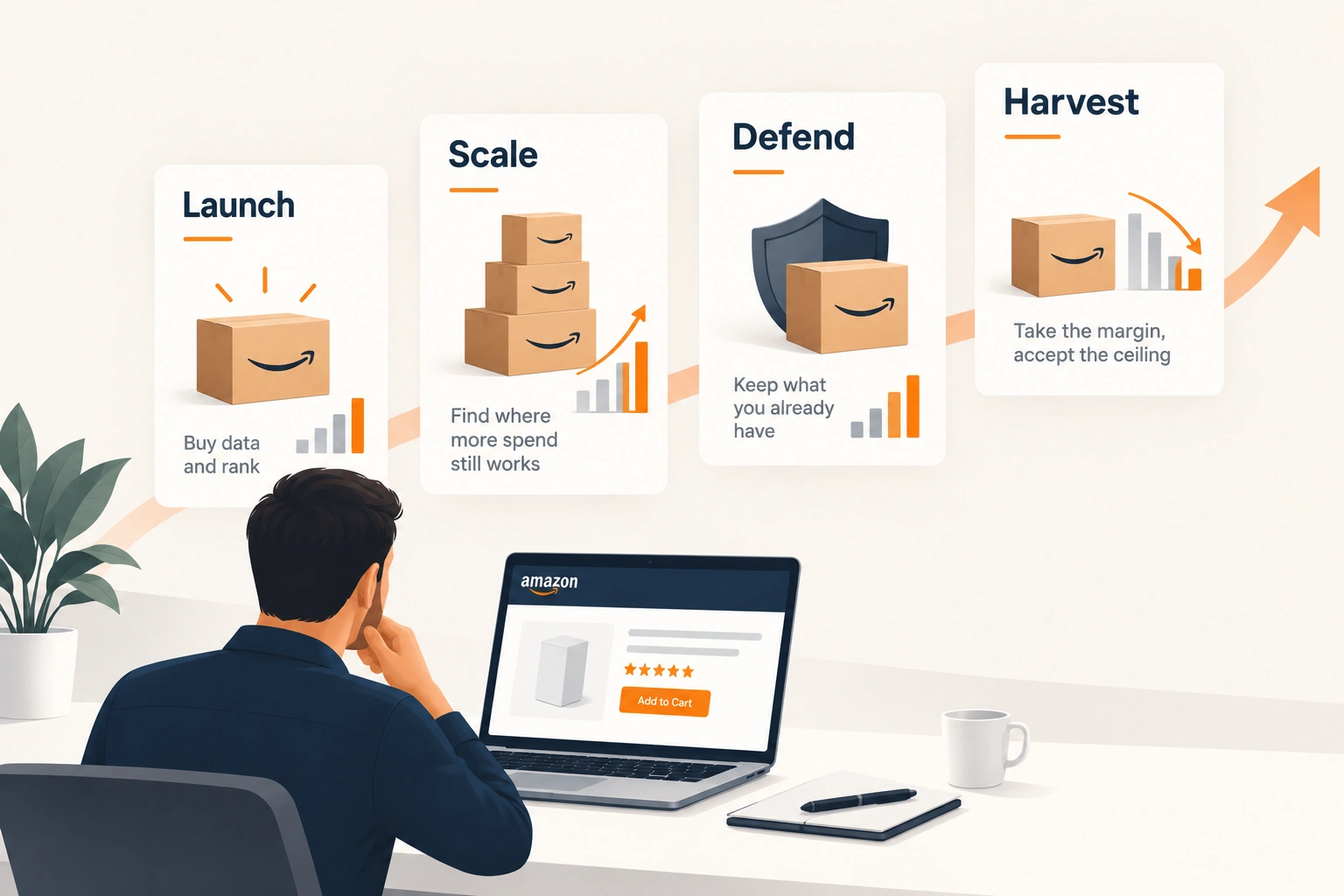
The launch phase ends when the product holds organic placement for its main terms without paid support. That is a condition, not a date, and it is usually somewhere between four and eight weeks.
At that point the targets change. The harvest campaign moves to a profitability ACoS, discovery shrinks to a maintenance budget, and defence stays exactly as it is. Our weekly optimization routine is what the account runs on from there.
The structural mistakes worth avoiding
One campaign doing every job. Judging a launch on immediate ACoS. Forgetting negatives, so discovery and harvest bid against each other. Ignoring the brand defence campaign because it looks too easy to be worth the money.
None of these are subtle, and all of them are common, because each one looks like tidiness at the time. If the account has grown past the point where this can be run by hand each week, seven clear signs you have outgrown manual management is a reasonable checklist to read next.
What we do with this
We build the three campaigns before the product is live, because retrofitting structure to a pooled campaign costs the launch window it was meant to win. The auction behaviour that makes the separation matter is in how Amazon pay per click works, and running the set through a launch is part of Amazon advertising management.
Frequently asked questions
The questions that come up most often on this subject.
Higher than your profitability target, on purpose. A launch is buying rank and reviews as well as sales, and judging it on immediate ACoS alone will end it before it works.
Usually four to eight weeks, and the end of it is a decision rather than a date: you move on when the product holds organic placement for its main terms without paid support.
Both, doing different jobs. Automatic finds the terms you did not think of, and manual buys the ones you already know matter. The automatic campaign feeds the manual one.
At least three, separated by the job each does rather than by product. A discovery campaign, automatic or broad match, finds new search terms on a modest budget. A harvest campaign holds the exact match keywords promoted out of discovery once they convert, and carries most of the budget. A defence campaign covers your own brand and product terms, so a competitor cannot buy the shopper who was already looking for you.