How to Choose an Amazon PPC Strategy for the Stage You Are At
There is no single right Amazon PPC strategy. There is the one that matches what this product needs this quarter, and four of them cover almost everything.


Loading Article banner

Ask ten people for an Amazon PPC strategy and you get ten lists of tactics. Tactics are not a strategy. A strategy is the decision about what you are buying with the money, and everything else follows from it.
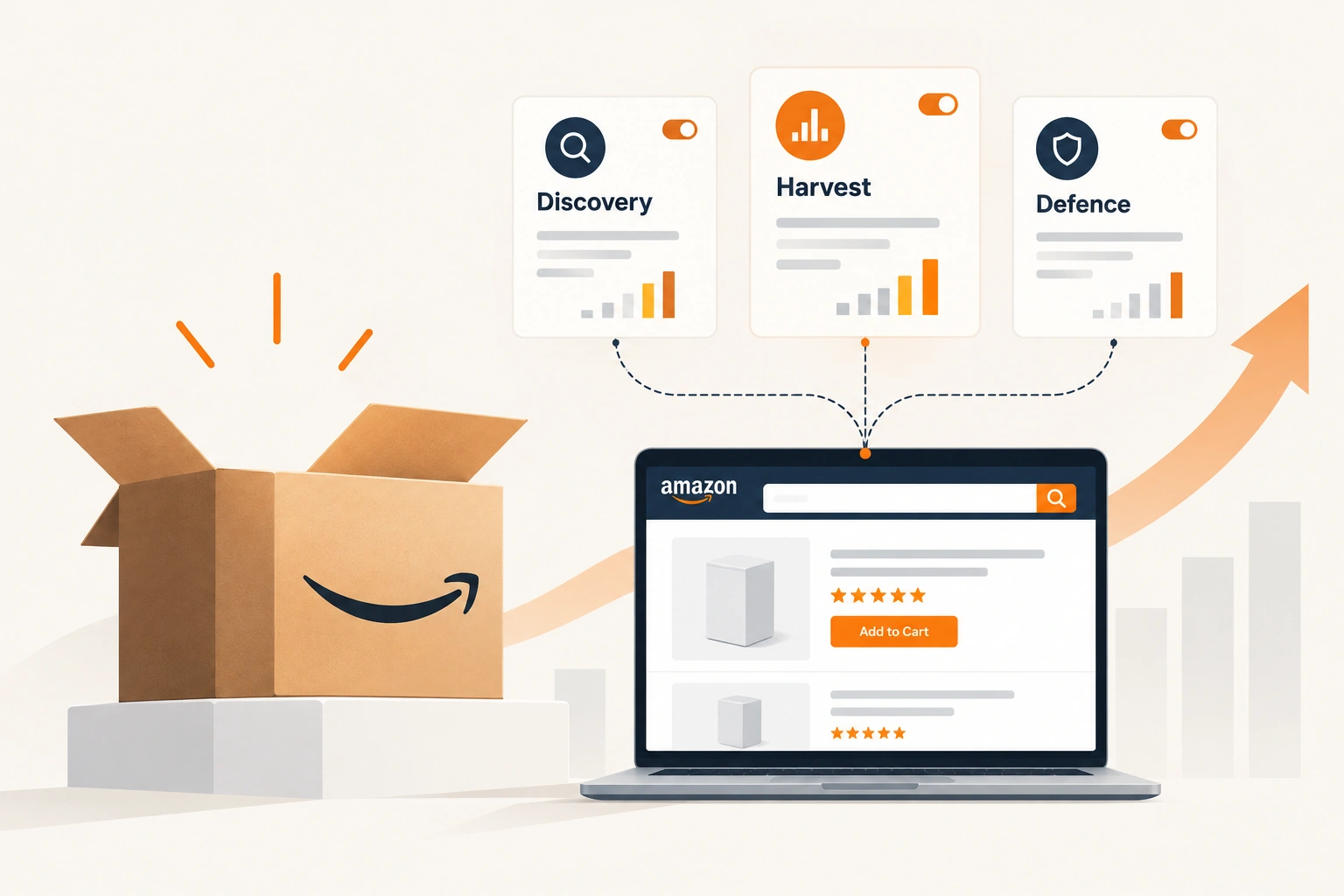
In practice there are four, they map to what a product needs at a given moment, and almost every account is running some mixture of them whether anybody has said so or not.
Launch: buying data and rank, knowingly above target
A new product has no history, no reviews and no organic rank. Amazon has nothing to judge it on, so it shows it rarely and charges more when it does.
The job of advertising here is to buy the sales that create the history. That means running above your eventual ACoS target on purpose, for a defined period, on a defined budget. Not because the maths works today, but because it is the cost of existing.
Two things make this go wrong. The first is not writing down when it ends, so a launch quietly becomes the permanent state of the account. The second is judging it on ACoS week by week, which will always look bad, when the number that matters is whether organic rank is moving.
The structure for this is in campaign structure for a product launch.
Scale: finding out where more money still works
The product converts, the numbers are acceptable, and the question is how much more it can take before the returns turn.
This is the strategy with the most upside and the one most often skipped, because it requires deliberately spending into uncertainty. The method is dull: raise budgets and bids on the campaigns that are limited rather than the ones that are performing, and watch where the efficiency curve bends.
A campaign limited by budget and a campaign limited by bid look identical in a report and need opposite responses. Knowing which is which is most of the skill here.
Defend: paying to keep what you already have
A mature product with organic rank and a competitor bidding on your listing. The advertising is not buying growth, it is stopping somebody else taking what you built.
Defensive spend has terrible ACoS by the standards of a harvest campaign and that is not a fault. It is insurance, and it should be judged against what losing the position would cost, not against the account average.
Bidding on your own brand belongs here. It looks like paying for traffic you would have had free, and sometimes it is, but it is also the cheapest placement you will ever buy and the alternative is a competitor buying the shopper who typed your name.
Harvest: taking the margin, accepting the ceiling
A product at the end of its run, or one whose category has become too expensive to grow in. The strategy is to keep only the terms that pay, at bids that pay, and let the rest go.
This is the only one of the four where cutting spend is the plan rather than a failure. It is also the one nobody announces, so it tends to happen by neglect: bids left alone, campaigns quietly starved, and nobody deciding anything.
Which one you are on
Three questions settle it almost every time. Does this product have organic rank on the terms that matter? Is there room to spend more without the returns collapsing? Is somebody else bidding on it?
No rank means launch. Rank plus room means scale. Rank without room, with competitors present, means defend. Rank without room and without a reason to protect it means harvest.
The point of naming it is that the target follows. A launch and a harvest running at the same ACoS target is a contradiction, and one of the two is being managed wrongly.
Different products, different strategies, same account
This is the part most often got wrong. A single account ACoS target applied across a launch and a mature hero product starves the launch and overpays for the hero, and the account average hides both.
Separate them by campaign, give each its own target, and judge each against its own. The account number then becomes a summary rather than a steering wheel.
Tactics still matter, second
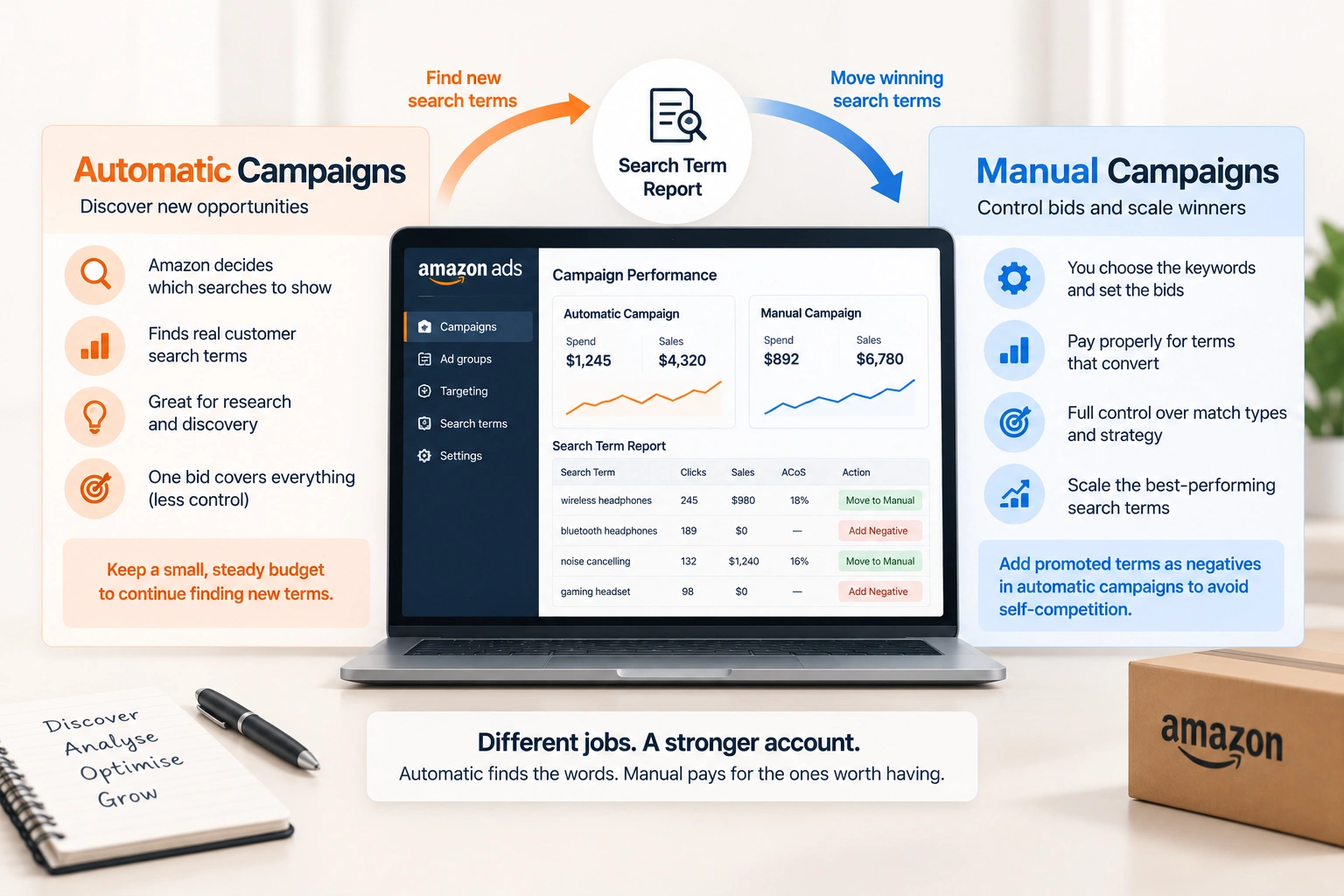
Once the strategy is named, the weekly work is the same in all four cases: read the search terms, negate the waste, promote what converts, adjust bids for stated reasons. That routine is in the weekly optimization routine, and the specific moves worth making are in eighteen Amazon PPC strategies.
What the strategy changes is which of those moves is right. The same underperforming keyword is worth defending in one context, scaling in another and cutting in a third, and no amount of tactical skill tells you which without knowing what the money is for. Targets worth holding yourself to are in our ROAS standards.
What we do with this
We choose the strategy from the account's constraint rather than from a list of tactics, and then hold it long enough for the result to mean something. The mechanics every one of these strategies is built on are in how Amazon pay per click works, and running an account to a stated strategy week after week is what Amazon advertising management does with an advertising budget.
Frequently asked questions
The questions that come up most often on this subject.
There is no single best one, and any answer that does not ask what stage your product is at is guessing. A launch runs above target on purpose, a mature product runs at it, and one being wound down runs below it. The same account can be doing all three at once.
Give a change enough clicks to be readable, not enough days. A keyword with thirty clicks says something; a keyword with four says nothing regardless of how long it took to get them. Most accounts change strategy far too often and read noise as a result.
You should. A launch and a mature hero product in the same account want opposite things, and forcing them to share one ACoS target guarantees the launch is starved and the hero is overpaid for.
Three questions usually settle it. Does the product have organic rank on the terms that matter? Is there room to spend more before the returns collapse? Is a competitor bidding on it? No rank means launch. Rank with room to spend means scale. Rank without room, with competitors present, means defend. Rank without room and nothing to protect means harvest.