Selling on Amazon Europe From the US: The Responsible Person, Packaging, VAT and the 2026 Parcel Duty
Amazon's tools can list a US product in its European stores in minutes. The EU's rules take longer: a responsible person, packaging registration, an EORI, VAT where the stock sits, and the parcel duty in force since July 2026.


Loading Article banner
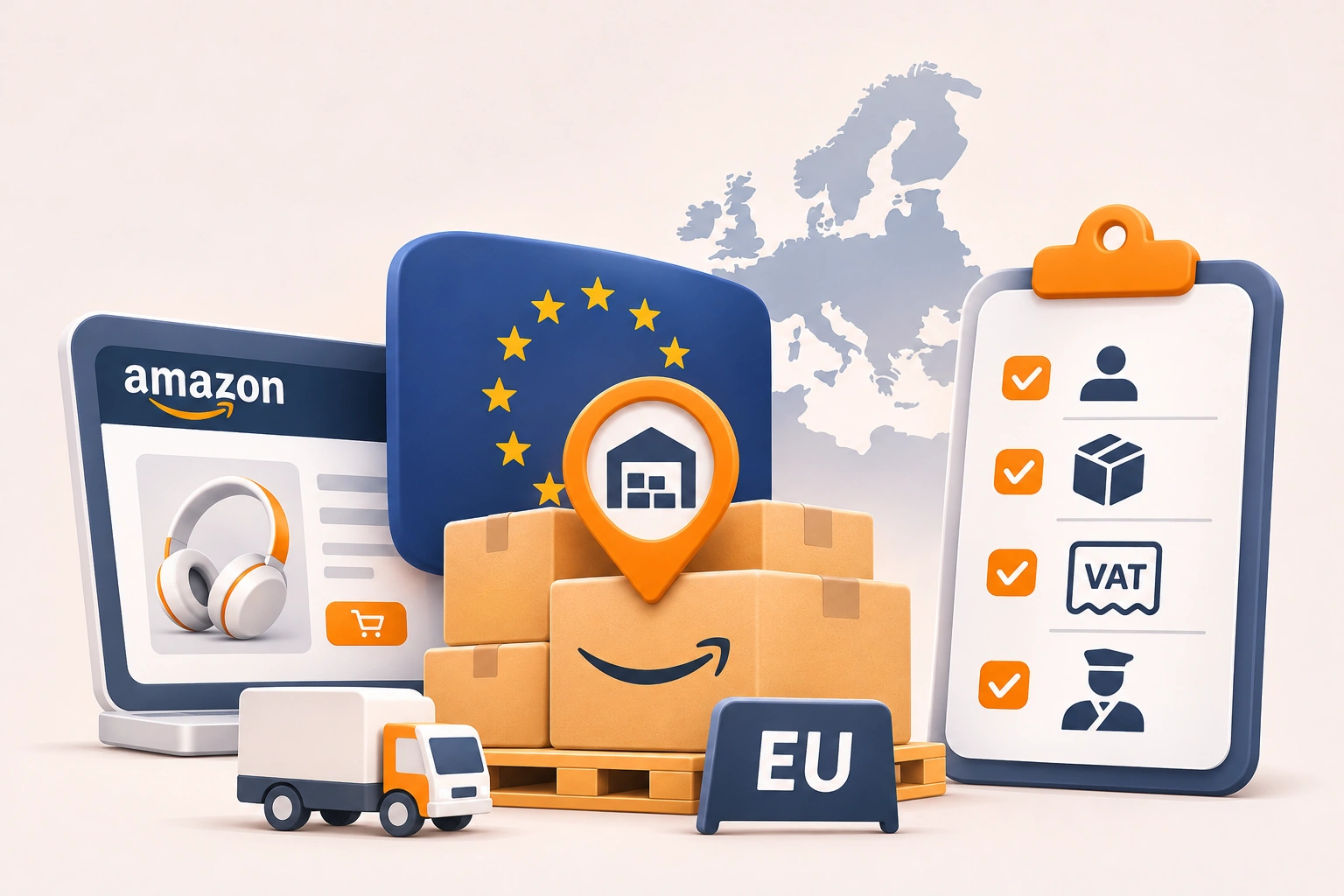
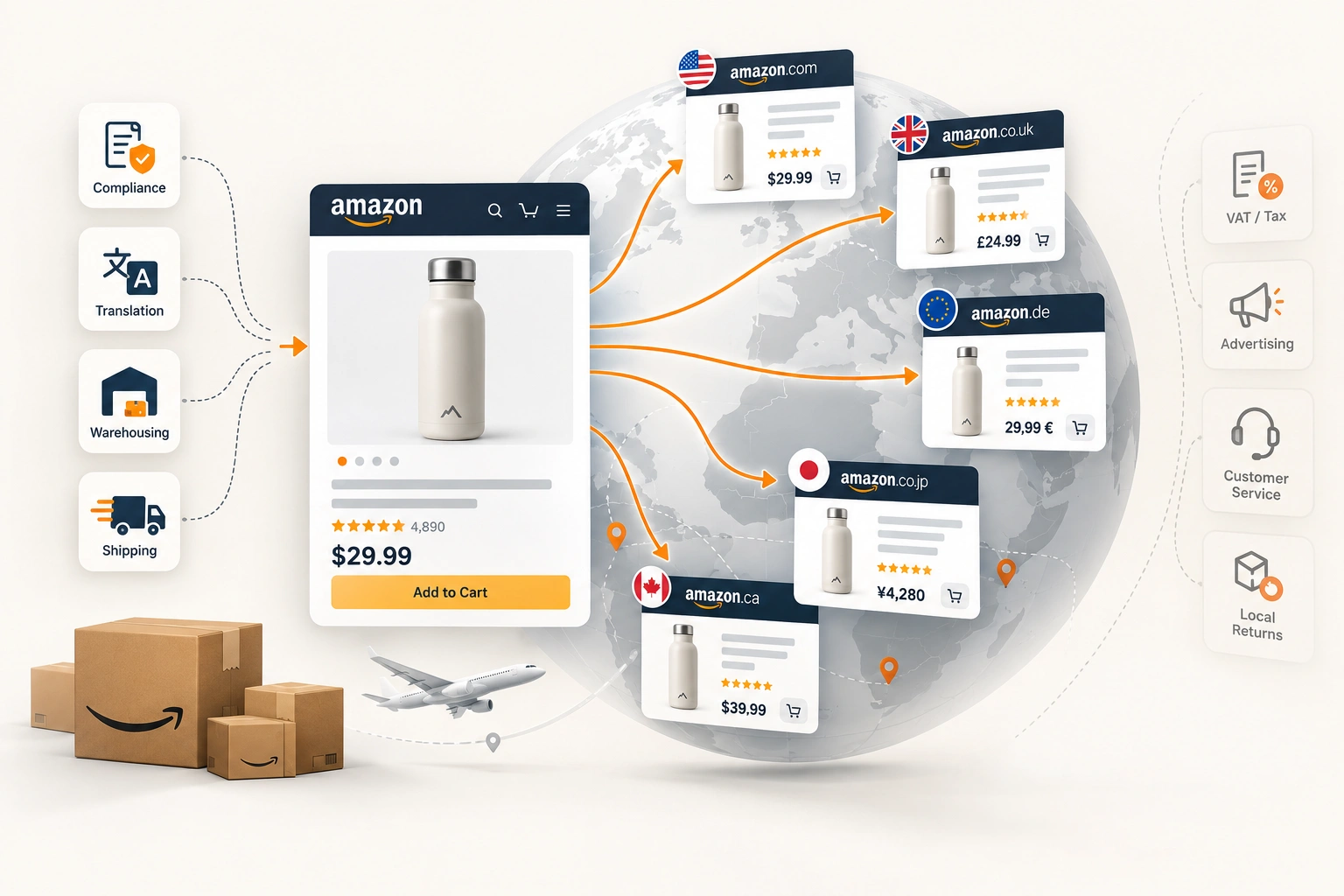
Amazon tells a US seller that a Europe account reaches Amazon customers in 28 countries, and its Build International Listings tool cross-lists a product into each of its European stores. What the tools do not do is make a US brand compliant in the European Union. The EU's rules attach to the product, the packaging and the shipment, and two of them changed in 2026.
This is what a US brand needs in place before its first sale in Amazon's EU stores, from Amazon's pages and the EU's own. The general case for opening a second country, and what Amazon's tools remove from it, is in Amazon's global expansion tools after Accelerate 2026; this is the European half of that list. The UK is a separate market with its own rules and is not covered here.
The account, the stores and the listings
A seller already on a US Professional plan creates a regional Europe account from Sell Globally in Seller Central. Inside the EU, Amazon's European stores include Germany, France, Italy, Spain, the Netherlands, Belgium, Poland and Sweden. Listing in one store does not list a product in the others, which is what the cross-listing tool is for, and Amazon says that in many cases reviews carry over and are translated automatically.
Proceeds can be held in Amazon's Seller Wallet or converted to a US bank account through the Amazon Currency Converter. Amazon suggests advice before opening a local bank account, because one may need a local legal entity.
A responsible person in the EU before the first listing
The EU's General Product Safety Regulation has applied since 13 December 2024. Amazon's own documentation says sellers of non-food products in its EU stores (Spain, France, Belgium, the Netherlands, Germany, Italy, Sweden and Poland) had to prove compliance by that date, by entering the manufacturer's and the EU Responsible Person's contact details in Seller Central, with safety information and compliance documents for the product.
For a US brand the second of those is the new obligation. A manufacturer outside the EU needs an economic operator established in the EU to answer for the product there, and the listing has to name it: an importer or distributor already in the EU, a firm that provides the service, or the brand's own EU company. Whoever it is holds the product documentation and answers the authorities, so the appointment is a contract, not a form field. The testing firm Intertek reports that the European Commission's guidance of November 2024 expects the responsible person's details on the packaging too, the part brands shipping existing US stock most often miss.
The documents behind the listing are the product's test reports and safety information, checked against EU rules rather than US ones. How Amazon verifies testing at home is in Amazon's third-party testing requirement; Europe asks the same question against its own standards.
Packaging: a registration, and a representative in Germany
Germany's packaging register, LUCID, run by the Zentrale Stelle Verpackungsregister, says plainly that anyone distributing packaged goods in Germany has to be registered with it. A company abroad that ships packaged products to end users in Germany is, at a minimum, the manufacturer and producer of its shipping packaging, and the register says it makes no difference whether the company is in another EU country or outside the EU. For some packaging, registration alone is not enough: the producer also needs a system participation agreement with a system operator, which pays for its recycling.
Two points catch US brands. A company not established in Germany has to appoint an authorised representative for its producer responsibility there, who takes over its packaging obligations except the LUCID registration itself, which stays with the company. And marketplaces and fulfilment providers have to obtain and verify each producer's registration confirmation and a self-certification before providing their services; without them, the register says, the products may not be offered. The register also tells online retailers to clarify whether they count as manufacturers under the EU's packaging regulation from 12 August 2026.
Germany is the clearest example, not the only one: other EU countries run their own schemes, and Amazon's Compliance Reference and Manage Your Compliance tools are where it shows what each store asks for.
Getting the stock in: an EORI and an importer
Stock sent to an EU fulfilment centre has to clear customs, with somebody as the importer. The European Commission says a business not established in the EU needs an EORI number to lodge customs declarations, registered in the EU country of its first customs operation and used as one identifier across the EU. Amazon's Europe page puts tax and regulatory compliance on the seller and offers nothing as importer, so the importer is the brand, its EU company or a partner acting for it.
Duty on that stock is a cost line like any other, and the pricing decision it forces is the one in what to do when import duties rise, wherever the duty is charged.
VAT where the stock sits
Amazon's Europe page says sellers may be required to register for VAT in a country where they store or sell, recommends starting as soon as the Europe account is created, and says each seller is solely responsible for compliance, with Amazon's tools to help and tax providers listed in its Service Provider Network.
Pan-European FBA is where this bites: Amazon describes it as distributing units across several EU countries at no additional cost to the seller. On our reading, every country holding the brand's stock is likely to need a VAT registration, so the convenience of distribution sets the number of registrations. A brand can start with stock in one country and add others to Pan-European FBA as the registrations are in place.
Orders shipped from outside the EU work differently. The EU's import scheme for VAT covers distance sales of imported goods in consignments of up to €150, and a marketplace that facilitates such a sale is treated as the supplier for VAT purposes.
Shipping from the US, or stocking in Europe: the parcel duty
Until the end of June 2026, a consignment worth €150 or less entered the EU free of customs duty. From 1 July 2026 to 1 July 2028, the European Commission says, a customs duty of €3 applies to consignments of €150 or less that are distance sales of imported goods to consumers, whichever VAT arrangement is used. An item is goods sharing one tariff classification, description and origin, and for now the €3 is applied per declaration line. After July 2028 the normal tariff takes over; a separate handling fee for customs processing is still under discussion and could arrive at the end of 2026.
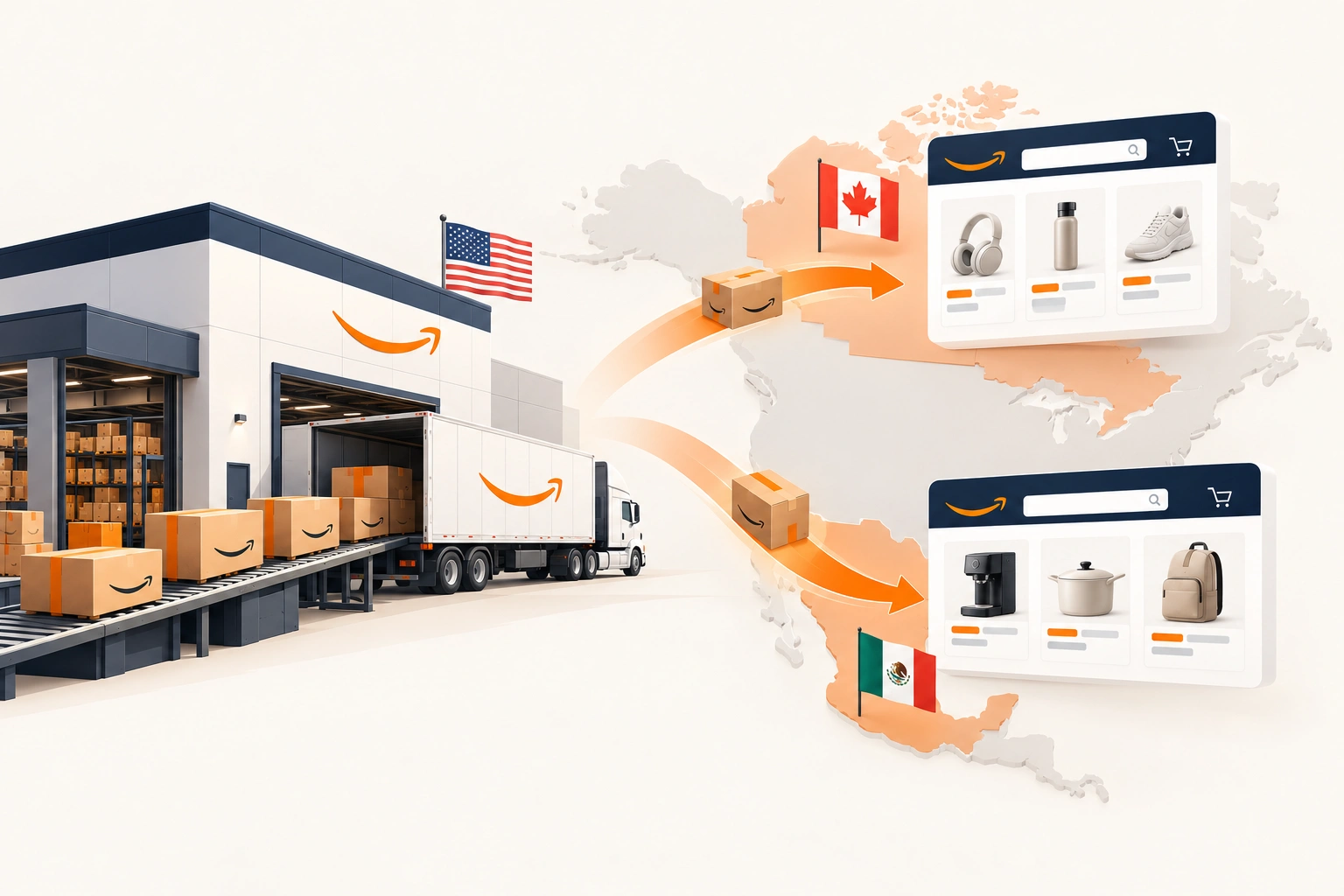
For a US brand the arithmetic is simple. Fulfilling European orders from a US warehouse now adds the €3 to every order, on top of import VAT and the international shipment. Stock imported in bulk to an EU fulfilment centre is a commercial import cleared once under its normal tariff, and the orders that follow are deliveries within the EU that the parcel duty does not touch. On our reading, that brings forward the point at which local stock pays for itself, for any product that sells more than occasionally. Canada and Mexico pose the same choice, set out in selling on Amazon Canada and Mexico from US stock.
The order to do it in
Six steps, roughly in this order, because each depends on the one before. Choose the first country and the first products, on the margin left after European fees, duty and VAT. Appoint the EU responsible person and check the product documentation against EU rules. Register the packaging, appoint the German representative and sign the system participation agreement. Get the EORI and the VAT registration for the country that will hold the stock. File the trademark where the brand will sell, because Brand Registry rests on it store by store; the Madrid route from a US application is usually the quickest. Then build the listings in each store's language and decide who answers customers in it.
Who runs it
Each of those steps is a few days of work once and a few hours a month after, in languages and legal systems the US team may not have. That is the gap a retail growth partnership is built for: we build the plan for the European stores, open the channels and run the selling, with the brand's inventory staying the brand's until it sells. If Europe is the next market and nobody owns the list yet, tell us what you sell.
Frequently asked questions
The questions that come up most often on this subject.
Amazon lets a US seller add a regional Europe account from Sell Globally in Seller Central, and none of the EU rules described here requires the brand itself to form an EU company. They do require people and registrations in the EU: an economic operator established in the EU named as responsible person for each product, an EORI number to import, VAT registration where the stock is stored, and in Germany an authorised representative for packaging. Amazon also notes that a local bank account may need a local legal entity.
An economic operator established in the EU: usually an importer or distributor that already handles the product there, a company that provides the responsible person service, or the brand's own EU subsidiary. Amazon asks for the responsible person's contact details in Seller Central for non-food products in its EU stores, under the regulation that has applied since 13 December 2024. Choose somebody who will hold the product's documentation and answer the authorities, because that is the job, not only a name on a listing.
Not to the stock itself, on our reading of the Commission's page. The €3 duty, in force from 1 July 2026 to 1 July 2028, applies to consignments worth €150 or less that are distance sales of imported goods to consumers. Stock shipped in bulk to an EU fulfilment centre is a commercial import cleared under its normal tariff, and the orders delivered from there stay within the EU. Orders shipped to EU customers from a US warehouse do carry it, per declaration line, on top of import VAT.
If your stock is stored in Germany, expect to. Amazon's Europe page says sellers may be required to register for VAT in a country where they store or sell, and recommends starting the registration as soon as the Europe account is created. Amazon provides tools and lists tax help in its Service Provider Network, but says each seller is solely responsible for compliance. Pan-European FBA, which spreads stock across several countries, can mean a registration in each country that holds it.
Yes, if you sell packaged goods to consumers in Germany. Germany's packaging register says anyone distributing packaged goods in Germany must be registered with LUCID, wherever the company is based, and that marketplaces and fulfilment providers must verify a producer's registration before providing their services. A company not established in Germany also has to appoint an authorised representative for its producer responsibility there, and for some packaging the register says a system participation agreement is needed as well.