The Video Formats That Actually Sell on TikTok Shop
Not every video is trying to do the same job. The ones that sell are answering an objection, and the format is chosen by which objection it is.


Loading Article banner
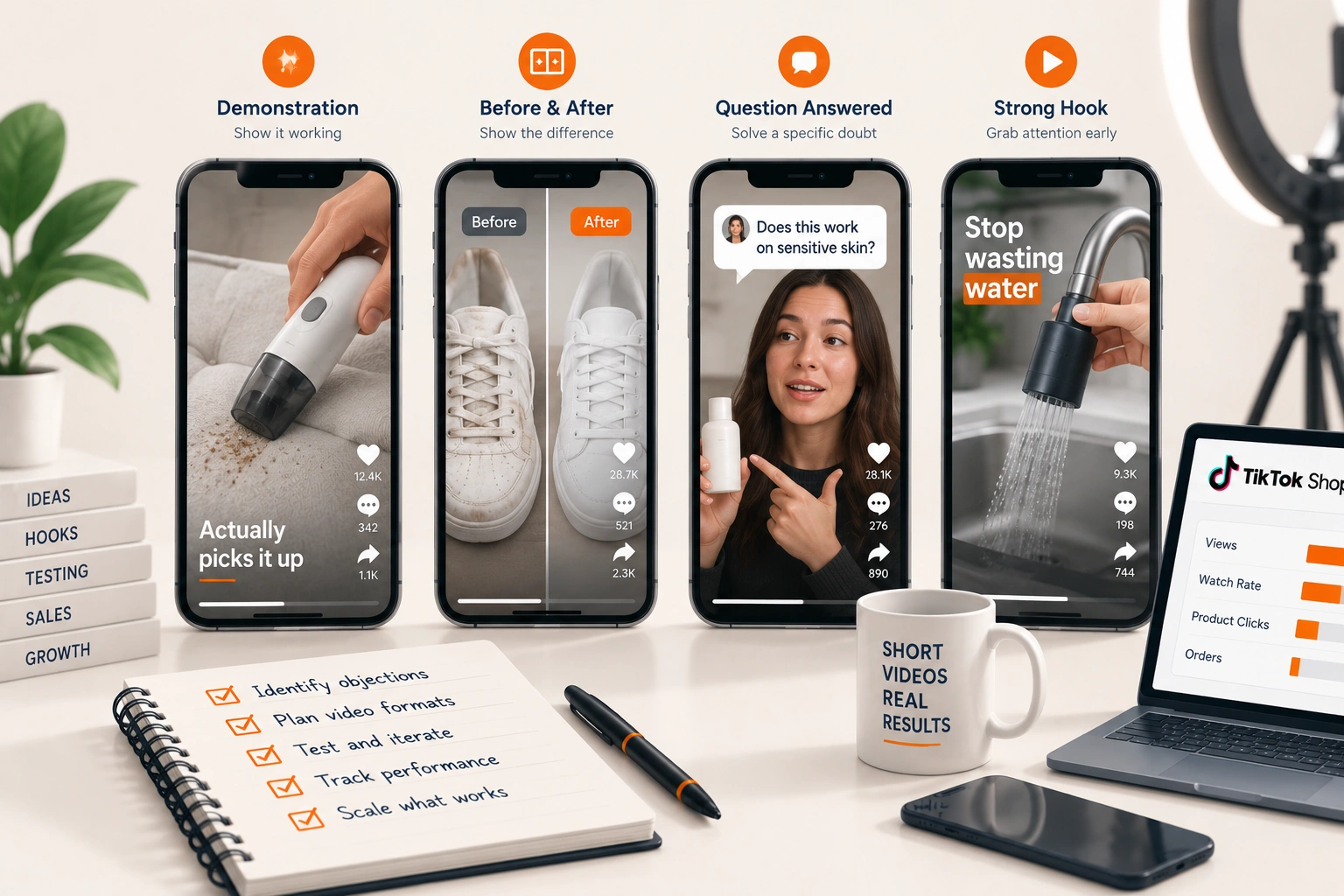
The useful way to think about a selling video is not as content with a product in it. It is an objection being answered in under a minute, and the format follows from which objection you picked.
That reframing does most of the work. A brand asking what to post produces a schedule of things and no reason for any of them. A brand asking what stops people buying this produces a list of videos with a job each.
The demonstration, for is it any good
The product doing the thing it exists to do, shot close, with no explanation over the top. It works because it substitutes for holding it, and it works best where the product has a visible behaviour: something that cleans, folds, pours, fits, absorbs or transforms.
The failure mode is showing the product rather than the behaviour. A slow pan over a bottle demonstrates nothing. The camera should be on whatever the product does to something else.
It also requires having the product, which sounds obvious until you consider the model most new sellers arrive with. A seller who never handles what they sell cannot make this video, and that constraint is one of the real limits discussed in what actually works when dropshipping on the platform.
The before and after, for will it work for me
Structurally the strongest format on the platform and the one with the most risk attached, because a before and after is a claim. In regulated adjacent categories it is where sellers get into trouble, and the constraint is the content policy rather than the format.
Where it is allowed, the rule is that the before has to be honest. Audiences on this platform are unusually good at spotting a staged before, and the response is not indifference, it is hostility in the comments, which is worse than the video not working.
The question answered, for I am not sure about one thing
Somebody asks a specific question, the video answers it, thirty seconds. It is the cheapest format to produce and the most consistently underrated, because it looks unimpressive and converts the people closest to buying.
The questions come from where questions already are: the comments, the reviews and the messages. A brand with a support inbox already has a content calendar in it, and each answer is a video that only needs making once.
That is also why this format compounds. The objections are finite, and a library covering all of them keeps working long after a trend has passed.
The first two seconds decide the rest
Whatever the format, the opening is doing a job separate from the video. It has to stop a thumb, and it gets about two seconds to do it.
What works is starting inside the moment. The product already doing the thing, the problem already visible, the question already asked. What fails is everything that delays: a logo, a title card, a person introducing themselves, a sentence of context before the point. Each of those is a reason to scroll, and the audience takes it.
There is a measurable version of this. If a video holds a low share of viewers past the first few seconds, the problem is the opening, and no amount of improving what follows will help because almost nobody reached it. If it holds people and still does not sell, the opening worked and the body is answering the wrong thing. Those two failures look identical in a sales report and completely different in the retention curve, which is the argument for reading the curve.
The other thing the opening decides is who stays. A hook built on a broad, entertaining idea attracts people with no interest in the product, which produces views and no sales. A hook built on the problem the product solves attracts fewer people, all of whom have the problem. The second video looks worse on every vanity metric and is worth more.
Why polish works against you
The counterintuitive part, and the part most brands with an existing marketing function get wrong. A video that looks like an advertisement is processed as an advertisement, and the platform's audience scrolls past advertisements faster than anything else.
That is not an argument for low quality. Lighting, framing and audio all matter and bad ones lose people in the first second. It is an argument against production values that signal a budget: the studio set, the voiceover, the brand ident at the front. Somebody holding a product in a kitchen outperforms all of it, repeatedly, which is uncomfortable for anybody who has paid for the studio.
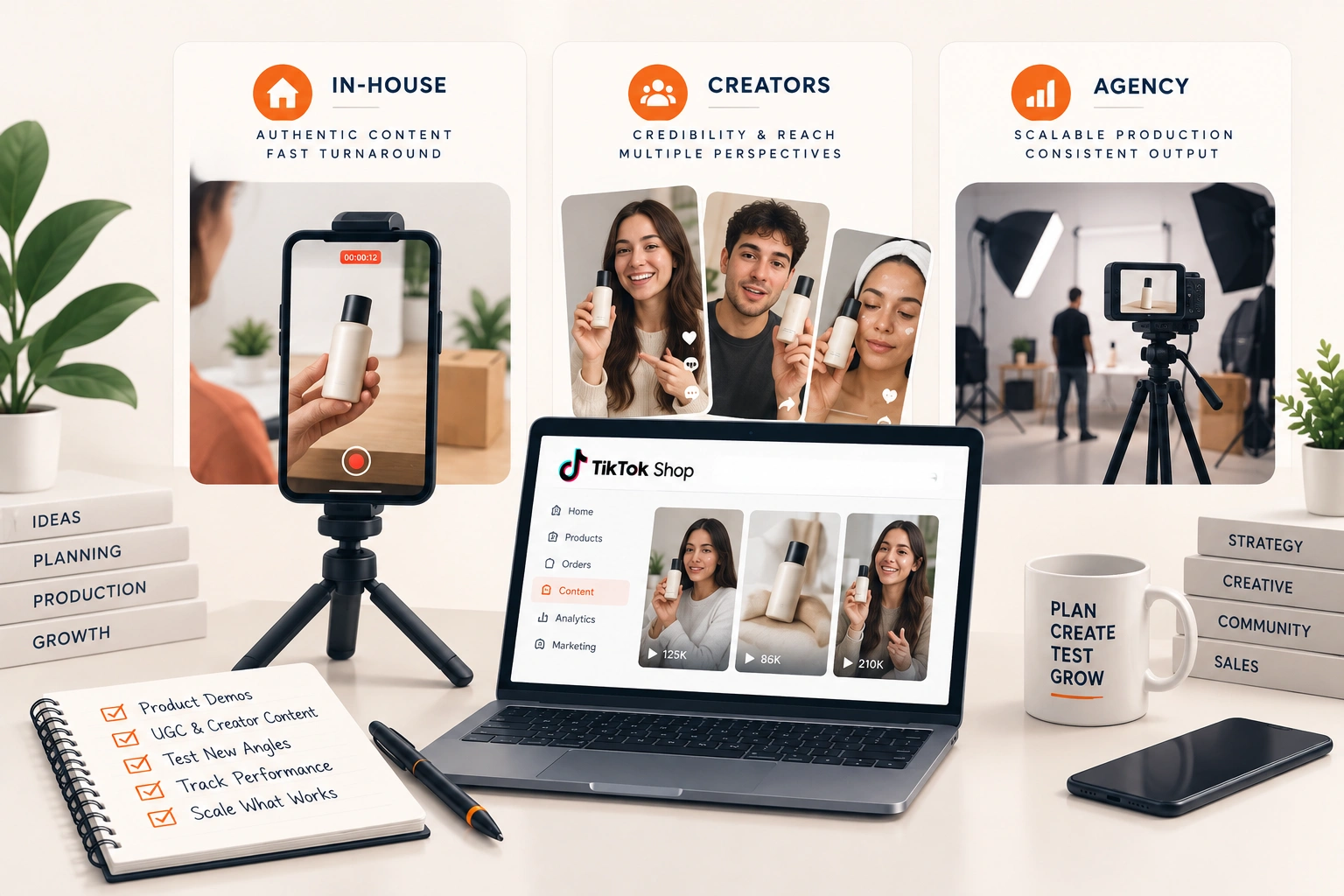
It is also why creator content generally outperforms brand content here, and why the decision about who produces it matters as much as what it contains. A brand that has only just got the shop open usually starts by filming it themselves, and that is the right answer for longer than most people expect.
Knowing what worked
Views are the least useful number available and the one everybody reports. A video with a hundred thousand views and no sales has entertained people who were never going to buy, which costs money to produce and returns nothing.
Watch through rate tells you whether the opening worked. Sales attributed to the video tell you whether the video worked. Those are different questions and a video can pass one and fail the other, which is the most common and most informative result: a strong hook pointed at the wrong objection.
Post enough to have a comparison. A brand posting twice a week is learning at a rate that makes any conclusion a guess, and the platform rewards volume anyway. Producing at that rate sustainably is the actual constraint, and it is the reason TikTok Shop management is a content operation before it is an advertising one.
One caution on the attributed number: judge it against what the channel should return rather than against zero. The standards that apply across marketplaces are the reference, and a video that produced sales at a cost above them has still lost money.
The channel these videos sit inside, and what it rewards beyond the video itself, is in how to sell on TikTok Shop.
Related reading: GMV Max, and What It Does With Your Budget.
Frequently asked questions
The questions that come up most often on this subject.
Ones that answer an objection. A demonstration answers whether the product is any good, a before and after answers whether it will work for the viewer, and a straight answer to a customer question converts the people closest to buying. The format follows from the objection rather than from a content calendar.
Lighting, framing and audio matter. Production values that signal a budget work against you: a video that looks like an advertisement is processed as one and scrolled past. Somebody holding a product in a kitchen repeatedly outperforms a studio set.
Often enough to have a comparison. Twice a week is learning at a rate that makes every conclusion a guess, and the platform rewards volume regardless. Sustainable production rate is the real constraint on most brands.
Not views. Watch through rate tells you the opening worked; attributed sales tell you the video worked. A video can pass the first and fail the second, which is the most informative result there is: a strong hook pointed at the wrong objection.