Trademark Office Action: What the USPTO’s Letter Means, the Three-Month Deadline and Brand Registry
An office action is not a rejection; it is a deadline. How to check the letter is real, which kind it is, how long there is to answer, the refusals online brands meet most, and what losing the application does to Brand Registry.


Loading Article banner
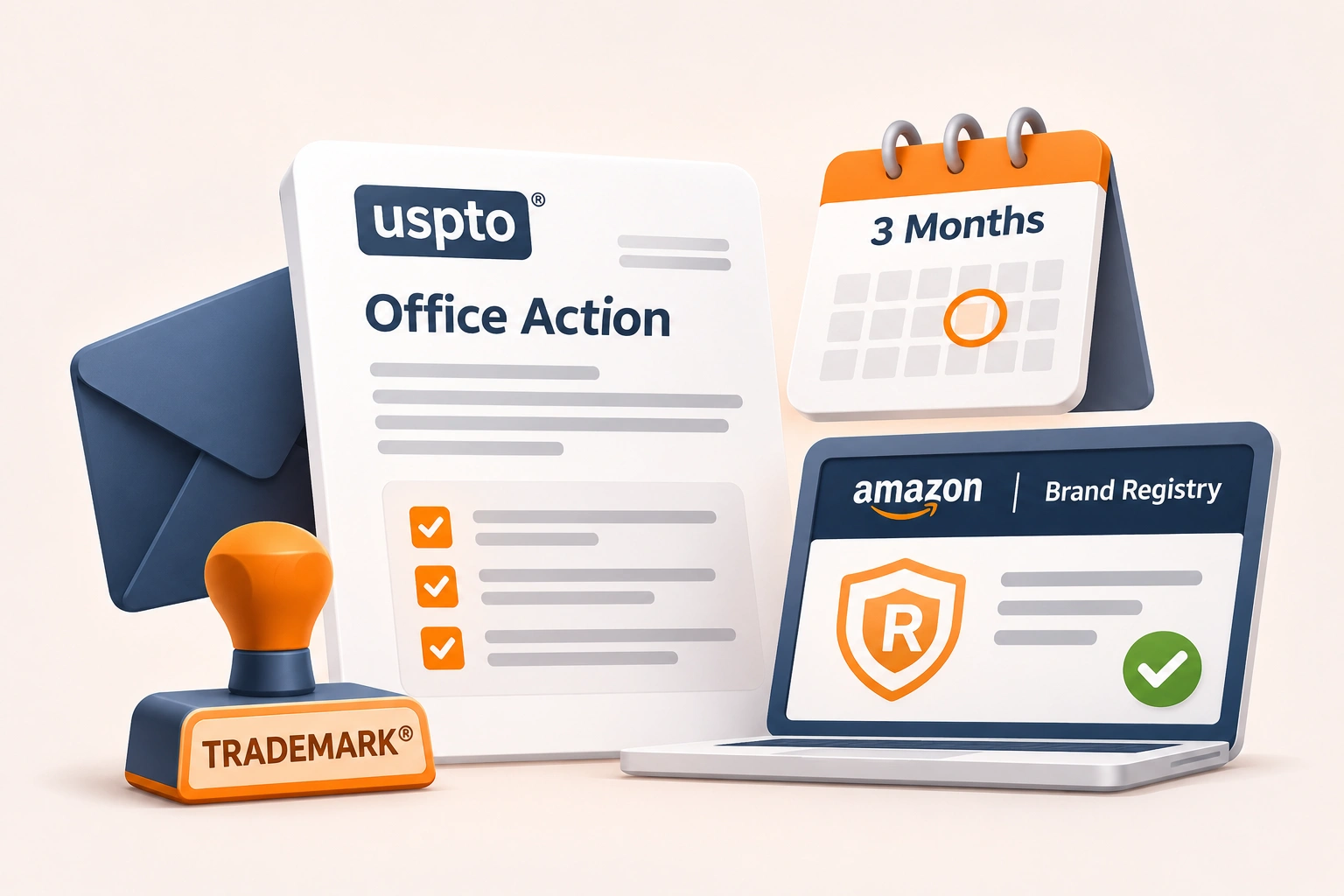
A founder files a trademark so the brand can join Amazon Brand Registry, and a few months later an email from the United States Patent and Trademark Office arrives with the words office action in it. The USPTO describes an office action as an official letter in which the examining attorney lists the legal problems that must be resolved before the mark can register. It is not a rejection. It is a deadline.
It arrives sooner than it used to: the USPTO said in May 2026 that first action pendency, the wait for the examining attorney’s first letter, fell from 5.6 months to 4.45 months in the first half of its 2026 fiscal year. What follows is how to check the letter, how long there is to answer, the refusals online brands meet most, and what losing the application does to Brand Registry. We prepare trademark filings; we are not a law firm, and a response that needs legal argument needs a licensed attorney.
First, check that it is real
Scams copy office actions because founders are expecting one. The USPTO’s warnings are short. Its emails come from a uspto.gov address. Its staff will never ask for personal or payment information by phone, email or text. And scammers “may create or forward a fake email chain that appears to come from a legitimate USPTO examining attorney”. The test that settles it is the USPTO’s own: “If it’s not in TSDR, it’s not an official communication.” Open the application in TSDR, the USPTO’s status and document system, by its serial number, and read the letter there.
Read the title: which letter it is
A nonfinal office action raises a problem for the first time. A final office action is, in the USPTO’s words, “your last opportunity to file a response during the application process”. An examiner’s amendment confirms in writing a change you agreed with the examining attorney by phone or email, and generally needs no response. A suspension letter pauses the application for something outside it, such as an ownership assignment or a foreign registration, and a response is optional. A notice of incomplete response says the last response was not signed by somebody with authority to sign it.
The examining attorney’s name and contact details are at the end of the letter. The USPTO warns that email to and from the office is uploaded to the application record and becomes public, and that its staff cannot give legal advice on how to respond.
The deadline, and what missing it costs
For an application filed directly with the USPTO, the response is due three months from the letter’s issue date, under 37 CFR 2.62. One extension of three months is available, up to six months from the issue date, if it is requested and paid for on or before the original deadline. An application that arrived through the Madrid Protocol has six months and no extension. The response is filed through the USPTO’s electronic system, since one sent by email or fax is given no date of receipt, and it is signed by the applicant, somebody with legal authority to bind it, or a qualified practitioner.
Miss the deadline, or file a response that does not answer everything, and the application is abandoned, with no refund of the fees. One narrower outcome is worth knowing: where a refusal is limited to certain goods, the application is abandoned only for those goods, so a response can drop the goods in trouble and keep the rest. An application abandoned through an unintentional delay can be revived by a petition filed within two months of the notice of abandonment, with the response attached and, for a three month deadline, the extension fee as well. Both the extension and the petition carry a fee of their own in the same schedule as the USPTO trademark filing fees paid at filing.
The refusals online brands meet most
The specimen. A use-based application has to show the mark as it is actually used, and the rules say an artist’s rendering, a computer illustration, a digital image “or similar mockup” is not a proper specimen. The examination manual’s May 2026 edition lists the signs that make an examining attorney suspect one: the mark appears to float over the product, there is pixelation around it, features of the item disappear near it, a label looks crudely applied to a plain box. One entry is written for online sellers: a marketplace page whose language, currency, price, first available date or ship-to destination shows the mark is not in use in US commerce.
A web page can serve as a specimen if it shows the goods, shows the mark with them and offers a way to order them, with its URL and the date it was accessed given. So the safest specimen is a photograph of the real product or its packaging bearing the mark, or a US listing page captured with its address and the date. A replacement specimen must have been in use by the filing date. A brand that filed before it was selling can instead change the basis to intent to use before the mark is published, which moves the proof of use to later.
Likelihood of confusion. The Trademark Act refuses a mark so close to a registered mark, or to one already used in the United States, that it is likely to cause confusion on the applicant’s goods. This refusal needs argument and evidence, sometimes a narrower list of goods or the other owner’s consent, and it is the one most worth taking to a licensed attorney. It matters on the marketplace too, where the other owner can complain to Amazon before the USPTO has decided anything.
Merely descriptive. A mark that merely describes the goods it is used on is refused as well. A name that says what the product is or does is the usual cause, and the search stage is the cheap place to find it.
The identification of goods. Wording the examining attorney finds indefinite, or goods in the wrong class, draws a requirement rather than a refusal, usually answered with wording from the USPTO’s ID Manual. Choosing both before filing is covered in which trademark class a product brand belongs in.
What an office action does to Brand Registry
On its own, nothing. Amazon’s Brand Registry page asks for “an active, registered trademark or a pending trademark application”, and an application waiting on a response is still pending. What enrolment gives a brand, and why the mark sits under all of it, is in how Brand Registry protects a listing.
Losing the application is the risk. Asked on the Seller Forums what happens to an enrolled brand whose application is abandoned, an Amazon community manager answered that the registry is connected to the trademark and “the brand will be marked inactive”, with the tools that come with it. That reply is about three years old and is a forum answer, not policy text, though nothing on Amazon’s public page says otherwise. The same team has warned that working with an attorney or agent who violates USPTO rules will prevent a brand from enrolling, and suggested checking whether the attorney is subject to a USPTO order for sanctions.
Representation matters for a second reason. The USPTO says only attorneys licensed in the United States and in good standing can represent an applicant, and that using somebody not authorized to practise before it could put the application and any registration at risk. An applicant whose domicile is outside the United States must be represented by such an attorney. Brands filing abroad through Madrid have their own deadlines, set out in the Madrid route for Amazon stores outside the US.
A response, in order
Check the letter in TSDR. Write the deadline down, three months from the issue date, and decide straight away whether the extension will be needed, because it has to be requested before the deadline passes. List every refusal and every requirement separately, because a response that answers only some of them is an incomplete response. Sort them into the ones the brand can satisfy itself, such as a specimen, a wording change or a disclaimer, and the ones that need legal argument. Decide whether any goods should be dropped rather than defended.
File through the USPTO’s system, then watch the record for the next letter. A final office action has its own deadline, and the answer to it is a request for reconsideration, an appeal to the Trademark Trial and Appeal Board, or both; a request for reconsideration does not extend the time to appeal.
Our trademark registration service prepares filings for marketplace brands and tracks every deadline through to the office’s decision, office actions included. Where a response needs legal argument or the applicant must be represented, it goes to independent counsel. If an office action has just arrived and the deadline is the first thing to pin down, send us the serial number.
Frequently asked questions
The questions that come up most often on this subject.
Three months from the issue date for an application filed directly with the USPTO. One extension of three more months is available, up to six months from the issue date, if you request it and pay the fee on or before the original deadline. An application that came through the Madrid Protocol has six months and no extension. Some letters set a different period, so the deadline printed in the office action is the one to work to.
The application is abandoned and the fees are not refunded. If the delay was unintentional, a petition to revive can be filed within two months of the notice of abandonment, with a signed statement that the delay was unintentional, the response to the office action and, for a three month deadline, the extension fee. If the notice of abandonment never arrived, the petition is due within two months of learning of it and no later than six months after the record shows the application abandoned.
Yes, as long as the application is still pending. Amazon’s Brand Registry page accepts an active registered trademark or a pending application, and an application waiting on a response is pending. The risk is abandonment: an Amazon community manager said on the Seller Forums that an enrolled brand whose trademark is abandoned is marked inactive, along with the tools that come with it.
Because the rules say a rendering, a computer illustration or a digitally created or altered image of the product is not proof of use. Examining attorneys look for a mark that floats over the product, pixelation around it, or a marketplace page showing the goods are not on sale in the US. The usual answer is a photograph of the real product or packaging, or a US listing page with its URL and access date. A substitute must have been in use by the filing date; if it was not, changing the basis to intent to use before publication may be the route.
Look the application up in TSDR, the USPTO’s status and document system, by its serial number. The USPTO says that if a letter is not in TSDR, it is not an official communication. Its emails come from a uspto.gov address, and its staff never ask for personal or payment details by phone, email or text. Scammers also forward fake email chains that look as though they came from an examining attorney, so check the record before replying to anyone.