USPTO Trademark Filing Fees: The $350 Base Application and the Surcharges That Add to It
Since January 2025 a USPTO trademark application costs $350 per class, and three surcharges can take one class past $900. What each surcharge is for, how to avoid all three, the fees that come after filing, and what it means for Amazon Brand Registry.


Loading Article banner
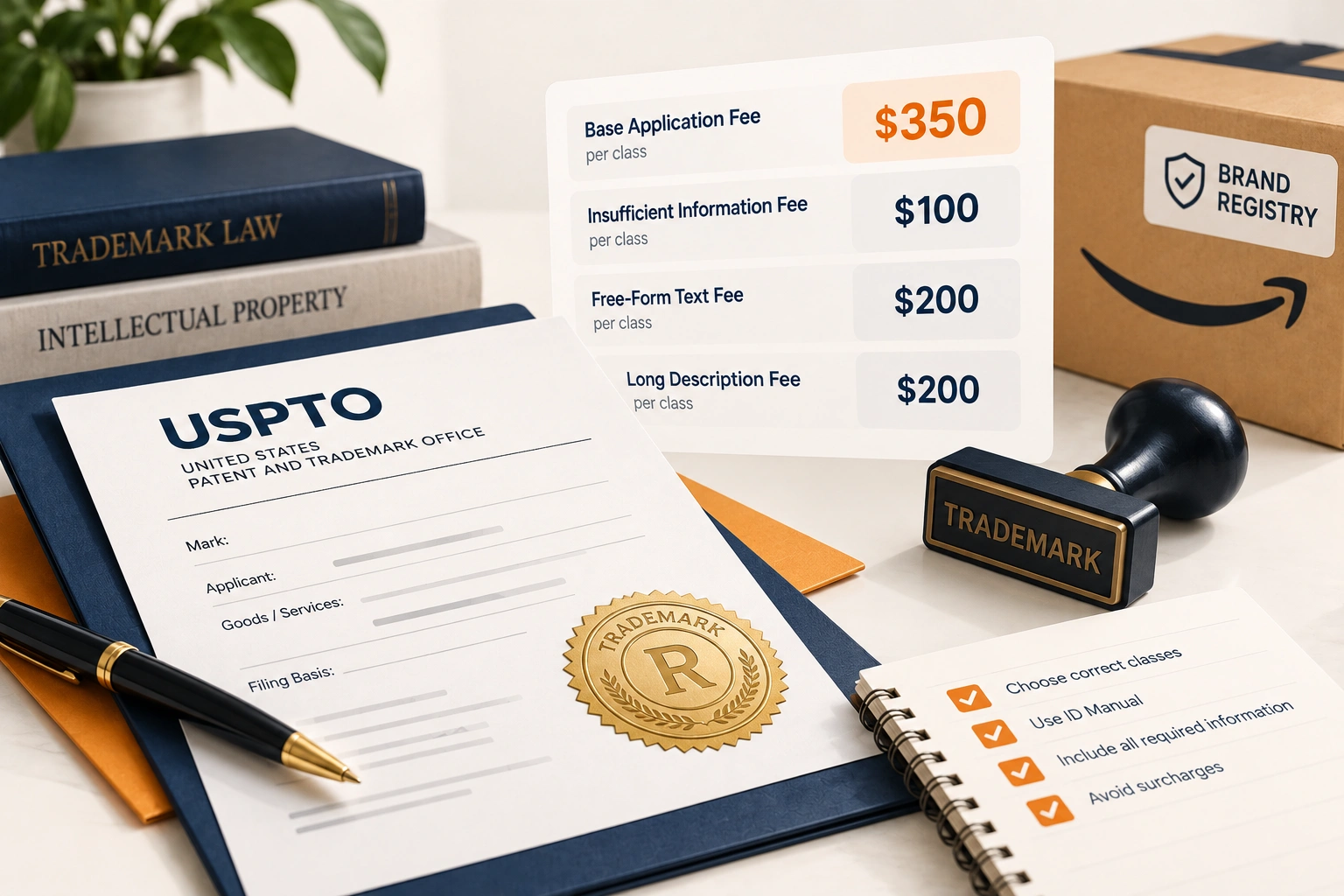
A brand that wants to join Amazon Brand Registry, stop copies of its name on social platforms or simply own what it has built usually starts with a US trademark application. What that application costs changed on 18 January 2025, and the change is easy to miss because the headline figure barely moved. The base fee is $350 per class. What moved is everything around it: three surcharges that can take the same one class application to $750, $850 or more.
Every one of those surcharges is decided by a choice made while filling in the form. This is what each one is, in the USPTO's own words, how to avoid all three, and what comes after filing.
What changed in January 2025
Until then there were two electronic filing options. TEAS Plus cost $250 per class and asked for everything up front; TEAS Standard cost $350 and asked for less. The USPTO's final rule, published on 18 November 2024 and in force from 18 January 2025, discontinued both and replaced them with one "base application" filed electronically, at $350 per class. A paper application went from $750 to $850 per class.
In the rule's words, the new fee is "$100 more than a TEAS Plus application, to help the agency recover its costs." The Federal Register's record of the USPTO's documents to the end of September 2026 carries no later change to these fees, so the figures below are the ones in force.
The three surcharges
The insufficient information fee is $100 per class. It applies when an application leaves out any of the information the rule lists as required for a base application. The list is the same one TEAS Plus used, so an application that would have qualified for TEAS Plus avoids it.
The free-form text fee is $200 per class. It applies when the goods and services are typed into the application's free-form box instead of being chosen from the USPTO's Acceptable Identification of Goods and Services Manual, the ID Manual. The rule is direct about the way out: "To avoid the surcharge, applicants may use the ID Manual within the electronic application, which includes thousands of identifications." Pasting ID Manual wording into the free-form box does not count, because the examining attorney cannot tell where the words came from and has to review them either way.
The long description fee is another $200 per class, "for each additional group of 1,000 characters beyond the first 1,000 characters in the free-form text box, including punctuation and spaces." It only arises in the free-form box. An identification chosen from the ID Manual does not incur it, however long it is.
What counts as insufficient information
The rule lists twenty requirements for a base application, and the $100 surcharge applies if any of the first nineteen is missing. Most are what any careful applicant supplies anyway: the applicant's name and domicile address, the legal entity, the citizenship or the state or country of incorporation, the basis for filing, a fee for each class, a verified statement signed by someone authorised to sign, and a drawing of the mark or the mark typed in standard characters.
The rest depend on the mark. A colour claim and a description of where the colour appears, if colour is part of the mark. An English translation of any non-English wording, and a transliteration of any non-Latin characters. The consent of a living person whose name or likeness is in the mark. A claim of ownership of earlier registrations of the same mark.
One requirement matters to a great many marketplace sellers: "An applicant whose domicile is not located within the United States or its territories must designate an attorney as the applicant's representative." A brand based outside the US needs a US attorney on the application, and leaving the attorney's details out is one of the gaps the surcharge charges for. Applications filed through the Madrid Protocol under section 66(a) are not subject to any of the three surcharges.
What one class can cost
Take one class of goods. Filed complete, with the goods chosen from the ID Manual, it costs $350. The same application with a custom description typed into the free-form box costs $550. If that description runs to 2,000 characters, it is $750. If the application also leaves out a required item, $850. Every fee is per class, so an application covering two classes doubles each figure.
None of those surcharges buys anything. They pay for the examiner's extra time. A description chosen carefully from the ID Manual protects the same goods without them, and it tends to reach examination with fewer questions, which is time as well as money.
The fees that come after filing
An application filed on an intent to use basis is not finished when it is filed. A statement of use, or an amendment to allege use, costs $150 per class electronically, and each six month extension of time to file the statement of use is $125 per class. After registration, the declaration of use under section 8 and the renewal each cost $325 per class electronically. A letter of protest against somebody else's application is $150 for each application protested.
Put those in the budget alongside the application. A brand that files on intent to use and needs two extensions before launch has spent $250 per class on extensions alone.
What it means for Amazon Brand Registry
Amazon does not wait for the registration. Its Brand Registry page says: "You must have an active, registered trademark or a pending trademark application for your brand name or logo," from the designated trademark office of a country with an Amazon store. The mark can be "a text-based mark (word mark) or an image-based mark with words, letters, or numbers (design mark)," and "Your trademark text must match the brand name on your Brand Registry application."
So a complete application, filed once, with the brand name exactly as it will appear on Amazon, is the fastest and cheapest route into Brand Registry as well as the cheapest filing. What the registry then protects is set out in Brand Registry and listing protection.
How we help
Our trademark registration service prepares the filing with the brand: the classes, the identifications from the ID Manual, and the information that keeps an application clear of the surcharges. We are not a law firm and do not give legal advice; where an attorney is required, including every applicant domiciled outside the US, the filing runs through independent counsel. The government's fees are the USPTO's and are paid to the USPTO. For what the rest of selling costs, see what it costs to sell on Amazon.
Frequently asked questions
The questions that come up most often on this subject.
An electronic base application is $350 per class of goods or services. Surcharges can add $100 per class for missing information, $200 per class for describing the goods in the free-form text box, and $200 per class for each further 1,000 characters of free-form description beyond the first 1,000.
It is a $100 per class fee on an application that leaves out any of the first nineteen items the USPTO lists as required for a base application, such as the applicant's domicile address, entity type, citizenship, basis for filing, verified statement, or a translation of non-English wording in the mark.
Choose the goods and services from the ID Manual inside the electronic application instead of typing them. Typing or pasting ID Manual wording into the free-form box still counts as free-form, because the examiner cannot tell where it came from.
Yes. Amazon's Brand Registry page accepts an active registered trademark or a pending application from the designated trademark office of a country with an Amazon store, and the trademark text must match the brand name on the Brand Registry application.
Yes. The USPTO's rule requires an applicant whose domicile is not in the United States or its territories to designate an attorney as its representative and include the attorney's name, postal address, email address and bar information in the application.