How to Close an Amazon Seller Account, and When to Downgrade Instead
Closing takes longer than opening did: ninety days after the last sale, a zero balance, every order and refund settled, every unit out of FBA. The prerequisites in Amazon's own words, the order to do them in, what closing gives up for good, and the two cases where a downgrade is the better answer.


Loading Article banner

The account was opened in an afternoon. Closing it takes a quarter, and the forum threads on the subject are written by sellers halfway through who have found that the button does nothing until a list of conditions is met, and that the list is not shown beside the button. The conditions exist to protect buyers who have not yet received their orders or asked for their refunds, and they are not negotiable.
This is the list in Amazon's own words, the order that gets through it fastest, what is given up when the account closes, and the two situations where the right move is to stop paying rather than to close.
The prerequisites, as Amazon states them
Amazon's forum staff set them out in reply to a seller who could not close: fulfil any outstanding orders; wait 90 days after your last sale to ensure the A-to-z Guarantee claims period has passed; wait until you have a zero balance in your account; resolve all of your transactions with buyers, including issuing any necessary refunds; confirm that your bank account information on file is up to date; and check your performance notifications to make sure that all the reasons for any suspension have been resolved. Then the Close Account option under account settings does what it says.
The ninety days is the one that decides the calendar. It runs from the last sale, not from the decision to close, so an account that keeps selling while the seller works through the list never reaches the end of it. The first act of closing is to stop selling.
The order to do it in
First, close every listing so no new orders arrive, and note the date, because the ninety days start at the last order that was placed. Second, fulfil what is open. Third, the FBA stock: create a removal order for every unit, to return it or to dispose of it, because inventory cannot sit in a fulfilment centre against a closed account and storage is charged for every day it does; sellers on the forum are blunt that the charges continue as long as the stock is there. Removal orders take weeks at busy times, so this goes in early.
Fourth, the money. Refund what is owed, wait for the disbursement cycle to run, and let the balance reach zero, which can take a payment cycle after the last fee lands; a negative balance from a late fee or a removal charge has to be paid before the account is closed, and a positive one has to be paid out. Fifth, the notifications: any open performance notification is resolved, because Amazon will not close an account that is mid dispute with it. Sixth, on day ninety one, the close request. The reconciliation of what Amazon still owes the account, which the reimbursements article covers, is done before step four, because a claim cannot be filed on a closed account.
What closing gives up
The account and its history: the feedback, the seller rating, the sales history that qualifies the account for programmes, and the Brand Registry roles attached to it, which have to be transferred to another account first if the brand is to keep them. The listings the account created stay in the catalogue as products, but the offers close, and the reviews stay with the products rather than the seller. A seller who thinks they may return in a year loses more by closing than by pausing, and Amazon's rules on a second account make returning under a new one a risk in its own right.
And it does not remove the seller's obligations already incurred: a buyer's claim inside the ninety days is still honoured, a tax document is still issued, and a policy violation on the record is still on the record. The account health that the account health article describes does not reset by closing and reopening.
When to downgrade instead
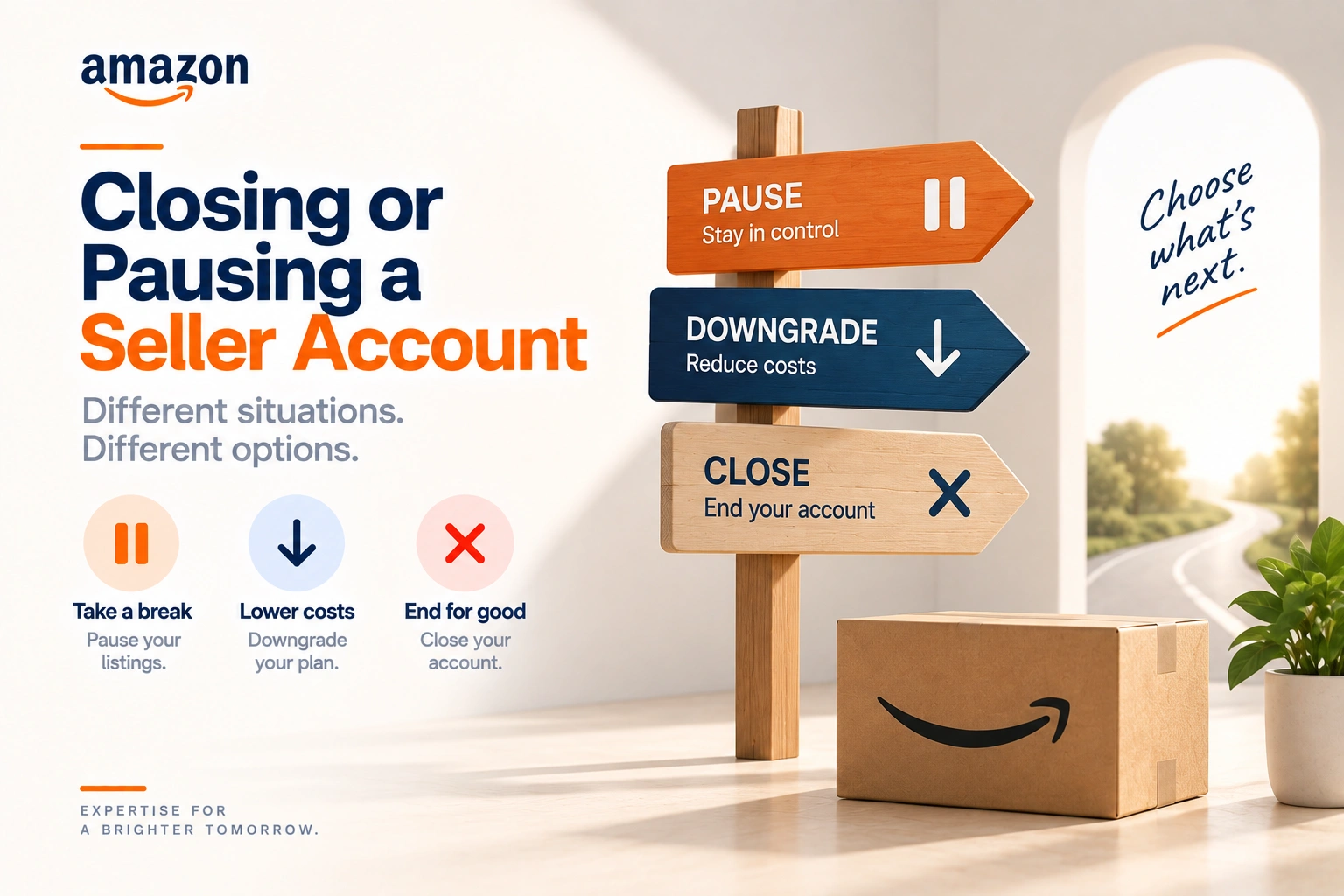
The professional plan has a monthly fee and the individual plan has a per item fee and no monthly one. A seller who is stopping for a season, testing whether to continue, or waiting out the ninety days, downgrades to individual and sets the account to vacation: the listings are inactive, the subscription stops, the history is kept, and the account can be turned back on in an afternoon. Sellers on the forum give the same advice to almost everybody who asks how to close, and for most of them it is the right advice.
The two cases where closing is right: the business is ending and the account holder does not want the liability of an open account in their name, or the account is being replaced by a new entity's account with Amazon's knowledge and the old one has to go so the two do not coexist. Everything else is a downgrade. For the brands we run under Amazon marketplace management, the question of whether to keep an account open is a question of what the account's history is worth, and the fee it costs to keep, set out in what it costs to sell on Amazon, is almost always less than the answer.
Frequently asked questions
The questions that come up most often on this subject.
Meet the prerequisites Amazon states: fulfil outstanding orders, wait 90 days after the last sale for the A-to-z claims period, reach a zero balance, resolve every transaction and refund, confirm your bank details, and resolve every performance notification. Then use Close Account under account settings.
Because one of the prerequisites is not met: a sale inside the last 90 days, a balance that is not zero, an open order or refund, stock still in FBA, or an unresolved performance notification. The 90 days run from the last sale, so listings have to be closed first.
It has to leave first, through a removal order to return it or dispose of it. Storage is charged for every day it stays, and the account cannot close with stock in a fulfilment centre.
Downgrade to the individual plan and set vacation mode unless the business is ending or the account is being replaced. Downgrading stops the monthly fee and keeps the history, feedback and Brand Registry roles; closing gives them up for good.
Not the same one. Opening another account after closing raises Amazon's rules on multiple accounts and needs Amazon's agreement, and the history of the closed account does not carry over. That is the main reason a downgrade is usually the better choice.