What TikTok Shop Will Not Let You Sell
The restricted list is longer than most sellers expect and wider than the obvious categories. Finding out after buying stock is the expensive way.


Loading Article banner
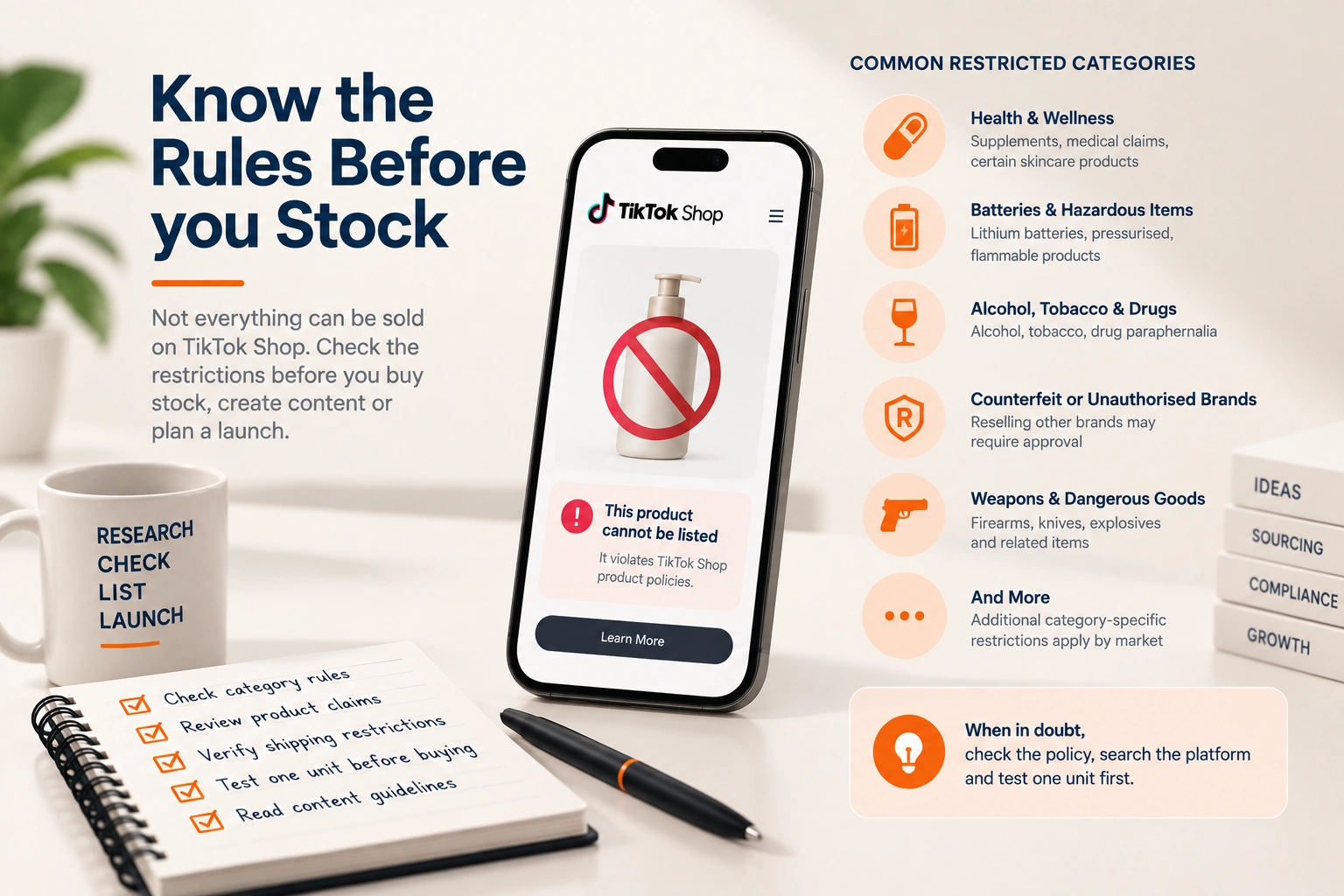
Every marketplace restricts what may be sold on it, and the lists are broadly similar: weapons, drugs, counterfeits, anything regulated. What makes TikTok Shop worth checking specifically is that the restrictions extend further than the obvious categories, and they are enforced through a review process that stops a listing rather than warning about it.
The cost of finding out late is the whole point. A seller who has bought stock, produced the video content and built a launch around a product that cannot be listed has spent everything except the sale.
Wider than the obvious categories
The predictable prohibitions apply and need no explanation. What catches sellers is the second tier, where the product itself is legal and ordinary and the platform still will not carry it, or will only carry it with approval.
Anything making a health claim is the largest of these. Supplements, skincare with active ingredients, anything described as treating or preventing something: the product may be perfectly legal and the claim is what is being restricted, which means the same product can be listable with different copy.
Anything with a battery, anything pressurised, and anything flammable sits in a shipping restricted band that varies by market and is the second commonest surprise.
And anything where the brand is not yours. Reselling somebody else's brand is possible in some categories and requires authorisation in others, which is a documentation exercise rather than a policy question. The equivalent rules elsewhere are in what reselling actually allows.
Why a compliant product still gets rejected
Three reasons, and none of them is about the product.
The words. Automated review reads the title, the description and the images together, and a phrase implying a restricted claim will stop a listing whose product is fine. Sellers rewriting a listing three times to find the offending phrase is a common and avoidable afternoon.
The category chosen. A product listed under the wrong category inherits that category's rules, and the rejection names the rule rather than the mistake, which sends people looking in the wrong place.
The images. Anything in shot that is itself restricted will stop a listing even when the product is not, and lifestyle photography is where this happens.
How to check before buying stock
Read the platform's own policy for the specific market, because these differ by country and a product that lists in one may not in another. That is the only authoritative source and it is worth the twenty minutes.
Then look for the product on the platform. If nobody comparable is selling it, that is a signal worth taking seriously: an absence in a category with obvious demand usually means a restriction rather than an opportunity.
Then list one unit before committing to a purchase order. The review process is the only thing that can definitively answer the question, and it costs nothing to ask it early. Doing that before the stock is ordered rather than after is the whole of the advice here.
One more check that is worth the time on anything borderline: look at what happens to the product in the markets you are not selling in yet. A category restricted in one country is frequently restricted in the next, and a brand planning to expand has just learned something about the second market for free.
The gap between allowed and worth selling
Passing review is a low bar and it is easy to treat it as a decision. A product can be perfectly listable and still be a poor thing to build a shop around, and the restrictions are a hint about which.
Anything sitting near a restricted boundary carries permanent operational cost. The listing needs careful wording, the content needs briefing, every new variant goes through review again, and a policy change can remove the product from sale with no notice. That is a real cost and it never appears in a margin calculation.
Categories with heavy approval requirements also tend to be the ones where enforcement tightens rather than loosens, because that is the direction platforms move. A product that needed approval last year and needs documentation this year will probably need more next year.
None of which means avoiding those categories, and some of them are the most profitable places to be precisely because the barrier keeps competitors out. It means pricing the overhead in deliberately rather than discovering it, and knowing that the first rejection is a signal about the next three years rather than an obstacle to get past this week.
What to do with a rejection
Read what was actually cited rather than what you assume it means. A rejection naming a category rule is often a category problem rather than a product one, and re-listing under the correct category resolves it without changing anything.
Change one thing at a time and resubmit, for the same reason it applies everywhere: three changes at once and a pass tells you nothing about which mattered, which is useless the next time.
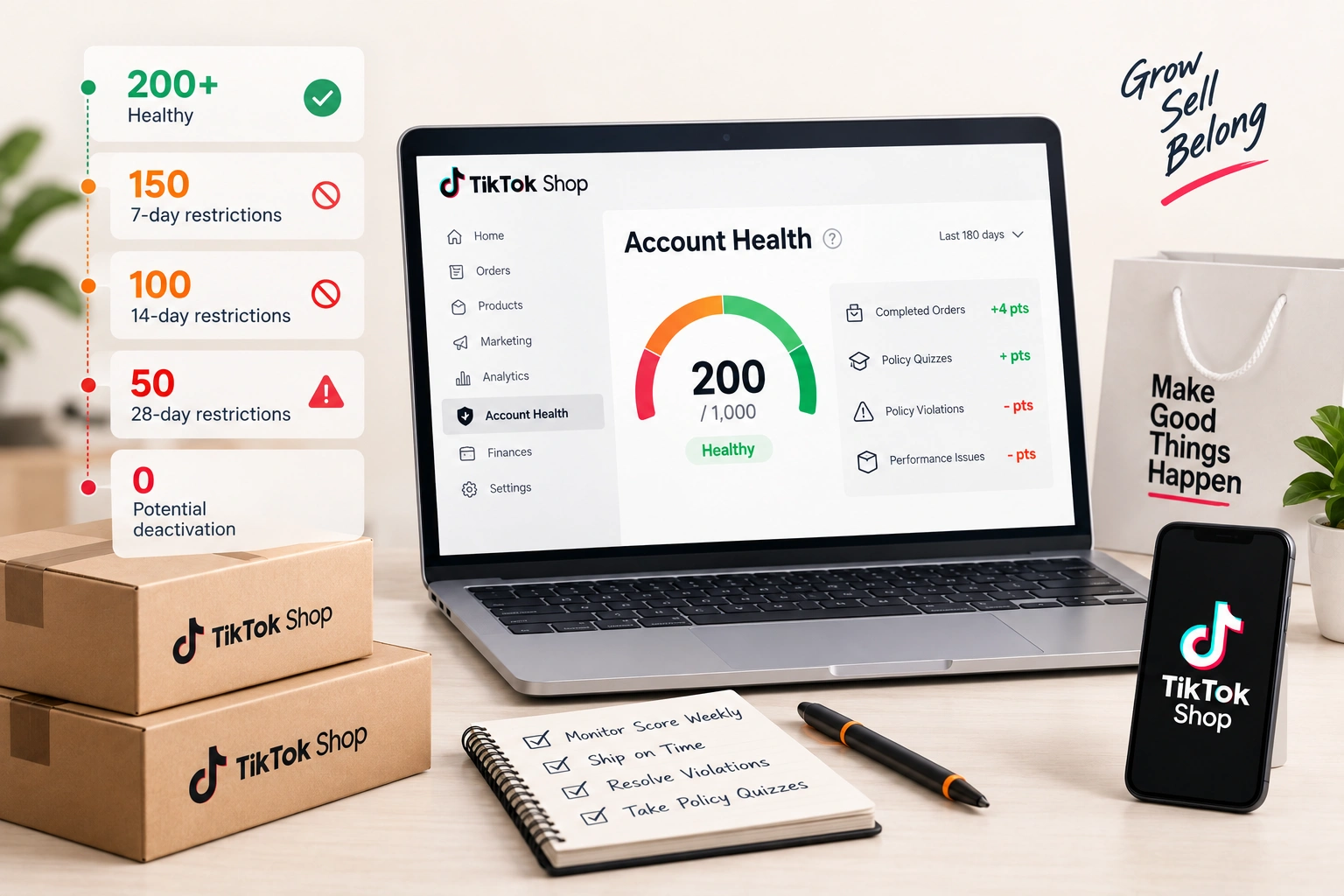
And treat repeated rejections as an account signal rather than a listing problem. Accumulating them is not free, and the pattern is what draws attention rather than any single one. The same logic that governs account health on other platforms applies here: what account health actually measures is a useful frame even though the platform differs. Running that process properly is part of TikTok Shop management rather than something to improvise per listing.
The rule that catches sellers who are already compliant
A product can be listable and its content not be. The listing passes review, the shop is open, and then a video promoting it is restricted or the account is limited for what was said in it.
That is the distinction worth holding: the listing rules govern what may be sold, and the content rules govern what may be claimed about it while selling. They are enforced separately and a seller can be entirely within one and outside the other.
It bites hardest in exactly the categories where the money is. Supplements, skincare and anything wellness adjacent can be sold and cannot be described the way the seller wants to describe them, and the video is where the temptation to overstate lives, because the video is what has to persuade in forty seconds.
The practical consequence is that anybody producing content for a restricted-adjacent product should read the content policy rather than only the listing policy, and should assume that a creator briefed loosely will say something the brand would not have written. A brief that names what cannot be claimed is worth more than one that names what should be. The same discipline governs everything published about a product, which what a description actually says covers from the catalogue side.
Where this goes next
A product that is allowed still has to be sold, and how to sell on TikTok Shop is the rest of the setup. A seller who sources without stock meets a second set of rules, which what works in TikTok dropshipping and what gets you suspended sets out.
Frequently asked questions
The questions that come up most often on this subject.
The predictable prohibitions apply, and the list extends further than most sellers expect: anything making a health claim, anything with a battery or pressurised or flammable, and anything where you do not own the brand and hold no authorisation. The lists also differ by market.
Usually the words rather than the product. Automated review reads the title, description and images together, and a phrase implying a restricted claim stops a listing whose product is fine. The other two causes are the wrong category, which inherits that category's rules, and something restricted appearing in a lifestyle image.
Read the platform policy for that specific market, look for comparable products already selling, and then list a single unit before committing to a purchase order. The review process is the only definitive answer and it costs nothing to ask it early.
Accumulating them is not free, and the pattern draws attention rather than any single rejection. Change one thing at a time and resubmit, so that a pass tells you which change mattered.