TikTok Shop Account Health Rating: How the Score Works, and How Not to Lose Your Shop
Since 29 June 2026 TikTok Shop scores every US seller from 0 to 1,000 and acts at 150, 100, 50 and zero. Most shops that were deactivated this quarter never opened the page. Here is the arithmetic, the four milestones, and the weekly routine that keeps the number up.


Loading Article banner
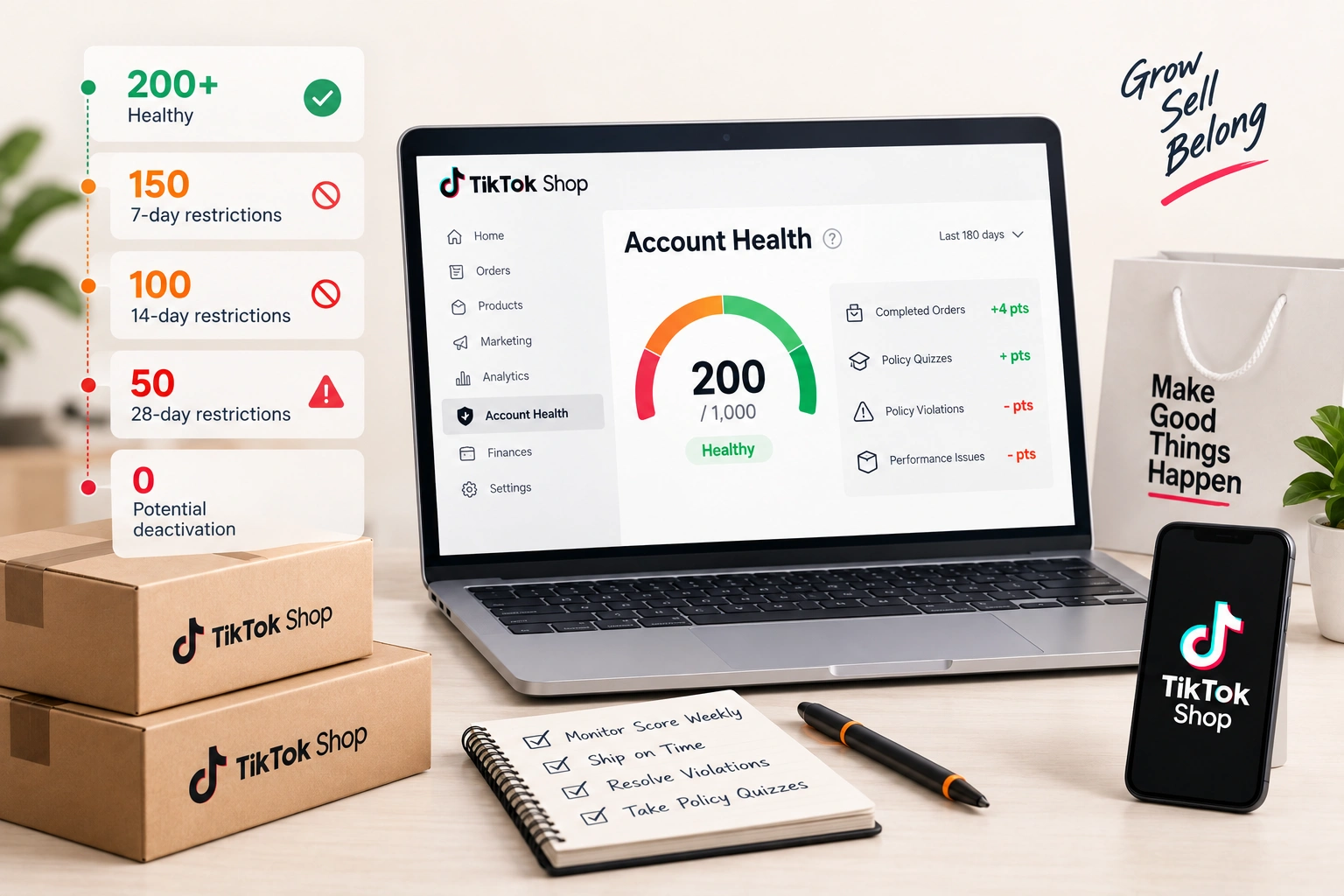
On 29 June 2026 TikTok Shop replaced its Violation Points system with the Account Health Rating, a single number from 0 to 1,000 that every US seller now carries. The old system counted strikes. The new one is a balance: you start at 200, you earn points by shipping orders and passing policy quizzes, and you lose them for violations and missed performance standards. Enforcement happens at fixed marks on the way down.
The reason it matters this quarter is that the score is quiet. Nothing interrupts a seller who is drifting from 200 toward 150; the first restriction lands when the number crosses the line, and the forum posts from August and September are almost all the same story: a shop deactivated "out of nowhere" by a seller who had never opened the Account Health page. This article is that page, explained, with the arithmetic TikTok publishes and the routine that keeps the number where it should be.
The score, and what you start with
Every seller begins at 200 points, which TikTok calls the base. From there the rating moves with what the shop does over a rolling 180-day window: points earned and points lost both expire 180 days after the date they were earned or lost, so the score is always a picture of the last six months and nothing older.
TikTok colour-codes it. Green is 200 and above, which it calls healthy. Orange runs from 51 to 199, which it calls at risk. Red is 0 to 50, where deactivation is the next step. A new shop is at the bottom of green on its first day, one violation from orange, which is the part new sellers do not expect.
If you have read a version of this with a 90-day window, four tiers and 16 points a week, that is TikTok's policy for Indonesia, the Philippines, Singapore, Thailand and Vietnam. The US page says 180 days, three colours and 20 points a week, and it is the US page that governs a US shop.
How points are earned
Two ways, and only two. Completed orders earn 4 points for every 200 orders completed in the last 180 days, capped at 20 points a week. Policy quizzes earn a variable number of points, and the quizzes are tied to violations: after a breach, TikTok offers the quiz that covers the policy you broke.
The order arithmetic is worth doing once. Twenty points a week is the ceiling, and it takes a thousand completed orders in the window to reach it. A shop doing fifty orders a week earns about one point a week from orders. That is the whole of the upward pressure for most sellers, which is why the score behaves like a savings account with a small deposit and occasional large withdrawals: you cannot earn your way out of a bad month quickly, so the work is in not having the bad month.
How points are lost
Points come off for policy breaches and for performance failures, and the deduction scales with the severity of the violation and how often you commit it. TikTok's page does not publish a fixed table for the US market, so treat any list of exact deductions you see elsewhere as somebody's reading of individual cases rather than the rule. What the page does say is the principle: a repeat of the same violation costs more than the first, and the serious categories (prohibited products and category rules, intellectual property, misleading claims, fulfilment failures) cost the most.
The performance side is easy to forget because it is not a rule you break on purpose. Late dispatch, cancellations you initiated, and returns and disputes decided against you all count as performance failures, and a bad fulfilment week during a campaign spike can take more points than a listing mistake; it is one of the reasons Fulfilled by TikTok is worth the stock commitment for a shop that cannot guarantee its own dispatch times. The shops that fall furthest in the forum threads are usually the ones that had a good month of sales and a bad month of shipping right after it.
The four milestones, and what each one does
TikTok acts at four marks on the way down, and the actions are published. At 150 points the shop is restricted for 7 days from creating new listings and from enrolling in mega campaigns. At 100 points the same two restrictions run for 14 days. At 50 points they run for 28 days. At 0 points the shop may be permanently deactivated, and reactivation is at TikTok's discretion.
The pattern matters more than the numbers. Every milestone before zero takes away the two things that grow a shop, new listings and campaign entry, for a fixed spell, and each spell is twice the last. A shop at 100 in the run-up to the holiday campaigns has just been locked out of them for two weeks. That is the cost that the score is designed to make you feel before the last one, which is the shop itself.
For each milestone there is a quiz. Passing the milestone quiz reduces the duration of the restriction; it does not cancel it, and it does not restore the points. Take it on the day the restriction lands, because every day it shortens is a day of listings and campaigns back.
Appeals, and what an appeal can and cannot do
A violation can be appealed through its ticket, and TikTok's enforcement policy says that a successful appeal or correction removes the enforcement actions for that violation and restores any privileges withdrawn. The Southeast Asia page adds that restored means the deducted points come back; the US requirements page points to the enforcement policy for the route and gives no deadline, so treat every ticket as urgent and appeal within days, not weeks.
An appeal is a claim that the violation was wrong, with evidence: the listing as it was, the invoice for the product, the tracking that shows the dispatch date, the customer message that shows the claim was answered. An appeal that says the penalty is unfair is not an appeal. And a correction is not an appeal either: fixing the listing removes the cause, and TikTok says a correction can lift the action, but it is a separate step from disputing the finding, and a seller who has done one has not necessarily done the other.
The weekly routine that keeps the number up
Open the Account Health page every Monday and write the number down. That single habit is the difference between the sellers in the forum threads and the ones who are not in them: a score you have watched drop from 200 to 170 over three weeks is a problem you can act on, and a score you first see at 50 is a shop you are about to lose.
Read every violation ticket the week it arrives, decide in that week whether it is a correction or an appeal, and do it. Take the policy quiz TikTok offers after a breach, because it is the one way to earn points that does not depend on order volume. Watch dispatch time and cancellation rate as performance, not as customer service, because the score counts them as breaches. And before enrolling a campaign, check the number: a shop sitting at 160 with a campaign inventory arriving is one late-shipping week from a 7-day lockout in the middle of the campaign it bought stock for.
Keep reading
None of this is complicated. It is the same discipline the Amazon account health page asks for, with a different scale and a shorter memory, and it is the first thing we put in place when we take on TikTok Shop management for a brand. The shops that keep it open are the ones that treat the number as a weekly figure rather than a warning they will hear about.
Related reading: How to Sell on TikTok Shop, and What Actually Moves Units.
Frequently asked questions
The questions that come up most often on this subject.
A score from 0 to 1,000 that TikTok Shop gives every US seller since 29 June 2026, replacing the old Violation Points. It starts at 200, rises with completed orders and passed policy quizzes, falls with violations and performance failures, and counts activity over the last 180 days. TikTok takes enforcement actions when it drops to 150, 100, 50 and 0.
A 7-day restriction on creating new listings and on enrolling in mega campaigns. At 100 the same restrictions run for 14 days, at 50 for 28 days, and at 0 the shop may be permanently deactivated. Passing the milestone quiz TikTok offers shortens the restriction; it does not remove it or restore the points.
Two ways: completed orders, at 4 points per 200 orders in the last 180 days and capped at 20 points a week, and policy quizzes, which earn a variable number of points and are offered after a violation. A successful appeal restores what a violation took. There is no faster route, so the score is protected by avoiding deductions more than by earning them back.
Yes. On the US policy both earned and lost points reset 180 days after the date they were earned or lost, so the rating is always a picture of the last six months. The 90-day figure that circulates is TikTok's rule for Indonesia, the Philippines, Singapore, Thailand and Vietnam, not for a US shop.
At 0 points TikTok says the shop may be permanently deactivated and that reactivation is at its discretion. The route is an appeal on the violations that took the score down, with evidence for each; the realistic position is that a shop should never reach zero, because every milestone before it was a warning with a fixed cost and a quiz to shorten it.