TikTok Shop Listing Removed: The Policy It Was Removed Under, the 30-Day Appeal, and What to Put in It
TikTok Shop rewrote its Product Listing Policy on 1 September 2026 and its Prohibited Products Policy on 29 September, and both list the same four things it can do to a listing. What gets a listing removed, the 30-day and 15-day appeals in TikTok's words, the documents it asks for, and the letter that gets read.


Loading Article banner
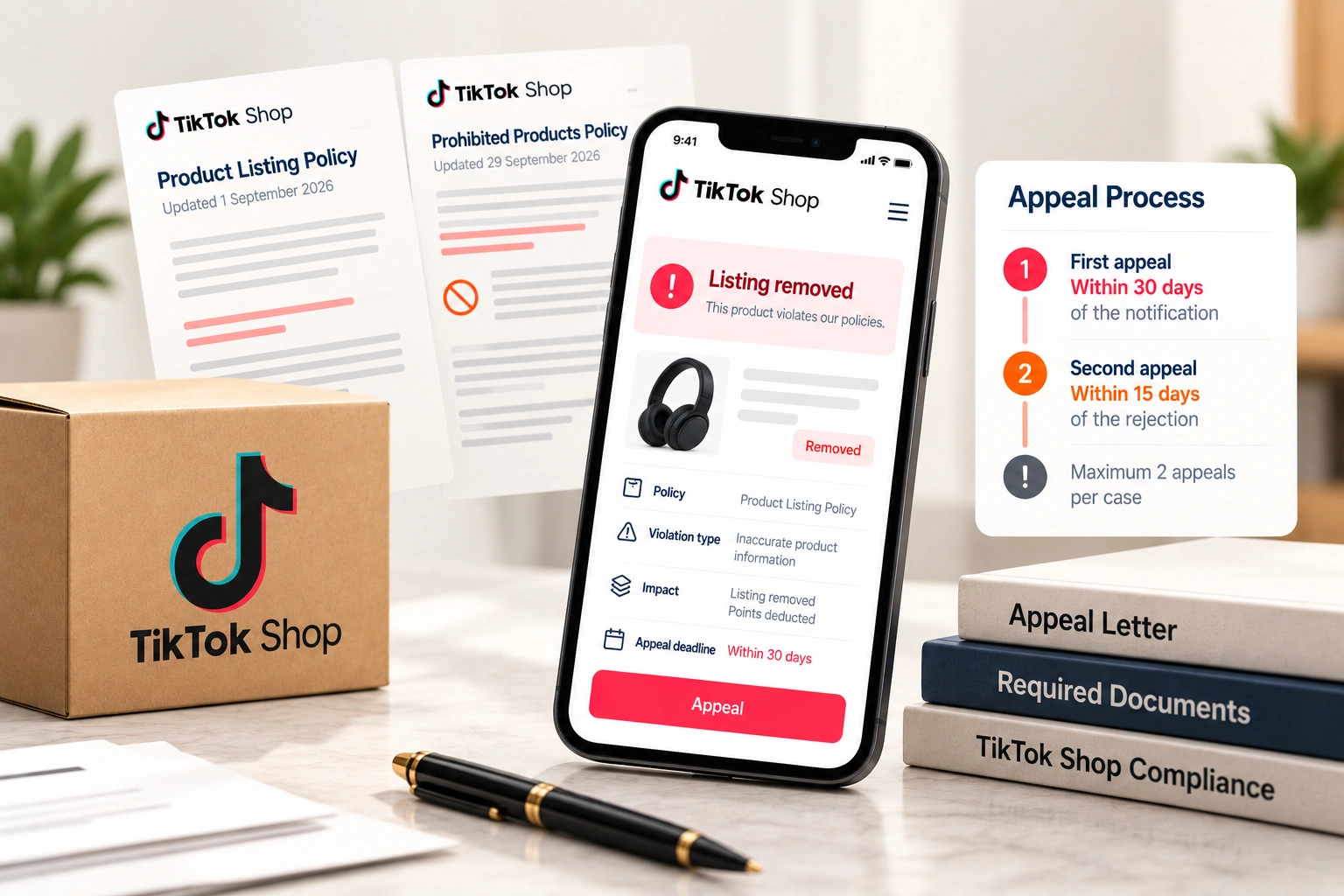
A removed listing on TikTok Shop arrives as a violation record: the product is gone from the shop, points may have come off the Account Health Rating, and a notification names a policy. The policies were both rewritten in September 2026, the Product Listing Policy on the 1st and the Prohibited Products Policy on the 29th, and the appeal process has fixed windows that a seller who waits for a human reply will miss.
This is what the two policies say a listing can be removed for, what TikTok can do to it, the appeal windows and document requirements in TikTok's own words, and what an appeal letter has to contain to be read as an appeal rather than as a complaint.
What a listing is removed for
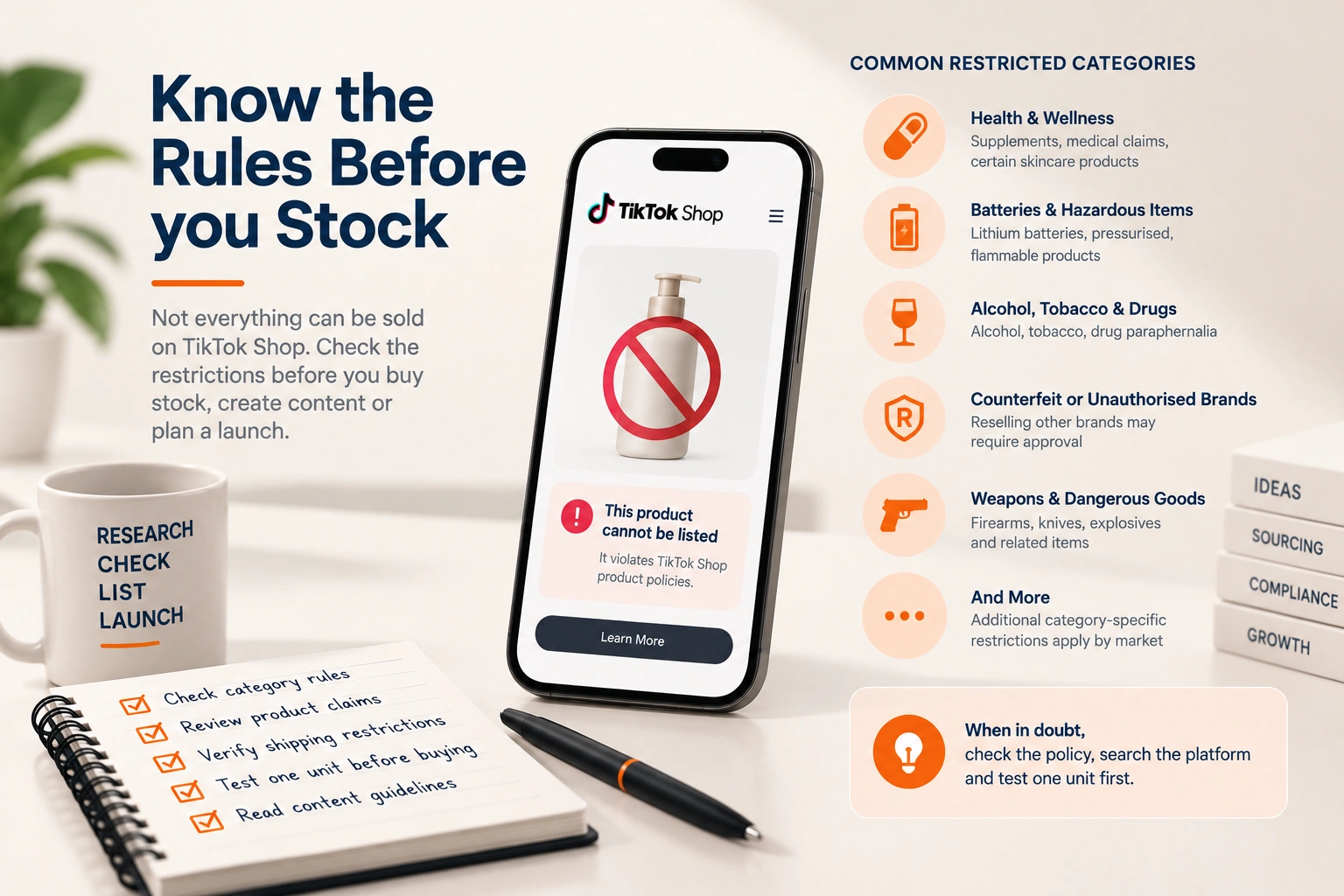
The Prohibited Products Policy's sentence on removal is about concealment: "TikTok Shop may remove listings that use disclaimers, altered spelling, incomplete images, misleading categories, or other methods to conceal that a product is prohibited under this policy." The list of prohibited categories is the subject of TikTok Shop's prohibited products and category rules; the removal sentence is about how a permitted-looking listing gets caught. An incomplete image set, an odd spelling or a category chosen to dodge a review is read as concealment whether or not it was meant as one.
The Product Listing Policy adds the accuracy side. Images must show what the customer will receive, with no placeholders or digital renderings, the main image a front view on a pure white background, and no added text or graphics on any image. A listing whose images do not match the product, or whose title and description make claims the product does not support, is removed under this policy rather than the prohibited one.
Both policies list the same four actions TikTok may take: deducting points from the Account Health Rating, removing product listings, revoking access to offer products for sale, and issuing refunds to customers. The prohibited products policy adds that enforcement is "at our sole discretion", weighed on the violation's severity, its impact, the seller's violation history and intent. History and intent are the two a seller can influence, and the appeal is where intent is shown.
The appeal windows, in TikTok's words
TikTok's Violation and Appeal Guide, updated on 29 May 2026, sets the clock. A first appeal must be filed within 30 days of the notification. If it is rejected, a second appeal can be filed within 15 days of the rejection. There is a maximum of two appeals per case. And for violations where enforcement is not yet immediate, the appeal window is 12 to 72 hours, which is the case that catches sellers who read the notice on Monday and plan to deal with it on Friday.
The route is in Seller Center: Account Health, then Violation Records, then View Details, then Appeal (TikTok's older guide names the same path as Shop Health, Violation Records, View and Appeal). The status shows as Under Review once filed. TikTok does not publish how long a decision takes.
The two outcomes are stated plainly. If the appeal succeeds, "TikTok Shop will remove any enforcement actions issued and restore any withdrawn privileges." If it fails, enforcement continues and, in TikTok's words, "All decisions made by TikTok Shop are at our sole discretion and are final once the appeal is concluded." Two appeals is the whole of the process, which is why the first one has to be the complete one.
What TikTok asks for
The guide's document list is specific, and it says documents must be "complete, original, and clearly legible". The business licence and the government identity document, photographed front and back. Proof of the warehouse: a lease, property documents or utility bills. Purchase contracts and invoices that match the business's registered details. A video of the account holder holding the identity document and the licence with their face clearly visible. Optionally, shipping records and videos of the warehouse or of qualifications.
Two sentences from the guide decide more appeals than the documents do. "Appeals submitted without a letter will not be processed." And incomplete or altered documents result in automatic rejection. An appeal that is a pile of attachments with no explanation is not read; an appeal with a cropped invoice is rejected by the system before a person sees it.
The letter that gets read
TikTok's own description of what an appeal contains is the outline: "a clear explanation of why they feel that the enforcement action was taken against them in error", with the supporting documents, images or videos, and anything else TikTok asked for. Written as four short parts, it is this.
Which policy, and which sentence. Name the violation record and the policy it cites, and say which specific rule the listing is alleged to have broken. A seller who cannot say which sentence applies has not understood the removal and cannot answer it.
Why it does not apply, or what has been fixed. If the product is not prohibited, say what it is and attach the evidence: the invoice naming it, the photograph of the real item, the certification where the category needs one. If the listing was inaccurate, say what was wrong, what has been changed and attach the corrected images and copy. Do not argue both at once.
What has changed so it will not recur. The category check added to listing creation, the image standard adopted, the person responsible. This is the intent factor TikTok names, answered directly.
The documents, complete and uncropped. Every item on TikTok's list that applies, originals, in a clear order, with the video of the account holder. The same preparation that Amazon's policy warnings require of an Amazon plan of action, which is no coincidence: a marketplace reads an appeal for evidence and for a changed process, on either platform.
What to do in the first hour
Read the violation record for the policy and the window, because a 72-hour window and a 30-day window call for different days. Do not relist the product under a new listing while the record is open; that is the altered-spelling and misleading-category behaviour the policy describes as concealment, and it converts a listing problem into an account problem. Check the Account Health Rating for the points taken, because how the rating works decides how much the next violation costs. Then assemble the documents before writing the letter, so the letter describes what is attached rather than promising it.
If the listing was removed for an image or content fault, the fix is on the listing before the appeal is filed, and the appeal says so. The listing standards are in how to sell on TikTok Shop; an appeal for a listing that still breaks the rule is a second violation waiting to be recorded.
How we work it
We read the record against the policy sentence, decide whether the case is not-prohibited or now-fixed, assemble TikTok's document list in full, fix the listing first where that is the answer, and write the letter in the four parts above, inside the first window so the second is still in hand. That is listing reinstatement as we do it on TikTok Shop, and the same shape on every marketplace. If a record landed in your Seller Center today, the window started today.
Frequently asked questions
The questions that come up most often on this subject.
Under TikTok Shop's Violation and Appeal Guide (updated 29 May 2026), a first appeal must be filed within 30 days of the notification, a second appeal within 15 days of a rejection, with a maximum of two appeals per case. Where enforcement is not yet immediate, the window is 12 to 72 hours.
In Seller Center: Account Health, then Violation Records, then View Details, then Appeal. TikTok's earlier guide names the same route as Shop Health, Violation Records, View and Appeal. The status shows as Under Review once filed.
TikTok's list: the business licence and government ID photographed front and back, proof of warehouse ownership (lease, property documents or utility bills), purchase contracts and invoices matching the business details, and a video of the account holder holding the ID and licence with their face clearly visible; shipping records and warehouse or qualification videos are optional. Documents must be complete, original and legible, and an appeal without a letter is not processed.
Under the Prohibited Products Policy of 29 September 2026, for using disclaimers, altered spelling, incomplete images, misleading categories or other methods that conceal a prohibited product; under the Product Listing Policy of 1 September 2026, for images or claims that do not match what the customer receives, including renderings, placeholders, text on images or a main image that is not a front view on white.
The enforcement stands. TikTok's guide allows a maximum of two appeals per case and says its decisions are at its sole discretion and final once the appeal is concluded. The listing can be fixed and the product relisted only where the policy allows it; relisting a removed product to get around a record is treated as concealment.