TikTok Shop Keyword Research: Where Keywords Go Under the July 2026 Listing Quality Guidelines
TikTok Shop's listing quality guidelines of 8 July 2026 cap a Good-tier title at 255 characters, ban a word repeated four times and forbid variant terms in the title. Where keywords actually go on a TikTok Shop listing, how to find the phrases shoppers use on TikTok, and what an Amazon keyword list gets wrong there.


Loading Article banner
Most brands write their TikTok Shop listings from the Amazon keyword list, and the result is a title that TikTok's own guidelines grade as Fair: too long, repeating the head term, naming every colour, and reading like a search string rather than a product. TikTok Shop has published what a Good-tier listing looks like, and keyword research for the platform starts from that document rather than from a tool export.
This is what TikTok's listing quality guidelines of 8 July 2026 say a title and a description may and may not carry, where that leaves the keywords, how to find the phrases shoppers use on TikTok rather than on Amazon, and the three habits from Amazon keyword work that have to be unlearned.
The title rules, from the guidelines
For the Good tier, TikTok's guidelines ask for a title of between 25 and 255 characters that is "concise, accurate, and free of unnecessary content". Three prohibitions do the work. No word or phrase repeated four or more times. No references to variants, colours, sizes or inventory counts. And no clickbait: terms such as best seller, discounts or buy now are named.
Read those against an Amazon-style title. The head term repeated in three forms is out. The list of colours is out; variants live in the variant fields. The urgency words are out. What remains is a title that says what the product is, what it is for and what distinguishes it, in the words a shopper would use, once each. TikTok's own example on the page is of that shape: a hand cream, for dry skin, with its ingredient claim and its size, and nothing else.
The description has its own floor: more than 80 characters or at least one image, relevant to the product and meaningful, with no broken links, clickbait or duplicated content. And the tier has a ceiling the title cannot lift. Without the category-specific information TikTok asks for (how to use, materials, specifications, sizing, model display images and the rest, varying by category), a listing is capped at Fair however good its title is.
So where do the keywords go
The primary phrase in the title, once. The thing the product is, as shoppers name it, followed by the one or two qualifiers that decide the purchase (for whom, what size, what material). A 255-character ceiling is generous; a title that uses all of it has usually broken the repetition rule on the way.
The questions in the description. The description is where the phrases that are really questions belong: how long it lasts, what it fits, whether it is safe for a given use. Written as sentences a shopper would read, which is also how an assistant reads them, as keyword research when shoppers ask instead of type describes for Amazon's assistant. The discipline transfers.
The attributes in the category fields. Material, size, scope of use, benefits: the category-specific information that decides the tier. On TikTok Shop these are structured fields, and a phrase that belongs in one of them is wasted in the title. Filling them is both the keyword placement and the tier requirement, which is the guideline's point.
The variant terms in the variants. Colour and size are variant data, named as such by the guidelines, and a title that carries them is penalised for it. The shopper who searches for the red one finds it through the variant, not the title.
Finding the phrases TikTok shoppers use
TikTok's pages do not say how Shop search ranks, and nothing here claims to know. What can be observed is what shoppers type and what TikTok suggests, and that is the research.
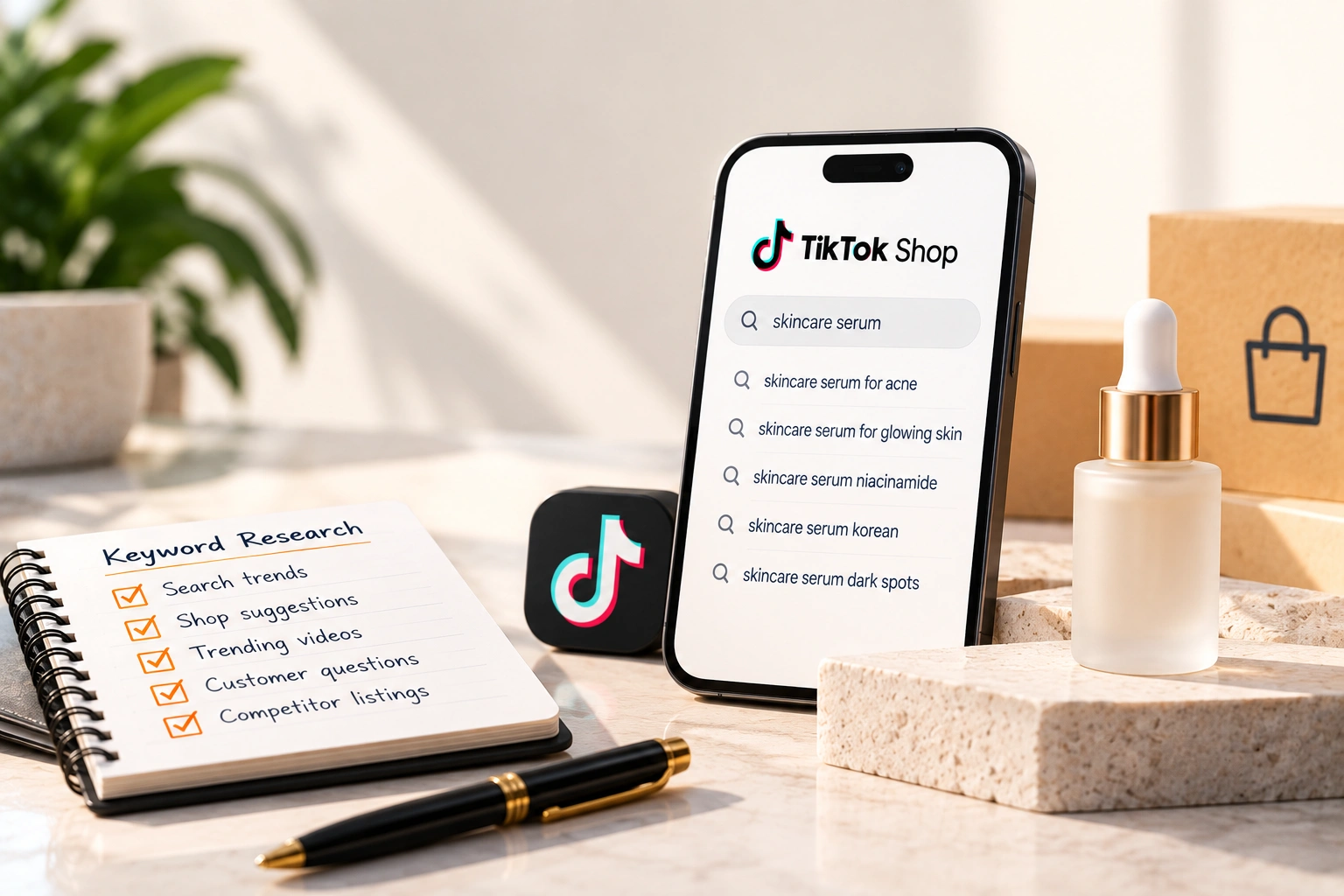
Type the product type into TikTok's search bar and read the suggestions and the Shop tab results, because those are completions of what people on that platform ask for, which differ from Amazon's. Read the captions and spoken lines of the videos selling the category, because on TikTok the phrase a buyer uses is usually the phrase a creator said first; the video formats that sell on TikTok Shop is where that language is made. Read the comments under those videos for the questions, which become the description. And read the competing listings in the Good tier, not for their keywords but for the structure that got them there.
Then check each phrase against the guideline before it goes anywhere: not a repetition, not a variant, not clickbait, true of the product. A phrase that fails the check is not a keyword; it is a point off the tier.
Three Amazon habits to unlearn
Stuffing the title. On Amazon the instinct, now constrained by the 75-character rule, was to front-load every term. On TikTok the repetition rule and the variant rule make the stuffed title a Fair listing by definition.
Writing for the index, not the shopper. A TikTok Shop listing is read by a shopper who arrived from a video and is deciding in seconds. The title confirms they are in the right place; the description answers the question the video raised. Copy that reads like a search string does neither, and setting up TikTok Shop as a brand covers how the listing and the content work together.
Generating copy without checking it. TikTok permits AI for copywriting and script support provided the content stays accurate, and its listing policy holds the seller to accuracy. A generated title that invents a benefit or a specification is a policy problem before it is a keyword problem. How to sell on TikTok Shop is the wider context for what the platform enforces and why.
How we do it
We build a TikTok Shop keyword set from TikTok's own surfaces, map each phrase to the field the guidelines put it in (title, description, attribute or variant), check every one against the repetition, variant and clickbait rules, and fill the category fields that lift the tier. That is the keyword research we do for brands on TikTok Shop, and it is different work from the Amazon list because the platform grades it differently. If your TikTok listings were built from the Amazon titles, the tier is telling you so, and it is a short job to fix.
Frequently asked questions
The questions that come up most often on this subject.
TikTok Shop's listing quality guidelines, dated 8 July 2026, give the Good tier a title of between 25 and 255 characters that is concise, accurate and free of unnecessary content, with no word or phrase repeated four or more times, no references to variants, colours, sizes or stock counts, and no clickbait terms.
The primary phrase goes in the title once, with the qualifiers that decide the purchase. Question-type phrases go in the description as sentences. Material, size, scope and benefits go in the category-specific attribute fields, which also decide whether a listing can reach the Good tier. Colour and size go in the variants, not the title.
As a starting list, with care. Amazon-style titles that repeat the head term and list variants break TikTok's repetition and variant rules and grade as Fair. The phrases TikTok shoppers use are found on TikTok: in the search suggestions, the Shop tab, the captions of selling videos and the comments under them.
For the Good tier the guidelines ask for a description of more than 80 characters or at least one image, relevant to the product and meaningful, with no broken hyperlinks, clickbait or duplicate content.
Often because the category-specific information is missing. TikTok's guidelines say a listing without the required category details (how to use, materials, specifications, sizing, model display images and so on, varying by category) is capped at Fair regardless of its title, description or images.