Amazon Renewed's Fee Cut, and the Standards That Keep You Selling
From 16 October 2026, Renewed products in eligible categories get a reduced referral fee for a year, automatically. What Amazon has said and not said about it, the guarantee and the condition standards every Renewed sale carries, how Amazon checks them, and how to spend a fee saving without betting the channel on it.


Loading Article banner
From 16 October 2026, Amazon is cutting the referral fee on Renewed products in eligible categories, automatically, for a year. For a refurbisher already approved, that is margin returned without lifting a finger. For one deciding whether to apply, it changes the arithmetic. Neither should read it without the other half of the programme: the promise every Renewed sale carries, and the checks that take Renewed selling away from sellers who break it.
This is what Amazon has said about the fee and what it has not, the guarantee and condition standards a Renewed seller backs, and how Amazon checks them. Who qualifies for Renewed and what approval asks covers getting in; this is about staying in.
The fee cut, in Amazon's words
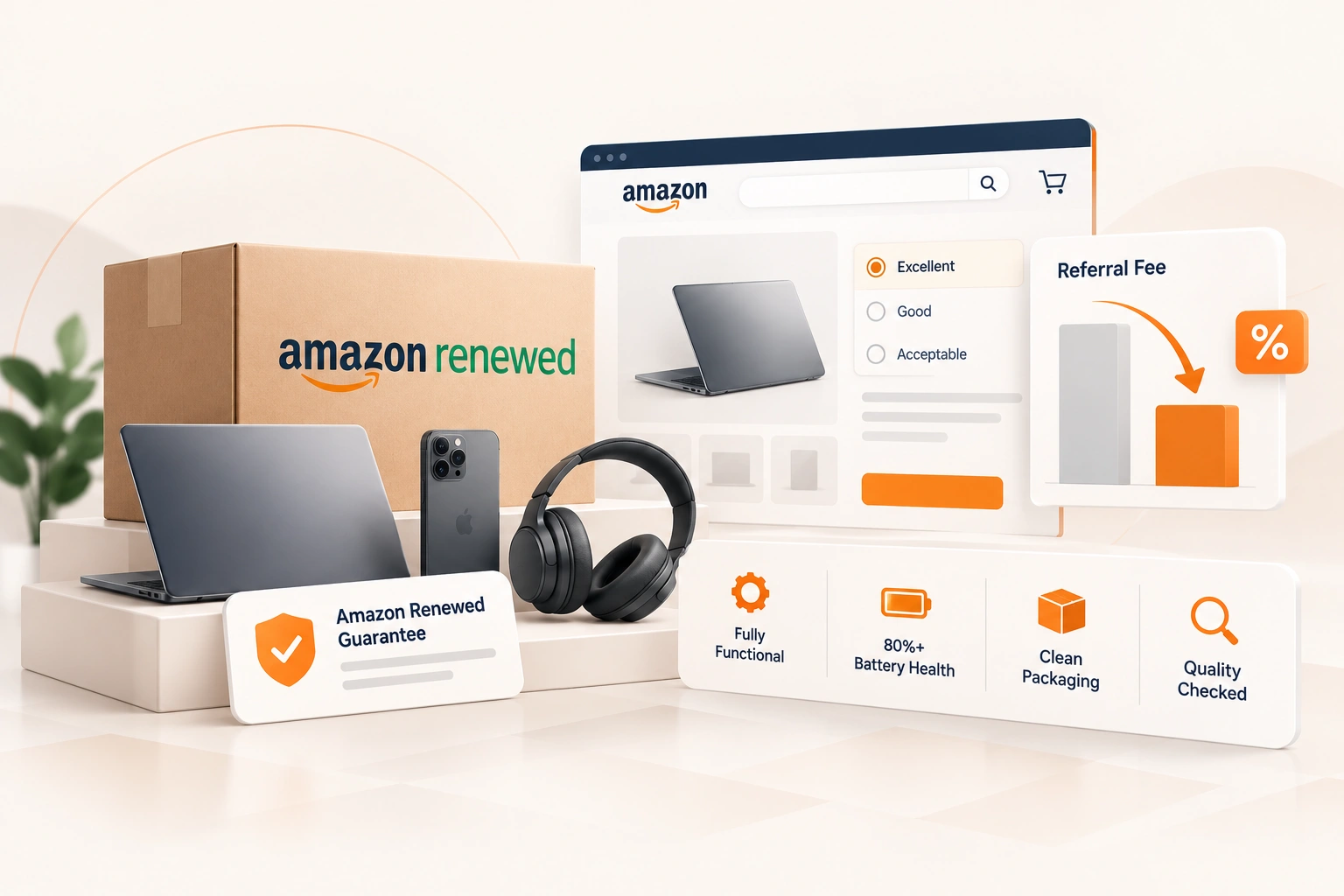
Amazon's Renewed page says that, for a limited time, "Renewed products in eligible categories receive a reduced referral fee", with "no action required", and that "The promotional rate applies automatically for one year, starting October 16, 2026."
What the page does not give is the rate, or which categories are eligible. Both are on a Seller Central help page linked from the announcement, which needs a sign in. Read it there before modelling a price, and check the fees on a live order rather than assuming the promotion has reached every product. How Amazon's seller fees are built shows where the referral fee sits in the total.
Two features matter for planning. It needs no enrolment, so there is nothing to apply for and nothing to miss. And it ends a year after it starts, unless Amazon extends it. A price cut made because the fee fell is a price that has to hold when the fee comes back, so model the business at both rates.
The promise you back
Every Renewed sale carries the Amazon Renewed Guarantee. Amazon's store page tells the shopper: "If the product does not look or work as expected, you are eligible for a replacement or refund within 90 days of receipt with the Amazon Renewed guarantee." Its seller page says where the cost lands: the seller "is responsible for all claims under the guarantee."
The same store page tells the shopper what to expect, and each line is a standard the unit has to meet. The product is restored to its original factory settings. Accessories "may not be original, but will be compatible and fully functional." Packaging is original or "a new and clean cardboard box". And "When present, batteries have a capacity that exceeds 80% of the original battery life."
Condition is graded at arm's length. Premium or Excellent means "no signs of cosmetic damage when held 12 inches away"; Good means "Light scratches, barely visible when holding the device 12 inches away"; Acceptable means "Scratches visible when holding the device 12 inches away and perceptible to the touch." For the application, Amazon's seller page asks for images that demonstrate the items meet the requirements for Excellent condition, and says mockups and digitally altered images are not accepted.
How Amazon checks
Amazon's seller page is direct: "We frequently assess product quality through test buys and customer feedback." Sellers follow their standing in the Renewed Seller Dashboard, and "Failure to meet quality requirements may lead to the deactivation of Renewed selling privileges."
A test buy is a real order opened by somebody whose job is to find what is wrong. A battery at 78%, a charger that is compatible on paper and not in practice, a scratch visible at 12 inches on a unit sold as Excellent: each is a broken promise, found before a customer finds it. Customer feedback finds the rest, and every guarantee claim is paid for twice, once in the refund or replacement and again in the inspection before the unit can be sold again.
Losing Renewed privileges is narrower than losing the account, but it ends the channel a refurbishing business was built on, and the appeal starts where any appeal does: what failed, why, and what has changed. What Amazon's policy warnings mean is the place to read the early signs.
Grading to the 12 inch standard
Amazon's grades are written as a test a person can repeat, which is the point: the shopper who opens the box will repeat it. A grading bench that matches it holds the unit at that distance under the same light every time, by one trained person or by people who check each other, and photographs every unit before it is packed.
Two rules keep the grade honest. A unit between two grades goes down, never up, because a Good unit sold as Excellent is a guarantee claim waiting to happen and a test buy failure if Amazon opens it first. And the battery figure is measured, not assumed: a reading per unit, recorded against its serial number, so a unit that left above the line can be shown to have done so.
The guarantee as a cost line
A 90 day promise is a cost that arrives after the sale, so it belongs in the price before it. The line is simple to build: the share of units that come back under the guarantee, multiplied by what each one costs, which is the refund or the replacement unit, the return shipping, the inspection, the repair if there is one, and the lower price the unit fetches when it is sold again.
Read by product, that line usually shows where the money goes. A model with a weak battery or a fragile screen carries a claim rate that a better margin elsewhere cannot hide, and the honest answers are a stricter intake, a different supplier or dropping the model. A fee saving is worth most where it lets a seller do one of those without raising the price.
The rules that do not change
Listings are created with the Certified Refurbished ASIN Creation tool. Warranties stay out of the copy: "Don't mention warranties in your title, descriptions, or bullet points." And the price floor still applies: Renewed products must be listed "at a 5% or more discount than their new product counterpart". That floor moves with the new product's price, and from 16 October it has to be read alongside a lower fee.
What the fee cut changes in the numbers
For an approved seller, the reduced fee is margin to spend on what protects the channel: inspection. A longer battery test, a second cosmetic check under good light, an accessory matched to the model rather than merely compatible with it. Spent on quality, a fee saving lowers guarantee claims and test buy failures. Spent entirely on price, it starts a race with other Renewed sellers that ends when the promotion does, with every one of them on a thinner margin.
For a refurbisher deciding whether to apply, a year of lower fees is a reason to look again, not a reason to apply in a hurry. The invoice threshold and the quality requirements have not changed, and a Renewed business that only works at the promotional rate does not work. The rules for selling used items outside Renewed are the comparison to make first.
How we approach it
We run Amazon Renewed for refurbishers as a quality operation first and a sales channel second: grading written to Amazon's 12 inch standard, battery and accessory checks recorded unit by unit, listings that promise only what the unit is, and the Renewed Seller Dashboard read every week. The fee cut goes into the model for its year, and the business is built to work without it.
Frequently asked questions
The questions that come up most often on this subject.
From 16 October 2026, Renewed products in eligible categories receive a reduced referral fee automatically, for one year, with no action required, according to Amazon's Renewed page. The rate and the eligible categories are on a Seller Central help page linked from that page, which needs a sign in.
No. Amazon says the promotional rate applies automatically and that no action is required. Check the fees on a live order to confirm it has reached your products.
90 days from receipt. Amazon tells shoppers that if a Renewed product does not look or work as expected, they are eligible for a replacement or refund within 90 days, and its seller page says the seller is responsible for all claims under the guarantee.
Amazon's Renewed store page tells shoppers that, when present, batteries have a capacity exceeding 80% of the original battery life. A unit below that breaks the promise the listing makes, and is the kind of fault a test buy finds.
Yes. Amazon assesses product quality through test buys and customer feedback, and its seller page says failure to meet quality requirements may lead to the deactivation of Renewed selling privileges. The Renewed Seller Dashboard is where performance is followed.