Selling to Business Buyers on Amazon: What a Consumer Brand Has to Add
Amazon Business puts the same catalogue in front of organisations that buy differently: in quantity, against a quote, tax exempt, through an approval. What Amazon gives a seller for it, how the bulk order fee discount works, the new business-only deals, and when the work is worth building or handing to a partner.


Loading Article banner
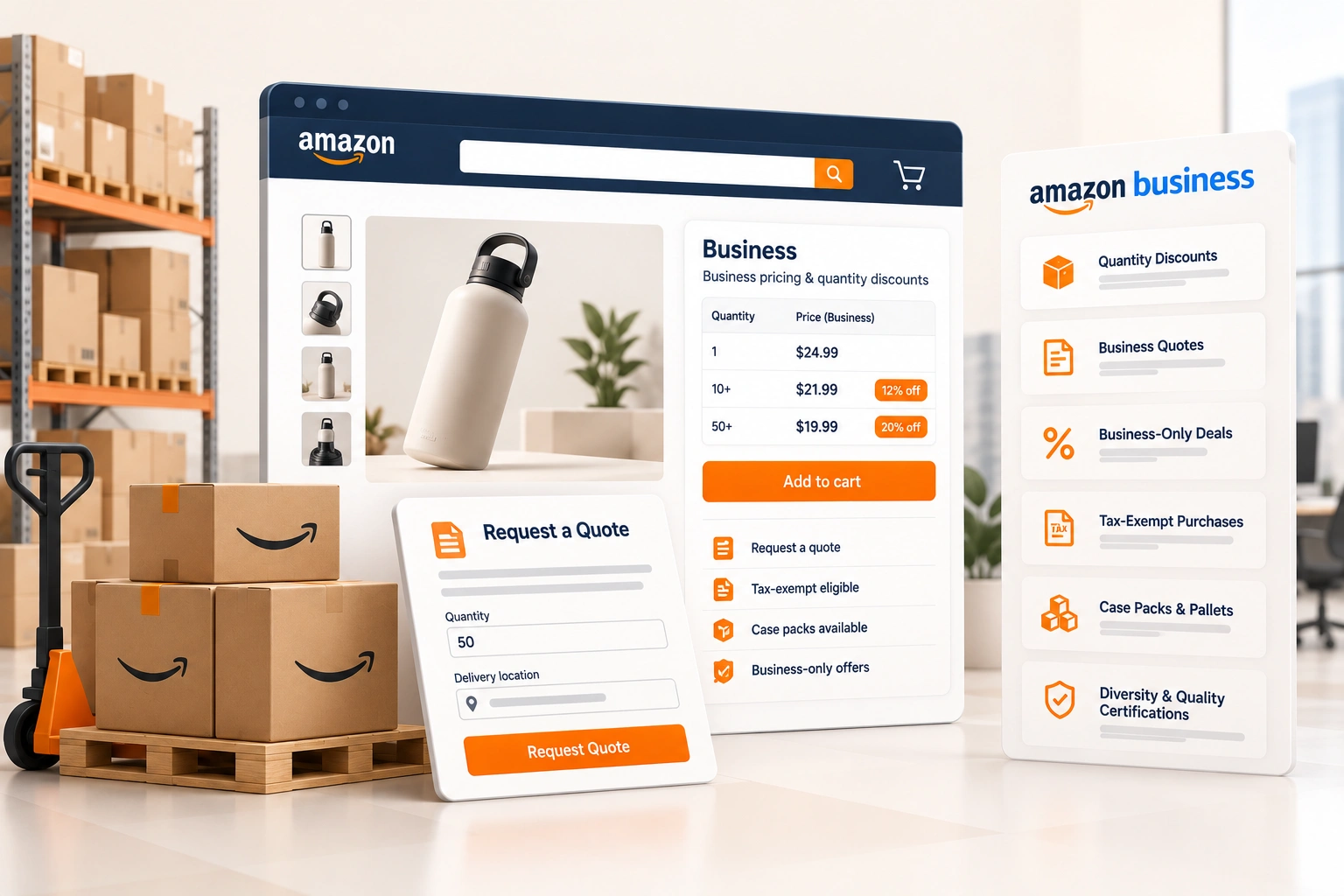
A brand that sells to consumers on Amazon is usually selling to businesses already. Offices, schools, clinics, hotels and contractors buy through Amazon Business from the same listings shoppers see. What they do not see, unless the brand sets it up, is anything written for them: a business price, a discount for buying ten, a case of twelve, an answer to a request for a quote.
Amazon describes Amazon Business as "a suite of features and tools that can help you connect with business-to-business (B2B) customers", and its seller page puts those customers at 8 million organisations. This is what business buyers need that consumers do not, what Amazon gives a seller to serve them, how the bulk order fee discount actually works, and who in a consumer brand should run it.
How a business buyer buys differently
Quantity, first. A business orders for a team or a site, so it looks for a price that falls as the quantity rises, and for a pack that matches how it stocks: a case, an inner pack, a pallet.
Process, second. Many business purchases go through an approval inside the buyer's organisation before they are placed, which is why an order showing approval needed is often a business account at work. Large or recurring purchases start with a request for a quote. Some buyers are tax exempt, and some look for suppliers holding particular diversity or quality certifications.
Reliability, third. A business buyer is usually replacing something that has run out at work, and Amazon measures it: the Business Hour Delivery Rate holds seller-fulfilled business orders to a 90% standard from 30 September 2026.
What Amazon gives a seller for it
Business pricing and quantity discounts, set through the Business Price column in Manage Inventory or by business pricing rules in Automate Pricing, which can follow the consumer price as it changes. Amazon's page says business pricing can help a seller win the Featured Offer.
Business-only offers, which reserve inventory for business customers. Quotes, reviewed and answered through Manage quotes. Tax exemption, automated on qualified purchases through the Amazon Tax-Exemption program. Case packs and pallets, listed through package hierarchies. Certifications: diversity and quality credentials shown to buyers while they shop, supported by a digital certificate or an identifier such as a DUNS number. Amazon says it does not certify sellers or help them obtain credentials.
Recommendations: B2B Central, B2B Product Opportunities, Case Pack Product Opportunities and Business Discounts Insights suggest products and prices, and the Business Price action panel, which Amazon says is "available for all professional sellers", suggests business discounts and quantity tiers once a business price is set. All of it needs a Professional selling account.
Fulfilment does not change. A seller can fulfil business orders itself, through FBA, or both, product by product, and FBA draws on the same inventory as consumer orders, less anything reserved for business-only offers.
Which products to start with
Not every product has business demand, and the ones that do are usually obvious once somebody looks: consumables a workplace runs out of, supplies bought for a whole team, equipment bought once per desk or per room. Amazon's B2B Product Opportunities and Case Pack Product Opportunities tools exist to recommend products and pack sizes for business buyers, so start from what they show and from the products already taking orders of more than a few units, rather than putting a business price on everything.
A business price on a product no business buys gives nothing away, but it still has to be set, checked and kept in line with the consumer price. That time is better spent on the handful of products that carry business orders.
The bulk order fee discount, read carefully
Amazon's announcement on the Seller Forums reads: "Starting October 1, 2025, you can access reduced referral fees for bulk Amazon Business orders when you set a business price or quantity discount of 3% or more off your standard price." A separate discount applies to FBA fulfilment fees on multi-unit business orders.
The condition is the important part. The reduced fee is unlocked by the discount, so a brand that never sets a business price never sees it, and a brand that sets one gives away margin on every business unit to earn a lower fee on the larger orders. Whether that trade pays depends on the fee brackets and the price point. In the replies to the announcement, one seller worked through the brackets for a high-priced item and argued that the bulk rate came out higher than the standard one. That is one seller's arithmetic, not Amazon's, and it is the arithmetic to do with your own prices against Amazon's bulk order fee page before assuming a saving. How Amazon's seller fees are built is the place to start.
Business-only deals, as reported
The newest tool is a deal only business customers see. PPC Land reported on 8 September 2026 that Amazon announced it on 31 August under the heading "Create exclusive deals for Amazon Business customers": deals built in the Price Discounts tool and calculated from the product's Business Price, so a product without one cannot take part, with minimum discounts of 10% for standard deals and 15% for the biggest shopping events, in ten marketplaces. We have not been able to read Amazon's notice itself, so treat those figures as reported and confirm them in the Price Discounts tool.
What matters for a brand is the dependency. The fee discount, the action panel's recommendations and the deals all start from a business price. A catalogue without one is invisible to most of what Amazon Business offers a seller.
Who in a consumer brand runs it
Nobody, usually, which is the problem. Business pricing sits between whoever owns pricing and whoever owns advertising; quotes need somebody with the authority to agree a price; certifications sit with finance; case packs need operations to agree a pack the warehouse can ship. A consumer team adds these to its list, and they come last.
There are three honest answers. Build it: give one person business demand as their job, with authority over business prices and quotes. Run it thin: set business prices and quantity tiers once, with pricing rules that follow the consumer price, and answer quotes when they arrive. Or hand it to a partner that already runs business and consumer demand against one catalogue. What to outsource first and what to keep sets out how to tell which work belongs inside.
Selling to businesses through a seller account keeps the brand's own price, which selling wholesale to Amazon does not; Vendor Central and Seller Central explains that difference. And the decision has the shape of opening a new country, set out in what Amazon's expansion tools remove and what remains: Amazon has made the mechanics easier, and deciding prices, packs and terms is still somebody's job.
How we approach it
In a retail growth partnership we plan business demand separately from consumer demand, because they buy differently: which products have business demand, business prices and quantity tiers set against the consumer price, case packs the warehouse can ship, and quotes answered by somebody who can agree a price. Then both run against one catalogue and one forecast, so a large business order does not empty the shelf consumers buy from.
Frequently asked questions
The questions that come up most often on this subject.
With a Professional selling account, set a business price, and quantity discounts if you want them, on the products businesses buy, through the Business Price column in Manage Inventory or a business pricing rule in Automate Pricing. Business buyers see the same listings as consumers; the business price and the tiers are what is written for them. Quotes, case packs, tax exemption and certifications can follow.
Since 1 October 2025, Amazon offers reduced referral fees on bulk Amazon Business orders when the seller has set a business price or quantity discount of 3% or more off the standard price. Whether it saves money depends on the price point and the fee brackets, so check Amazon's bulk order fee page against your own prices before counting on it.
An offer that reserves inventory for Amazon Business customers, so stock set aside for business buyers is not sold to consumers. Without one, FBA draws business and consumer orders from the same inventory.
No. They are optional. Sellers can add diversity and quality certifications, supported by a digital certificate or an identifier such as a DUNS number, and they are shown to buyers while they shop, which matters to buyers who look for them. Amazon says it does not certify sellers or help them obtain credentials.
As reported in September 2026, Amazon has added business-only deals, built in the Price Discounts tool against a product's Business Price, with minimum discounts of 10% for standard deals and 15% for major shopping events. A product needs a business price to take part. Confirm the current terms in the Price Discounts tool before planning around them.