The Available at Amazon Logo and Other Retailer Marks: What Amazon and Walmart Let a Brand Use
A brand selling on Amazon and Walmart wants to say so in its ads, emails and on its site. Amazon lets sellers use its available at Amazon logo in ads without review and keeps its own logo closed; Walmart asks for written permission first. Each retailer's rules in its words, and the section brand guidelines need.


Loading Article banner
Every brand that sells on a marketplace wants to say so sooner or later: a line under an ad, a row of retailer logos on its website, a card in the box. The marks belong to the retailers, and each writes its own rules for them. Amazon's and Walmart's differ in ways that change what a designer can put on the page.
This is what each retailer allows in its own words, and the short section we add to a brand's guidelines so the question is answered once, not in every campaign.
Amazon: the logo a seller may use without asking
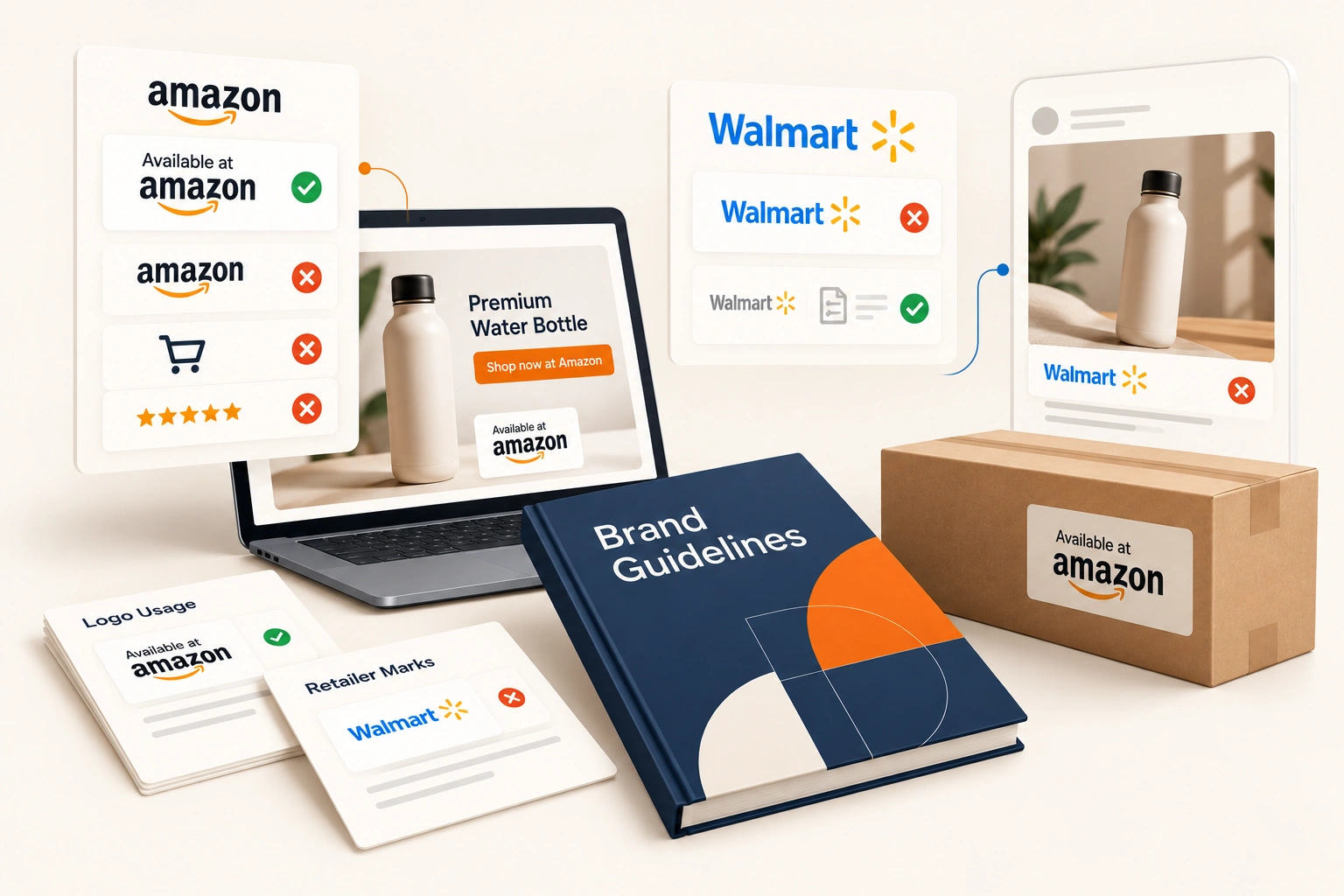
Amazon publishes brand usage guidelines for third-party digital display ads, and they open with the one mark a seller can use freely. "Third-party vendors and sellers on our marketplace are permitted to display the 'available at Amazon' logo in their ads to promote the availability of their products and services at Amazon. No formal review or approval is needed to use this logo."
The rules around it are exact. It comes in white and squid ink, whichever is "most legible for the logo placement." The stacked version is never narrower than 0.75 inches in print, 90 pixels on a standard screen or 180 on a high resolution one; the horizontal version never narrower than 1.4 inches, 140 pixels or 280. Where the lockup would be too small, advertisers may typeset Available at Amazon "in their typeface of choice with the word 'Available' capitalized."
An ad running off Amazon that links in to Amazon "should clearly display the 'available at Amazon' logo or the appropriate text link CTA." On Amazon's own site, the logo is "strongly discouraged".
The text links have six permitted calls to action: Shop now at Amazon.com, Shop now, Pre-order now, Learn more, See details and Watch now. And "Amazon should always be in title case (all capitals or lowercase is not allowed)."
Amazon: what needs approval, or is not allowed
The available at Amazon logo is the exception. The rest of Amazon's brand is closed by default.
The Amazon logo. "The Amazon and Smile logos are not permitted in third-party advertising by vendors and sellers linking in to Amazon." There is one opening: "The Amazon logo is permitted for use when a vendor is using it in a line up with two or more other retailers and not linking in to Amazon."
Amazon's buttons. Not allowed as an ad's call to action, because their look and feel "is an integral aspect of the overall brand". eCommerce ad units with Add to Cart, Add to Wish List, Shop now or Clip coupon are the exception.
Amazon's own words. Terms such as Gold Box, Deal of the Day, Today's Deals, Subscribe & Save, 1-Click and Wish List need Amazon's approval where they tie to an Amazon feature, and anywhere else are not allowed unless expressly approved.
Amazon's icons. "The Amazon family of icons and site elements should not be used in advertisements unless expressly approved by Amazon." The examples are the cart, the add to cart symbol, the star rating and the leaf. On our reading, that includes a star rating screenshotted from a listing into a social ad.
Images. Owned by the advertiser or cleared before launch, and never "downloaded from Google or any other search engine site".
Outside advertising, one sentence decides. The page covers "digital display advertising associated with third-party products sold at Amazon.com", and "Other uses of the Amazon brand require review and written approval by Amazon in accordance with our advertising policies." On our reading, packaging, inserts and the brand's own website are other uses, so the Amazon logo on any of them waits for Amazon's written yes. Sellers have asked exactly this on Amazon's European forums, about a thank-you card sent only with Amazon orders, and other sellers advised against it.
Walmart: written permission first
Walmart's rules sit in its brand center and start from the other end. "Some of Walmart's trademarks, including Walmart's logos, may only be used with Walmart's prior written permission." There is no free badge. Walmart considers requests to use certain logos as vendor tags, which relate to the availability of products or services from Walmart, "in third party advertisements through its Vendor Tagged Advertising process."
Walmart considers those requests "from entities with which it has existing relationships, such as vendors, suppliers, service providers, charities, community organizations, and industry associations." Marketplace sellers are not named. On our reading, a seller treats the logo as unavailable until a Walmart contact says otherwise, which is where the page sends anything it does not cover: "an appropriate Walmart business contact."
Four of its rules reach designers and media buyers.
Ads and search. No Walmart logo "in advertisements without prior written approval", and no Walmart trademark "in any search placement, content targeting, or other advertising placement services without prior written approval." That covers the name as well as the logo, so a search campaign bidding on Walmart's name sits under it. Amazon's display guidelines do not address search bidding, and on our reading silence is not permission.
Prominence. Walmart's marks are never used "except in a manner that is less prominent than your own trade name or trademarks."
Form. No logo may be modified, distorted, rotated, animated or altered, and each appears only "in the form, orientation, and colors supplied by Walmart."
The word in copy. Walmart's name in running text stands apart from the words around it, and is never a verb or a generic word.
The section to add to your brand guidelines
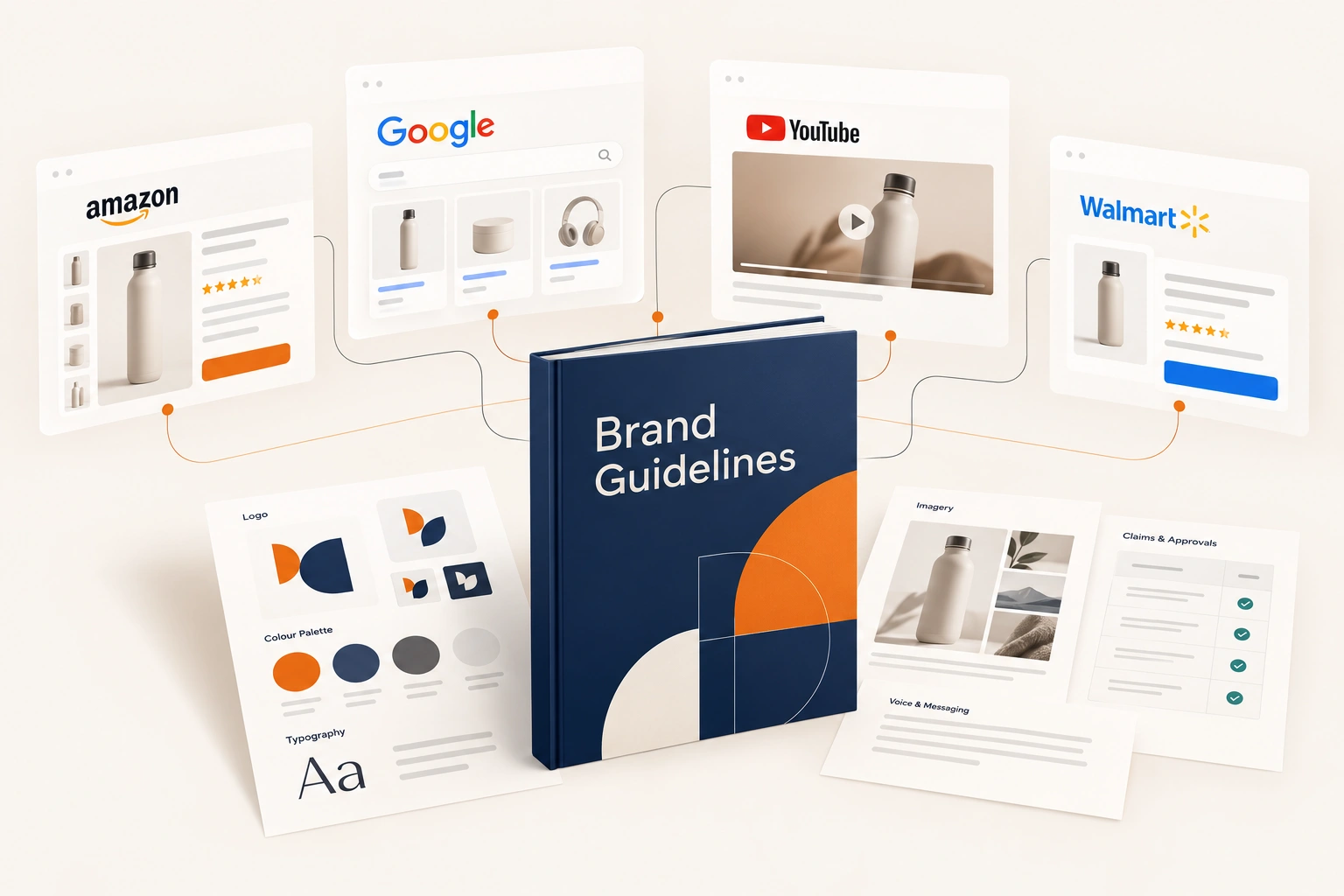
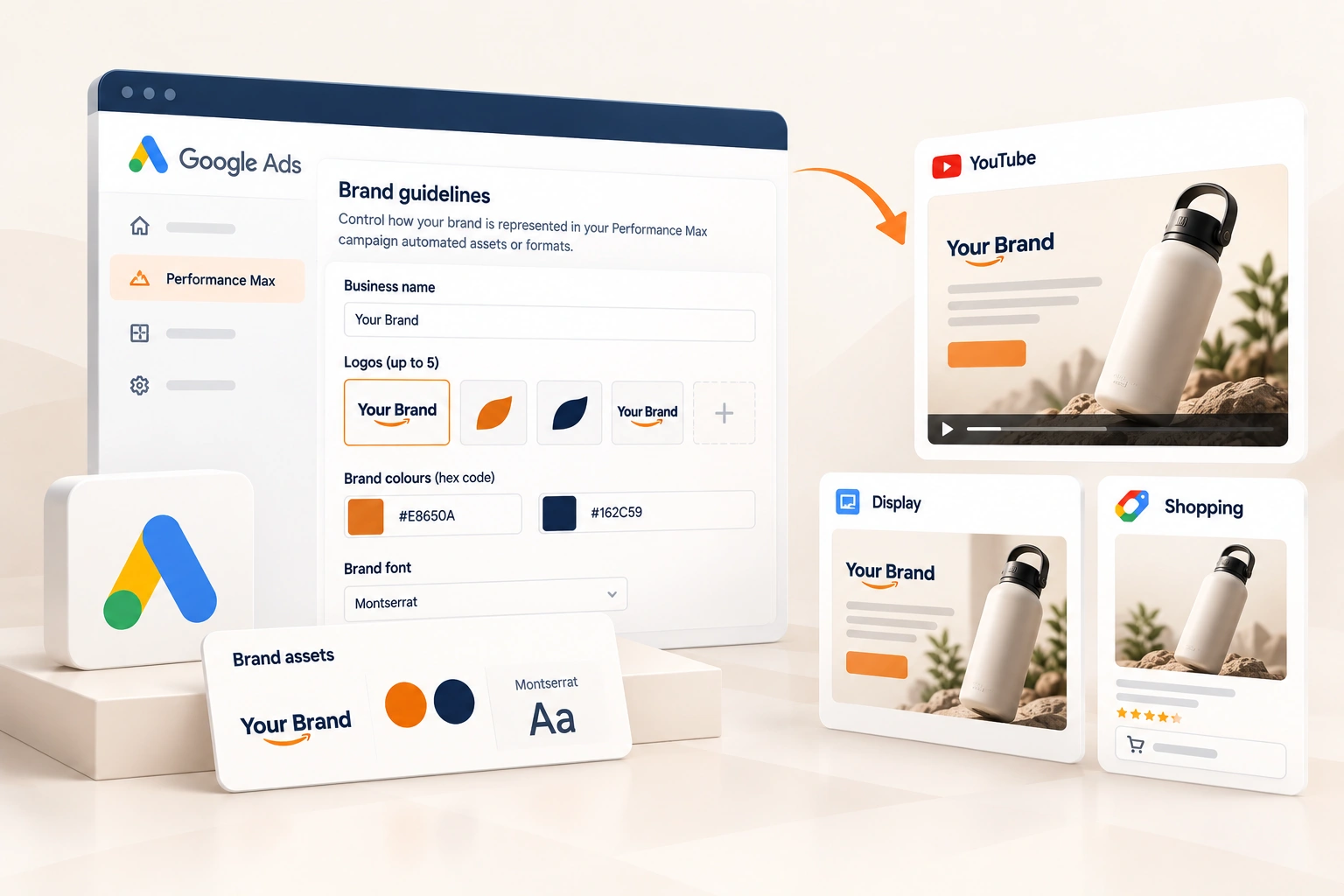
Most guidelines documents cover the brand's own logo in detail and say nothing about anybody else's, so the question is answered campaign by campaign by whoever builds the asset. That is how an Amazon logo ends up on a box insert. Guidelines already answer questions from machines as well as designers, from the fields in Google's Performance Max brand guidelines to the written standard Amazon's Branded Conversations will draw on. A retailer marks section belongs beside them, in five parts.
The marks we may use, and where. The available at Amazon lockup in white and squid ink, with Amazon's minimum sizes, the typeset fallback, and the rule that it appears only off Amazon. Every other retailer mark listed as needing written approval.
The words. The six approved calls to action for Amazon links, each retailer's name in its required form, and the proprietary terms nobody uses.
The hierarchy. The brand first and largest, the retailer badge after it and smaller, with every retailer: Walmart's written rule, and good practice everywhere.
The destinations. Where an ad that links in to Amazon lands, the product page or the Brand Store, decided by the campaign rather than the designer.
The approvals log. Every written permission: what was asked, who approved it, the date and any end date, and the date each retailer's rules were last read.
Two neighbouring rules belong here too. Imagery is owned or cleared on every channel, never pulled from a search engine. And the brand's own trademark symbols follow its registrations: Walmart forbids the registration symbol beside a mark not registered with the USPTO for the goods in question, the same discipline that makes the trademark class a brand files in matter. Retailers guard their marks as firmly as a brand should guard its own against scam ads that copy it.
Where we fit
Writing the rules a brand's team and agencies work from, its own marks and the retailers' alike, is part of how we build brand guidelines for brands that sell on marketplaces. If retailer logos are turning up on inserts and in ads, the approvals log is where we would begin.
Part of the guide: Brand Guidelines for eCommerce Brands: The Visual Rules and the Written Standard Every Platform Checks.
Frequently asked questions
The questions that come up most often on this subject.
Not in ads. Amazon's brand usage guidelines say vendors and sellers may display it in their ads to promote the availability of their products at Amazon, with no formal review or approval. Amazon strongly discourages it on its own site, and other uses of its brand need its written approval.
Not without Amazon's written approval. Its guidelines say the Amazon and Smile logos are not permitted in sellers' ads linking to Amazon, and that uses of its brand beyond digital display advertising require review and written approval. The one opening they name, in ads, is a line up with two or more other retailers that does not link to Amazon.
Amazon allows six in its text links: Shop now at Amazon.com, Shop now, Pre-order now, Learn more, See details and Watch now. Amazon's own button styles are not allowed as calls to action, except Add to Cart, Add to Wish List, Shop now and Clip coupon in eCommerce ad units.
Walmart's trademark guidelines say its logos may only be used with prior written permission, and never in advertisements without prior written approval. It considers requests from businesses it already works with, such as vendors and suppliers, and handles availability badges in ads through its Vendor Tagged Advertising process. Marketplace sellers are not named on the page.
Walmart's trademark guidelines say its trademarks may not be used in any search placement, content targeting or other advertising placement service without prior written approval. That covers the name as a word as well as the logo.