Performance Max Brand Guidelines: What Google Uses and What It Guesses
Every Performance Max campaign carries brand guidelines: a business name, up to five logos, two colours and a font, used when Google makes ads for you. What each part controls, what Google infers from your website when you leave it blank, and the brand decisions to make once rather than campaign by campaign.


Loading Article banner
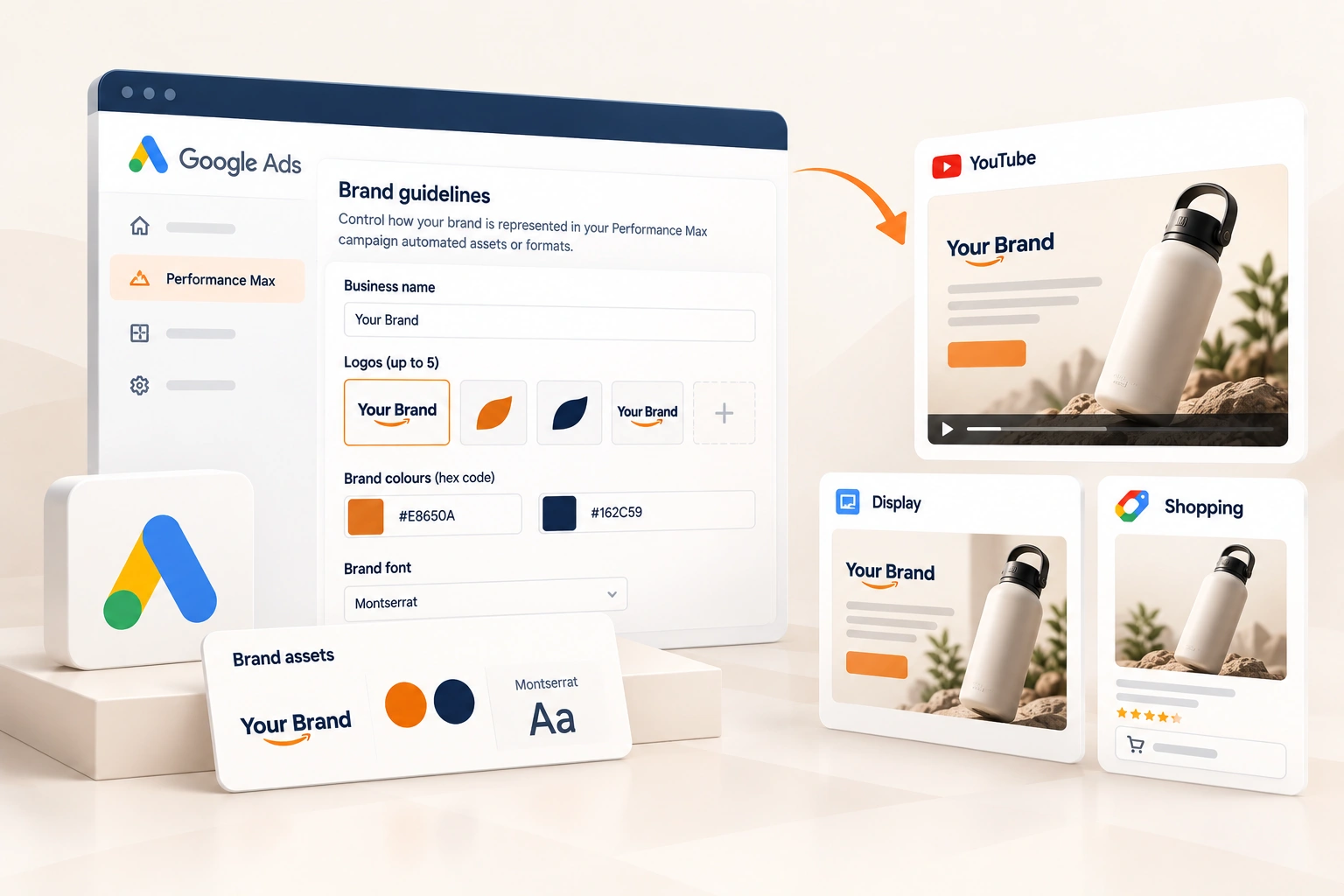
Performance Max does not run the ads a brand designed. It assembles ads from parts, headlines, images, logos and video, and where a format needs something the brand did not supply, it makes it: Google's help page speaks of "automated assets or formats", including videos generated for YouTube and responsive ads across the Display Network. What those ads look like depends on a short set of settings most brands fill in once and never look at again.
Google calls them brand guidelines. Since Google moved business names and logos into them, with a deadline of mid-April 2025 for advertisers to check theirs, they are where a Performance Max campaign keeps both, and they hold two optional controls, colours and a font, that most brands leave to Google. This is what each part does, what Google infers when it is left blank, and the decisions behind them that belong in a brand's own guidelines rather than in a campaign setting.
What brand guidelines are
In Google's words, brand guidelines let you "control how your brand is represented in your Performance Max campaign automated assets or formats." There are four parts: a business name, logos (one to five images), a brand colour pair and a brand font. They "exist at a campaign level and can be modified during or after campaign construction", and they are reached when creating or editing an asset group.
They are a Performance Max setting. The Google Ads API reference, updated on 13 October 2026, describes them as "Settings that control the visual appearance of your brand in a campaign's automatically generated assets and formats. Only applicable to Performance Max campaigns." A Search campaign is shaped by other controls, and what the AI Max upgrade changes in Search campaigns covers those.
The required half: business name and logos
Both are required, and both are reviewed. The business name has to match "exactly with your domain or verified legal name", and Google warns that discrepancies "can lead to disapproval or assets being marked as irrelevant." A brand that trades under a shorter name than the one it verified, or adds a product line to it, should check which version Google will accept before typing it.
Logos must be high quality, "legible at small sizes", meet Google's size and format specifications, and be "approved and visible on your landing page." Up to five can be uploaded. Review "typically takes up to one business day", longer for complex cases, and Google notes that a completed Advertiser Verification can influence approval times.
Two warnings from the same page. A logo is "not guaranteed to serve in every impression", because the system chooses whichever format performs best. And if the wrong logo keeps appearing, Google suggests checking whether Dynamic Business Logos is enabled at the account level, and considering turning it off.
The optional half: colours and font
The colours are a pair: primary and secondary in the interface, main and accent in the API, each "entered as a hex code", and the API requires both or neither. The font comes from a fixed list. The API names eight Google Fonts: Open Sans, Roboto, Montserrat, Poppins, Lato, Oswald, Playfair Display and Roboto Slab.
Both apply to two formats only: autogenerated videos on YouTube and responsive display ads on the Google Display Network. Even there, Google says it "will do its best to apply your brand guidelines where eligible. However, not every creative type will support rendering with your specific brand guidelines." They are a strong suggestion to the system, not a template it must follow.
What Google does when you leave it blank
Google reads the campaign's final URL. The first time a final URL is used, Google infers the business name and logo from it and pre-fills them, and it recommends a font and colours from the same page, which you have to confirm or change yourself. If no recommendation appears, Google may not have been able to detect one.
Then it remembers. Every later campaign using the same final URL defaults to the most recently used business name, logos, colours and font. That saves typing, and it means a wrong colour confirmed once travels into every campaign built on that address until somebody notices.
Older campaigns have one more reason to be checked. When Google moved business names and logos into brand guidelines, it said that if no updates were made by mid-April 2025, "the business name and logos from the top performing asset group from your campaign will be used." A campaign built before then may be carrying whichever name and logo happened to perform best in one asset group, chosen by the system rather than by anybody at the brand.
Inference is only as good as the page it reads. A site with a different accent colour on every template, a logo served as a small header image, or a theme font that is not on Google's list gives the system three guesses to make, and a busy person confirming its recommendations is accepting three guesses.
Why this is a brand question, not a campaign setting
Every field above asks for a decision a brand should have made once: the exact name it advertises under, the logo files in the versions an ad system needs, the two colours that represent it when there is room for only two, and the typeface it uses when its own is not available. The last is the real test. A brand set in a typeface outside Google's eight has to choose the nearest of them, and if its guidelines do not name that substitute, every media buyer chooses again, campaign by campaign, and the brand looks slightly different everywhere.
Google is not the only system now asking. Amazon's AI creative tools make display and video from a product page, and what they make and what you still supply is the same question on another platform. Amazon's Branded Conversations goes further, asking for the written standard behind a brand's voice. Each rewards a brand that has written its rules down, and is harder on one that left a machine to infer them.
Before the next Performance Max campaign
The name. Confirm the business name matches the domain or the verified legal name, character for character.
The logos. Upload the versions the landing page shows, legible at small sizes, and remove any Google pre-filled from an older page.
The colours. Choose the main and accent hex values deliberately rather than confirming the pair Google detected, and record them where the next campaign will find them.
The font. Pick the nearest of the eight to the brand's own, and record it as the brand's substitute for ad systems.
The account. Check Dynamic Business Logos and Advertiser Verification before blaming a disapproval on the asset.
Then judge the campaign on what it earns, not on how it looks. What Google Ads actually costs explains why Performance Max needs boundaries on where it spends; brand guidelines are the boundary on how it presents you.
How we approach it
The brand guidelines we write give a marketplace brand its logo and variants, its palette with the values a designer needs and its typefaces with their uses, written so a third party can follow them without asking. For a brand that advertises on Google, that includes the two colours to use when there is room for only two and the nearest of Google's eight fonts, so the Google Ads campaigns we run are entered from the document, and the ads Google makes look like the brand that paid for them.
Frequently asked questions
The questions that come up most often on this subject.
In a Performance Max campaign, when you create an asset group during campaign construction, create a new asset group afterwards, or edit an existing one. Brand guidelines are set at campaign level and can be changed during or after construction, and the Google Ads API reference says they apply only to Performance Max campaigns.
Google requires the business name in brand guidelines to match your domain or your verified legal name exactly, and warns that a discrepancy can lead to disapproval or to the asset being marked as irrelevant. Check the name against both, character for character, and confirm your Advertiser Verification is complete. Review usually takes up to one business day.
Eight Google Fonts, according to the Google Ads API reference: Open Sans, Roboto, Montserrat, Poppins, Lato, Oswald, Playfair Display and Roboto Slab. A brand whose own typeface is not on the list should choose the nearest of the eight and record it in its guidelines, so every campaign uses the same one.
No. Google lists two eligible formats: autogenerated videos on YouTube and responsive display ads on the Google Display Network. Even there Google says it will do its best to apply them where eligible, and that not every creative type supports rendering with them.
Google infers a font and colours from the campaign's final URL and recommends them, and its help page says you have to confirm or modify the values yourself. Whatever you confirm becomes the default for later campaigns that use the same final URL, so a recommendation accepted without checking carries forward.