The Meta Ad Auction: How Meta Picks Your Ad, and What a Product Brand Still Controls
Meta says the highest bid does not automatically win its auction, and that shipping speed, support and checkout friction count towards ad quality. How the auction weighs bid, estimated action rate and ad quality in Meta's October 2026 words, and the brief a brand still has to write.


Loading Article banner
A brand that spends more on Meta in November and gets less back usually reaches for two levers: a bigger budget and a higher bid. On 28 October 2026 Meta published an explanation of how its ads system chooses an ad, and the sentence to read first is this one: "The highest bid or the biggest budget doesn't automatically win in the auction."
The same post says the quality of the whole experience counts, after the click as much as before it, and names shipping speed, support and checkout among the things that decide it. This is how the auction works in Meta's own words, what Meta changes on every account without asking, and what a product brand still controls going into peak season.
How Meta chooses an ad, in three steps
Meta describes its ads system as "a market, where there is a limited number of opportunities to auction impressions." Three stages run before an ad is shown.
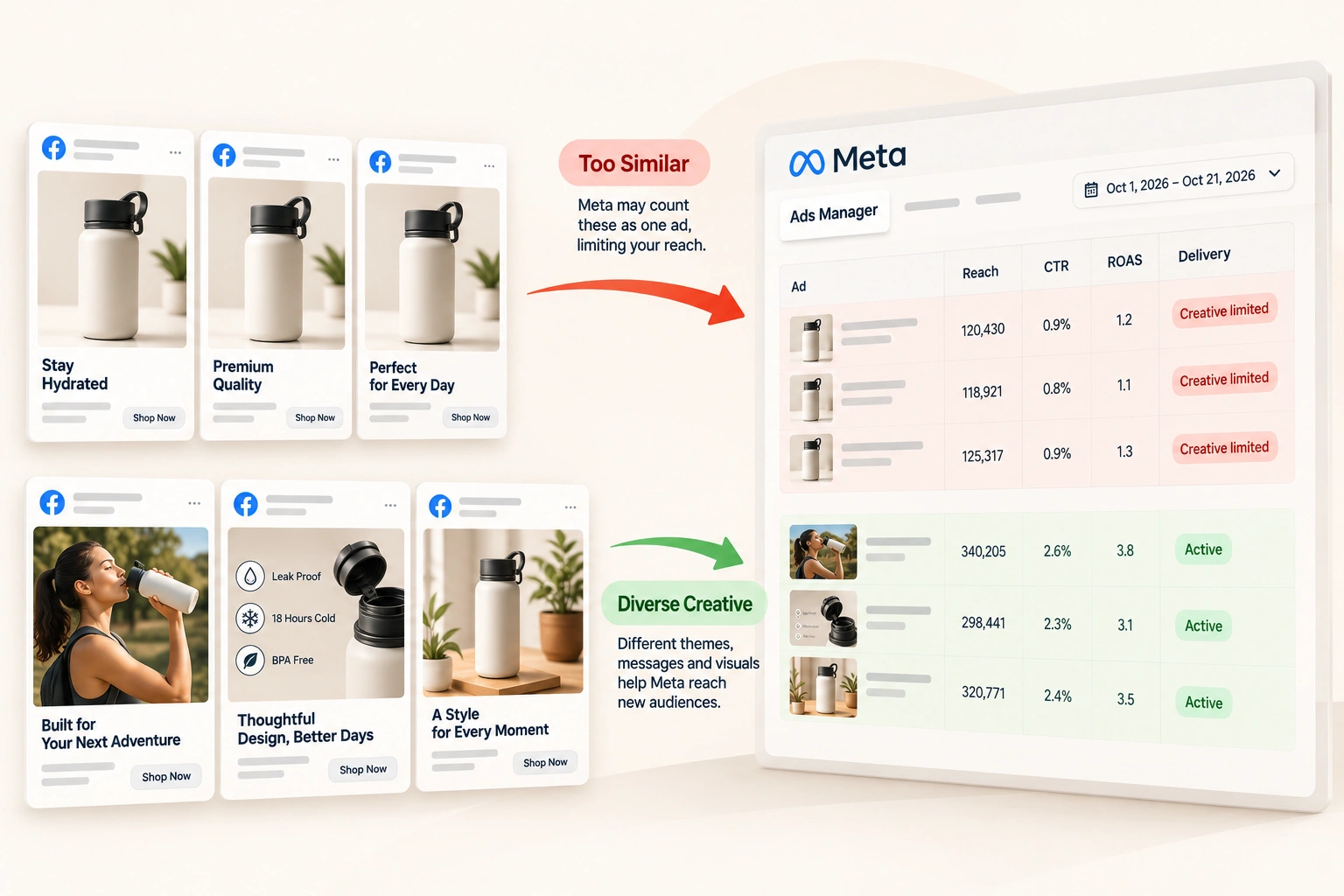
Retrieval. Meta Andromeda "narrows tens of millions of ads to the few thousand worth ranking for each person." Why ads that look too alike are treated as one at this stage is the subject of Meta's creative diversification, and it is why creative variety matters before the auction has even started.
Ranking. Models predict who is likely to act. Meta names GEM, which "learns from trillions of signals", and sequence learning, "which reads the order of what someone does."
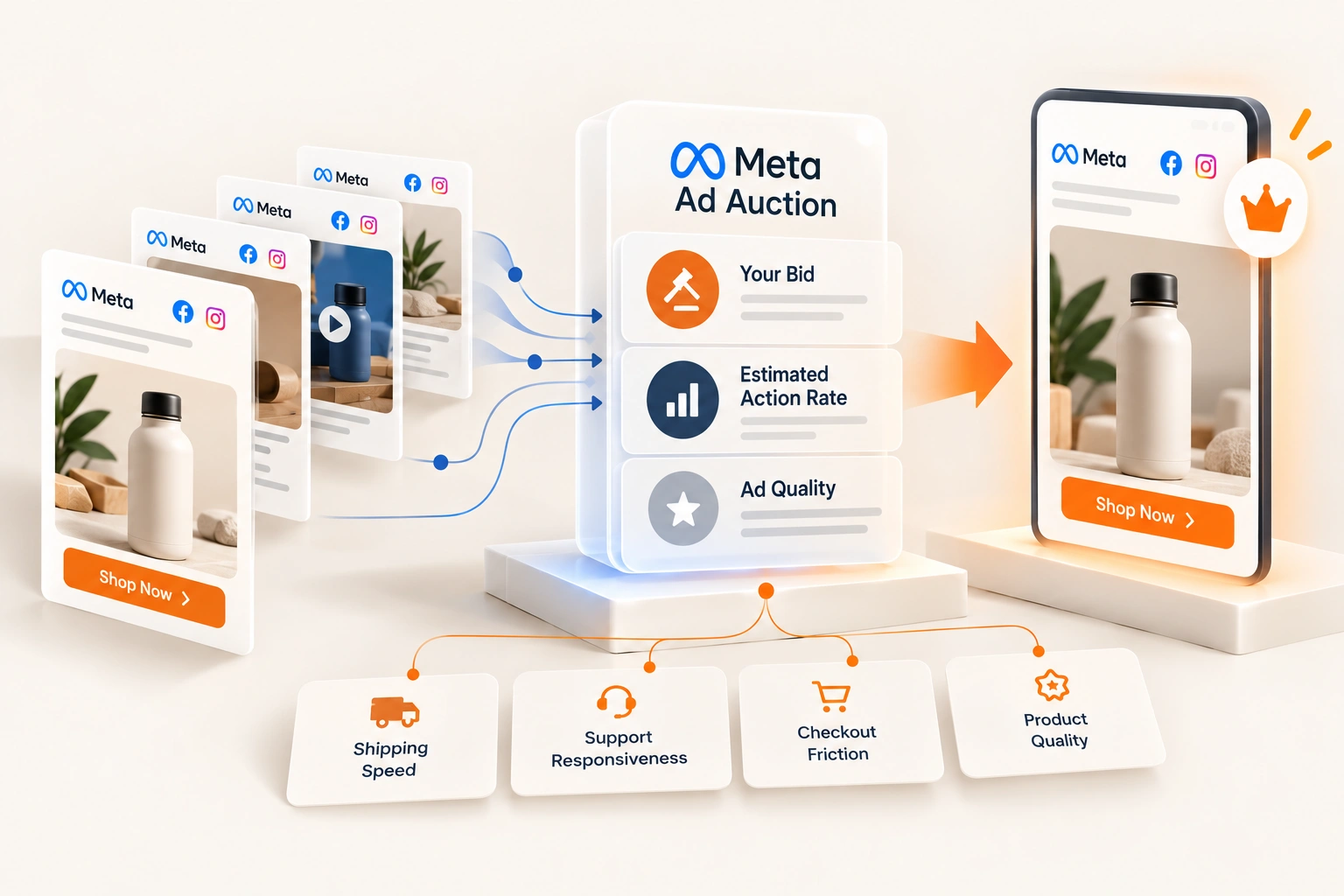
The auction. The ads that remain compete "with other eligible ads for every available impression", and Meta weighs three things.
What the auction weighs
Your bid. In most campaigns this is not a number typed into a box. "We turn your budget and goals into a bid for each impression, continually adjusted to maximize your results", which Meta calls pacing.
Estimated action rate. Meta's prediction "that this person will take the action you're asking the system to optimize for." The action is the advertiser's choice, which is why the goal matters more than any setting beneath it.
Ad quality. "The quality of the whole experience, from the ad itself to what happens after the click." Meta says it reflects feedback from people who view, click or hide ads, the detection of low-quality traits "such as engagement bait or withheld information", and "more than 200 million customer survey responses a year" on satisfaction with purchases, shipping delays, unexpected charges and whether people felt misled.
Meta's own summary of the three: "A more relevant ad, backed by a better customer experience, can beat a higher bid."
Why your shipping and checkout are part of the auction
The line in the post with the most consequence for a product brand is this one: "Audit your customer experience. Shipping speed, support responsiveness, product quality and checkout friction impact ad quality."
Meta does not say how much each one weighs, and nobody outside Meta can. The direction is plain all the same, on our reading. A store whose orders arrive late, whose buyers cannot get an answer, or whose checkout adds a charge at the last step pays for it in the auction, through ad quality, before any ad is judged on its creative. Unexpected charges are named in Meta's own survey, and a shipping fee that first appears at checkout is one.
So part of the work that lifts a Meta account is not in Ads Manager. What actually slows a store down is advertising work as much as development work, and so is every step between the product page and the order confirmation. Removing that friction is the conversion rate optimisation half of a Meta budget.
What Meta changes without asking
Meta's second post that day, on ads ranking, says improvements to its models drove 8.3% more ad clicks and a 15.7% uplift in conversions on Facebook in the second quarter of 2026. "Every one of these improvements reaches your account automatically. There's no setting to switch on, no new campaign type to adopt, no migration to plan."
Those are Meta's figures for its own system, measured across advertisers, and no account should plan on them. The useful sentence comes after them: the system "still needs you to tell it what winning looks like for your business."
The four things a brand still controls
Meta's peak season post of 21 October 2026 puts it as a rule: "None of this replaces the creative. It decides which creative wins." Between the two posts, four decisions are left with the advertiser.
The goal. "Choose the outcome you actually want, not the closest proxy you can measure. A lead isn't a sale, and an install isn't a subscriber." For a store, that usually means purchases rather than add to carts or landing page views.
The value. "Send back the value of each conversion, not just the fact that a conversion happened", so delivery leans towards the more valuable orders. Meta recommends a goal-based bid with Value Optimization and Value Rules for the same reason. Our addition: where margin differs widely by product, the value sent should reflect it.
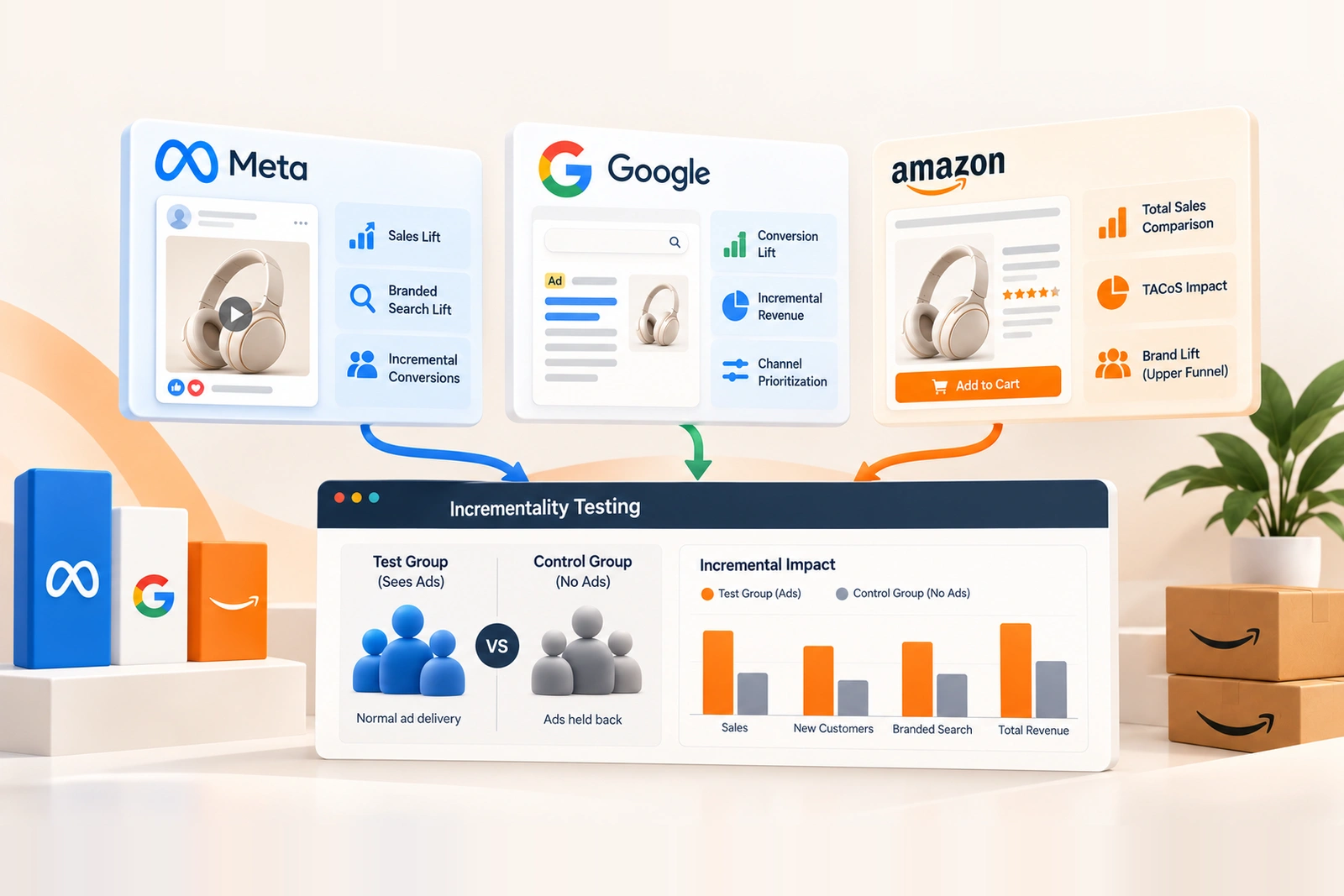
The measurement. "Standard attribution counts what the ads touched. Incremental attribution counts what the ads added." Meta's advice is to judge results on cost per result or return on ad spend and to test incrementality, which matters more on a channel that makes demand than on one that captures it, the difference behind Meta Ads against Google Ads. Incrementality testing across Meta, Google and Amazon sets out how.
The budget, and how many ad sets it can feed. Meta asks for "Roughly fifty conversions a week" in each ad set, and says that "In our analysis, ad sets under that threshold ran about 28% more expensive per purchase." Its rule of thumb: the total weekly budget, divided by the cost per result multiplied by 50, gives "the most ad sets your budget can support". An account running ten ad sets on a budget that supports four is spreading the conversions four could learn from across ten that cannot.
Before and during peak season
Meta's peak season post has one rule for the weeks that matter most: "Change a campaign and you pay twice." Once in the learning phase the change restarts, and once in the old instruction, which kept spending at full price for as long as it was wrong. Its advice is to group the changes: "Take one learning phase instead of five. Then hold it still."
Our practice, in this order.
Fix the experience first. A delivery promise the store can keep, the shipping cost shown before checkout, and messages answered. Ad quality is earned there.
Write the brief once. The goal, the value sent back and the attribution the finance team will use, decided before the budget rises rather than during it.
Size the ad sets to the budget. Consolidate until each can reach about fifty conversions a week.
Feed it different creative, different in concept rather than in headline, so retrieval has more than one ad to find.
Protect the budget for the buying windows, using Meta's budget scheduling to "grow or shift spend automatically", and plan it alongside the Q4 budgets on the marketplaces.
Then leave it alone, and read cost per result or return on ad spend over the week, not the day.
Where we fit
Writing the brief Meta's auction works from, the goal, the value and the measurement, and fixing the store experience that decides ad quality, is how we run Meta Ads for product brands. If spend is rising and results are not, the experience after the click is where we would start.
Frequently asked questions
The questions that come up most often on this subject.
No. Meta says the highest bid or the biggest budget does not automatically win. The auction weighs the bid with the estimated action rate, Meta's prediction that the person will take the action the campaign optimises for, and with ad quality, which covers the whole experience from the ad to what happens after the click.
Meta's measure of the whole experience, from the ad itself to what happens after the click. It reflects feedback from people who view, click or hide ads, detection of low-quality traits such as engagement bait or withheld information, and more than 200 million customer survey responses a year on purchase satisfaction, shipping delays, unexpected charges and whether people felt misled.
Meta says it does. Its October 2026 guidance names shipping speed, support responsiveness, product quality and checkout friction as things that impact ad quality, one of the three inputs to the auction. Meta does not say how much each one weighs.
Meta's peak season guidance says roughly fifty a week, and that in its analysis ad sets under that ran about 28% more expensive per purchase. To find how many ad sets a budget supports, divide the total weekly budget by the cost per result multiplied by 50.
No. Meta says improvements to its ranking models reach every account automatically, with no setting to switch on, no new campaign type and no migration. What it still needs from the advertiser is the goal, the value of each conversion and the measurement to optimise against.