Podcast Ads on Amazon DSP: What Self-Service Buyers Can Now Buy
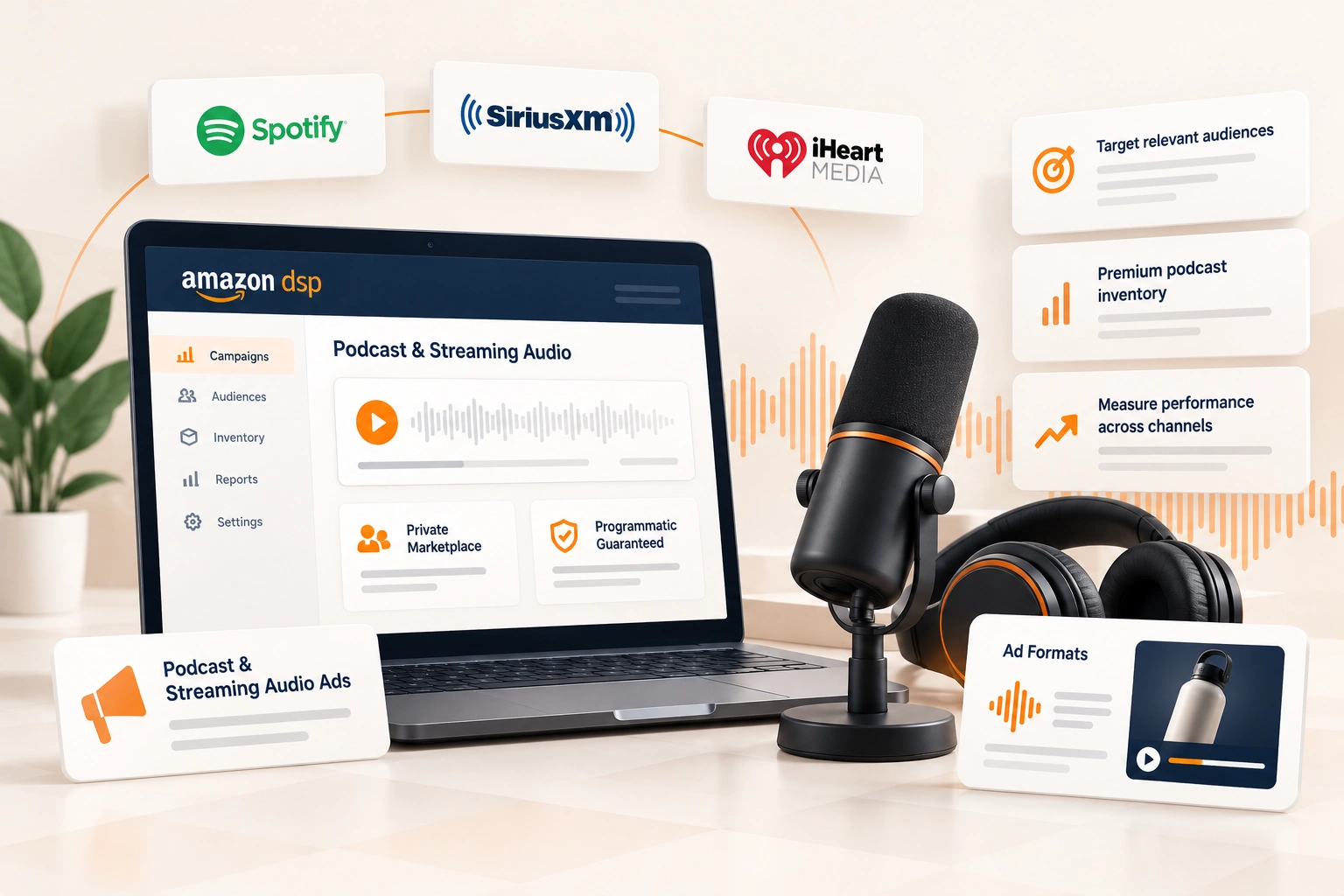
On 6 July 2026 Amazon opened programmatic podcast and streaming audio ads to self-service Amazon DSP advertisers, through PMP and guaranteed deals on the Spotify, SiriusXM and iHeart exchanges. What was launched, what the deal types mean, what a product brand has to bring, and how to read a result nobody can click.


Loading Article banner
For most product brands, a podcast ad has meant a sponsorship: a show chosen by hand, a host who reads the script, a fee agreed per episode and a discount code to count what it sold. It works, and it does not scale past the shows somebody has time to negotiate with.
On 6 July 2026 Amazon announced a second route. In its words, "self-service advertisers using Amazon DSP can access programmatic podcast ads across premium publishers and SSPs." This is what was launched, what the two ways of buying it mean, what a product brand has to bring to it, how to read a result nobody can click, and who should wait.
What Amazon launched, in its own words
The announcement is titled "Amazon DSP expands omnichannel capabilities with new open internet podcast and streaming audio inventory at scale". It names three supply side platforms, the exchanges that sell publishers' inventory to buyers: "Spotify Ad Exchange, SiriusXM Media/AdsWizz, and iHeart Media/Triton." It covers two formats, podcasts and streaming audio, bought through "PMP and Programmatic Guaranteed (PG) deals for both podcasts and streaming audio."
Three more details matter. Under who can use it, Amazon lists "Self-service advertisers": the brands and agencies running their own DSP seat, rather than buying through Amazon's managed service. Advertisers can "execute Inventory Groups across both formats for unified campaign management", so a podcast buy and a music streaming buy can be planned and paced as one. And the inventory comes with "the same measurement capabilities advertisers expect from Amazon Ads across their digital campaigns."
Amazon lists 34 countries across North America, Brazil, Europe, the Middle East and Asia Pacific, among them the United States, Canada, the United Kingdom, Germany, India, Japan, Australia, Saudi Arabia and the United Arab Emirates. The page says nothing about open auction buying, targeting options or a minimum spend. Those are questions for the DSP console, not for the announcement.
Sponsorship and programmatic are different purchases
A sponsorship buys a show. The brand picks the programme, agrees the episodes and the read, and the host's voice carries the message to an audience that already trusts it. The price is negotiated, the inventory is fixed, and measurement is usually a code or a short web address.
Programmatic buys listeners. The ad is inserted into episodes and streams as they are played, across whichever shows and stations the deal covers, and it is bought by the impression. The spot is usually produced by the brand rather than read by a host, so it carries less of a host's trust and far more reach. The two are not rivals: a brand that has found a show that sells can keep sponsoring it, and use programmatic to find out whether the same message works across a wider audience.
PMP and Programmatic Guaranteed, in plain terms
A private marketplace deal, or PMP, is an auction a publisher runs for selected buyers on a defined slice of its inventory, usually above a floor price. The buyer's DSP seat receives a deal ID, bids on impressions as they come up, and wins only those it bids enough for. Nothing is reserved: a PMP gives access, not volume.
A Programmatic Guaranteed deal is the opposite trade. The buyer and the publisher agree a fixed price and a fixed volume of impressions in advance, and the DSP delivers them automatically. The volume is reserved, and so is the commitment: the brand pays for impressions it has agreed to take.
Either way, a deal exists before it can be bought. Somebody on the selling side sets it up for the buyer's seat, so the first step of a podcast plan is a conversation about publishers, genres and terms, not a box ticked at launch. For a first test a PMP is the lower commitment. A guaranteed deal suits a brand that already knows an audience delivers and wants to secure it for a season.
What a product brand has to bring
A spot written for the ear. Audio has no image and no button. The listener has to remember the brand name, know where to find it and have a reason to look, from one hearing, often while doing something else. A brand whose name is hard to say or spell has a problem no targeting will solve.
A destination that matches the spot. If the spot says search for the brand on Amazon, the brand's own listings have to own that search, with the hero product first and a page that converts a stranger. That is the readiness that the test for whether a brand is ready for DSP sets out, and audio makes it stricter, because there is no retargeting click to bring the listener back.
A baseline taken before launch. Branded search volume, new to brand orders and organic sales for the products the spot names, measured over the weeks before the first impression, so there is something to compare against afterwards.
A budget that can be read. Audio works by repetition, so a test spread thinly across 34 countries proves nothing. One country, a handful of genres, a fixed period and enough frequency for a listener to hear the spot more than once is a test that can answer a question.
Reading a result nobody can click
Amazon promises the measurement advertisers already use on their digital campaigns, and its announcement does not list the metrics. Check in the console what the audio line items report before agreeing a target, because an audio campaign judged on the clicks it cannot get will always look like a failure.
What audio should move is the brand's own search: more people typing its name, a higher share of new to brand customers, and organic sales on the products the spot named. Those land in the organic line and in the search campaigns, which will take the credit if nobody is watching. Which of ACoS, TACoS and ROAS answers which question explains why TACoS is the honest figure here: it shows whether total sales grew faster than total ad spend, wherever each sale was credited.
A cleaner read comes from a holdout. Run the audio in one country or region and not in a comparable one, and compare branded search in both. It is not perfect, and it is better than a campaign report that cannot see what it caused.
Who it suits, and who should wait
It suits a brand that already wins its own branded search on Amazon, has a hero product a listener can remember by name, and has outgrown the reach of search ads. It tends to suit categories with a story that sounds better spoken than shown: food and drink, fitness, parenting, personal care and the home.
It should wait in a brand whose sponsored search is not yet profitable. The order in which each Amazon ad type earns its budget still applies: search first, because it captures demand that already exists, and the upper funnel second, because it creates demand that search then has to capture. A podcast campaign that sends listeners to a search the brand does not win is paying to send customers to a competitor.
Where it sits beside DVA+
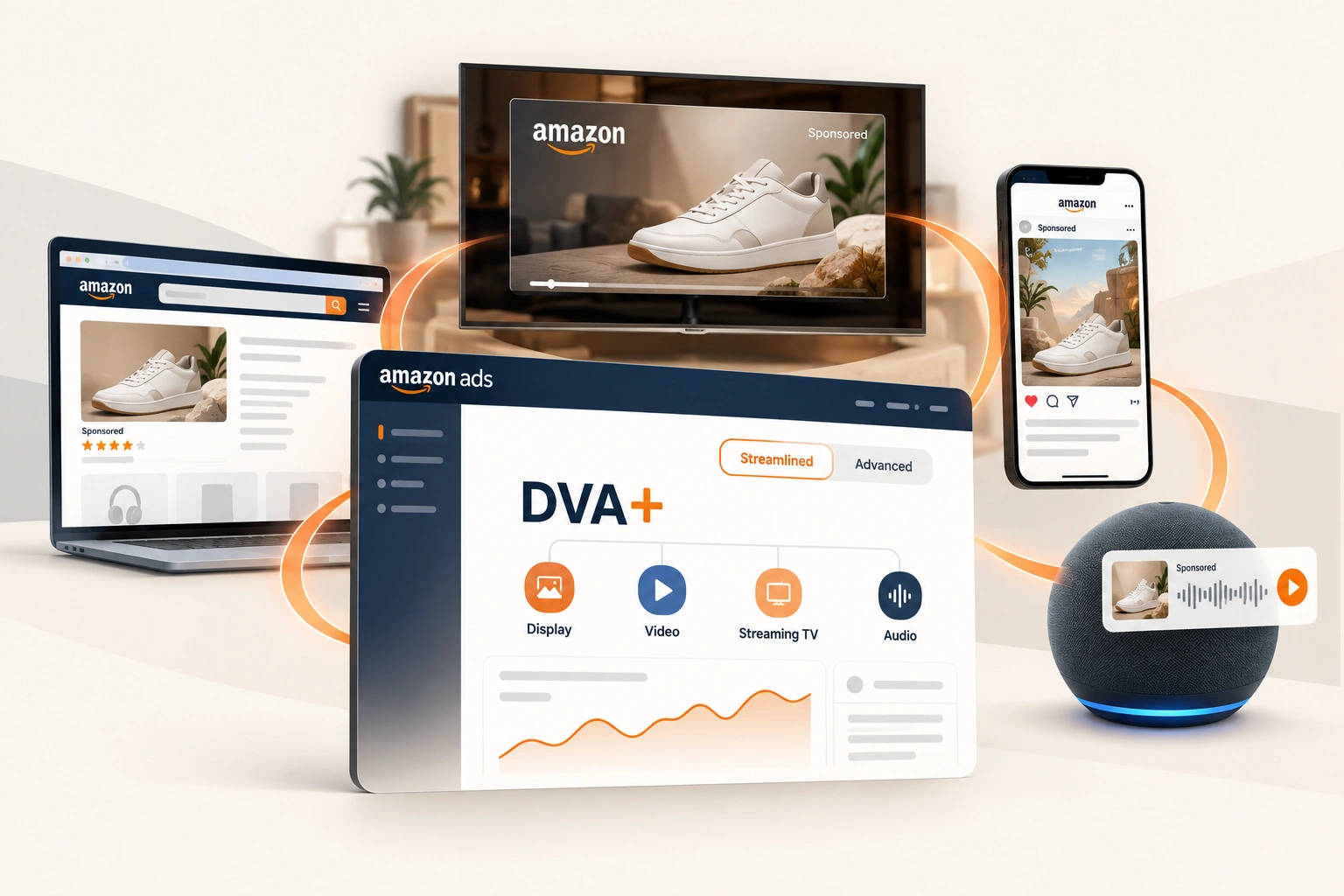
Less than three months after the audio launch, Amazon announced DVA+, a campaign type that brings display, video, streaming TV and audio into one budget and rolls out from late October 2026. What DVA+ merges and whether a brand is ready for it covers it in full. Amazon has not said how the podcast deals launched in July sit inside the new campaign type, so a brand planning audio for early 2027 should confirm in its own console where those deals are bought.
Amazon's Full-Funnel Campaigns go further still and hand the split between formats to Amazon's AI. A brand that wants to know what audio alone did should test it on its own first, then let a combined campaign decide the mix.
How we approach it
We treat audio as the last layer of a brand's Amazon advertising, not the first. The brands we run programmatic advertising for start with the search they already win, add display and video where the retargeting pool supports it, and test audio once there is a product worth naming out loud and a baseline to read it against: one market, a PMP before a guarantee, a spot written for the ear, and a result read through branded search rather than clicks.
Frequently asked questions
The questions that come up most often on this subject.
Yes. Since Amazon's announcement of 6 July 2026, self-service advertisers using Amazon DSP can buy programmatic podcast and streaming audio ads across premium publishers, through private marketplace (PMP) and Programmatic Guaranteed deals. Amazon names self-service advertisers as the audience for the feature and the DSP as where it is accessed.
Amazon names three supply side platforms: Spotify Ad Exchange, SiriusXM Media/AdsWizz, and iHeart Media/Triton. Which shows and stations a particular deal covers is agreed when the deal is set up, so what a brand can buy depends on the deals arranged for its DSP seat.
A PMP is a private auction: the publisher invites selected buyers to bid on defined inventory, usually above a floor price, and nothing is reserved. Programmatic Guaranteed fixes the price and the volume in advance, so the impressions are reserved and the buyer is committed to them. A PMP is the lower commitment for a first test; a guaranteed deal suits an audience already proven.
By what it should change: branded search volume, new to brand orders and organic sales on the products the spot named, compared with a baseline taken before launch and, ideally, with a comparable market where the audio did not run. Amazon says the inventory comes with the same measurement capabilities as its other digital campaigns, so check what the audio line items report in the console before setting a target.
Amazon's announcement lists 34: the United States, Canada and Mexico; Brazil; Germany, Spain, France, Italy, the United Kingdom, Belgium, Switzerland, Poland, Turkey, Austria, the Netherlands, Sweden, Finland, Norway, Ireland, Denmark and Luxembourg; Saudi Arabia, the United Arab Emirates, Israel, Egypt, Morocco, Bahrain and Kuwait; and Australia, India, Japan, China, New Zealand and Singapore.