Amazon DVA+ Arrives in Late October: What It Merges, What Streamlined and Advanced Mean, and Whether Your Brand Is Ready
From late October 2026 Amazon folds Sponsored Display, Sponsored TV and the DSP into one display, video and audio campaign type called DVA+, with a streamlined mode and an advanced one. What changes for a brand buying programmatic on Amazon, what does not, and the readiness test that still applies.


Loading Article banner
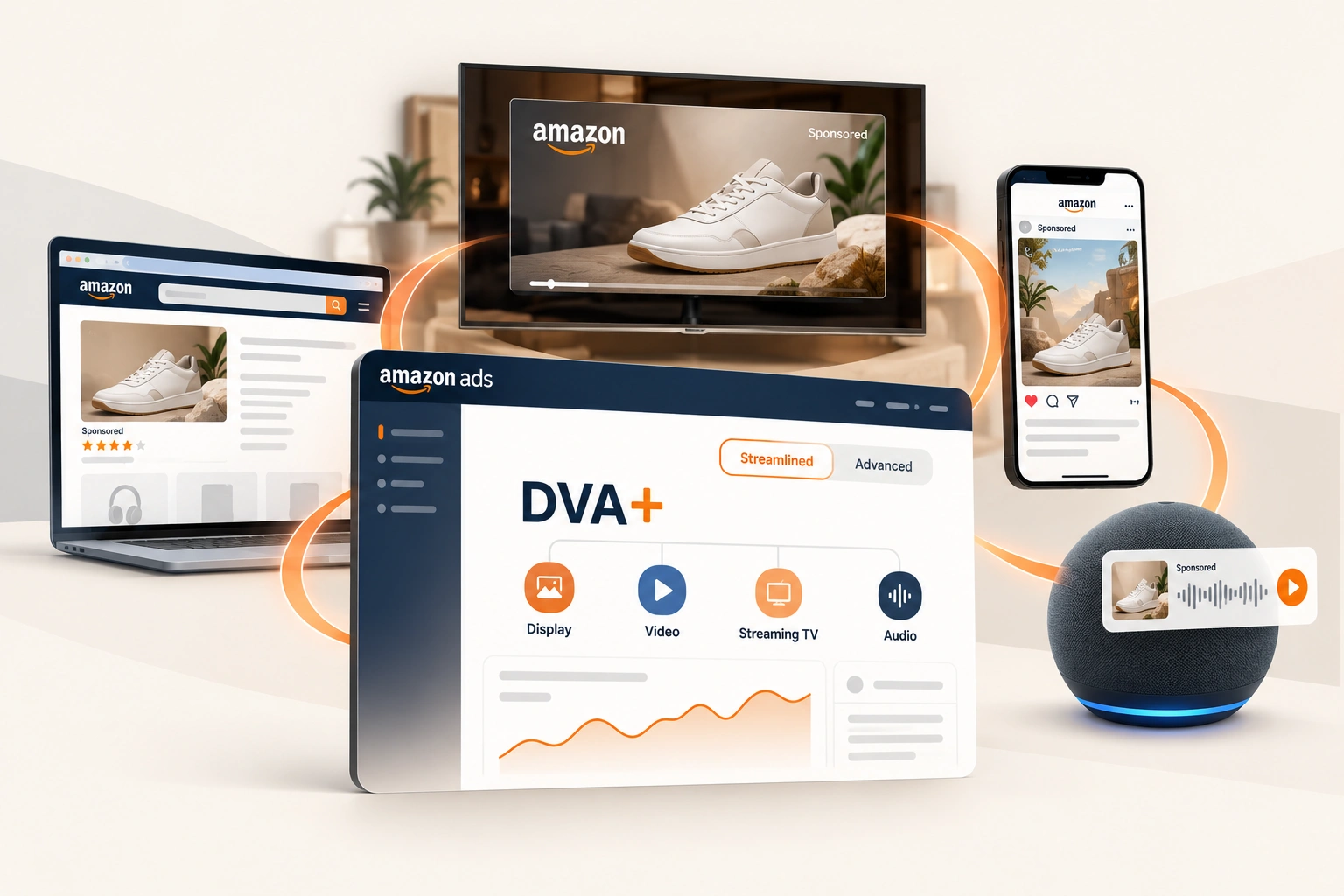
Programmatic on Amazon has been three products wearing three interfaces. Sponsored Display, the self-service one most sellers try first. Sponsored TV, for streaming placements without a DSP contract. And the DSP itself, bought historically through a managed service with a minimum, reaching audiences on and off Amazon. Three setups, three budgets, three reports, and a brand usually ran one of them.
Amazon's unBoxed announcement of 29 September 2026 puts it in those terms: "Running separate campaigns for display, streaming TV, and audio has meant separate setups, separate budgets, and separate optimizations." DVA+ is the replacement, and Amazon says it "will begin rolling out to advertisers beginning in late October." This is what it merges, what the two modes mean, what Amazon's pages do not say, and how to decide whether a brand that was not ready for DSP is ready for this.
What DVA+ is, in Amazon's words
The name stands for Display, Video, Audio+. Amazon describes it as combining what was previously managed through separate campaign types, "including Sponsored Display, Sponsored TV, and programmatic campaigns", into one buying experience, and states the structure in a line: "One objective, one budget, one campaign across all media types."
The placements are the DSP's placements. The product page says DVA+ "lets you reach audiences across streaming TV, online video, display, and audio on Amazon properties and the open internet", and the DSP page describes the inventory as Amazon-owned properties plus thousands of premium third-party sites and apps. Amazon's own framing of the platform change is blunt: "Amazon DSP has evolved into Amazon Ads Agent, one omnichannel ad platform with AI that works in service of you."
Streamlined and advanced: the two modes
Amazon's announcement offers both: "For teams that want speed, it's streamlined. For those that want full control, advanced settings put every programmatic lever at their fingertips." The product page describes the streamlined path as "Select an objective, set a budget, and launch in minutes", with advanced settings available "when more control is needed". The DSP page confirms the advanced path is the old DSP: "Existing Amazon DSP and new capabilities are now accessible through DVA+ with advanced settings."
That is the practical change. The brand that used to run Sponsored Display gets, in the streamlined mode, the reach the DSP used to gate behind a managed relationship. The brand that already ran DSP keeps its levers under the advanced settings, in the same campaign type as everybody else. The difference between the two is no longer which product was bought; it is how many decisions the brand chose to make itself.
What Amazon's pages do not say
Whether DVA+ carries a minimum spend. The DSP page says only that "Sponsored ads remain cost-per-click with no minimum spend", and says nothing about a floor for DVA+. Whether the streamlined mode reaches the open internet as fully as the advanced one. How DVA+ is billed in the streamlined mode (impressions, outcomes or something else), and what measurement the console reports by default. Amazon's pages describe self-service and managed-service options for programmatic, without saying which applies to which mode.
Until the console shows those, the budgeting question is open, and a plan built on an assumed minimum or an assumed billing model is a plan built on a guess. What can be planned now is everything else: the products, the audiences, the creative and the measurement.
The readiness test has not changed
Whether a brand is ready for DSP set out the test: the audiences DSP reaches are not searching for anything, so the intent has to be created rather than captured, and the return arrives days later through branded search and organic sales, where the search campaign takes the credit. DVA+ removes the setup barrier. It does not remove any of that.
So the questions are the same. Does the brand have a retargeting pool worth buying back: enough product page visitors who did not buy to fill a campaign? Does it have a listing that converts the stranger it is about to pay to bring in? Does it have creative for a streaming TV placement, which is a different asset from a display tile? And can it read a result that shows up in the organic line three weeks later, rather than in the campaign's own column? Which of ACoS, TACoS and ROAS answers which question matters more here than anywhere, because a programmatic campaign judged on its own ROAS will always look worse than it is.
The one real change in readiness is cost of entry. A brand that could not justify a managed DSP commitment can now run a bounded streamlined campaign and learn from it. That makes DVA+ worth a test for brands a size below the ones DSP used to suit, provided the test is designed to read the organic effect and not only the campaign report.
What to prepare before late October
Creative for every format in the campaign. One campaign across display, online video, streaming TV and audio means assets for all four or the campaign quietly runs in the formats it has assets for. Amazon's generative tools inside Ads Agent can make display and video from the product page; a streaming TV spot that carries the brand is still a production job.
Audiences, written down. Who the brand wants back (viewers, lapsed buyers) and who it wants for the first time (category buyers, competitor buyers). The advanced settings will ask; the streamlined mode will infer from the objective.
A baseline. Branded search volume, organic rank and new-to-brand share for the products in the test, taken before the campaign starts, because those are the lines it is supposed to move. The order in which each ad type earns its budget still applies: sponsored search first, then the formats that reach people who are not searching.
A benchmark that is not the search campaign's. ROAS standards across Amazon, TikTok and Walmart in 2026 gives the ranges; a programmatic campaign is read against the upper-funnel figure, not the Sponsored Products one.
How we run it
We treat DVA+ as the DSP with the door open: the same readiness test, the same measurement through the organic line, now available at a budget that allows a real test. The brands we run programmatic advertising for get the advanced settings where the levers earn their complexity and the streamlined mode where they do not, with the creative made for every format the campaign will run in. If you were told you were too small for DSP, late October is the month to find out whether that was true.
Frequently asked questions
The questions that come up most often on this subject.
Display, Video, Audio+: an Amazon Ads campaign type announced on 29 September 2026 that combines Sponsored Display, Sponsored TV and the programmatic campaigns formerly run through Amazon DSP into one buying experience, with one objective, one budget and one campaign across streaming TV, online video, display and audio on Amazon properties and the open internet. It rolls out to advertisers from late October 2026.
Amazon says Amazon DSP has evolved into Amazon Ads Agent, and that existing Amazon DSP capabilities and new ones are accessible through DVA+ with advanced settings. The levers remain; they sit inside the DVA+ campaign type rather than in a separate product.
Amazon's words: for teams that want speed it is streamlined, and for those that want full control the advanced settings put every programmatic lever at their fingertips. The streamlined path is select an objective, set a budget and launch; the advanced path is the former DSP's controls.
Amazon's pages do not say. They state that sponsored ads remain cost-per-click with no minimum spend, and describe self-service and managed-service options for programmatic, without stating a floor for DVA+. Until the console shows one, assume nothing and plan a bounded test.
Only if it passes the same readiness test as DSP: a retargeting pool worth buying back, a listing that converts strangers, creative for every format in the campaign, and a way to read the result in branded search and organic sales rather than in the campaign's own return. The change is the cost of finding out, which DVA+ lowers.