Can You Sell Digital Products on TikTok Shop?
Mostly no, and the workarounds people describe are usually against the rules. What does work is selling the physical thing and using the content to carry the rest.


Loading Article banner
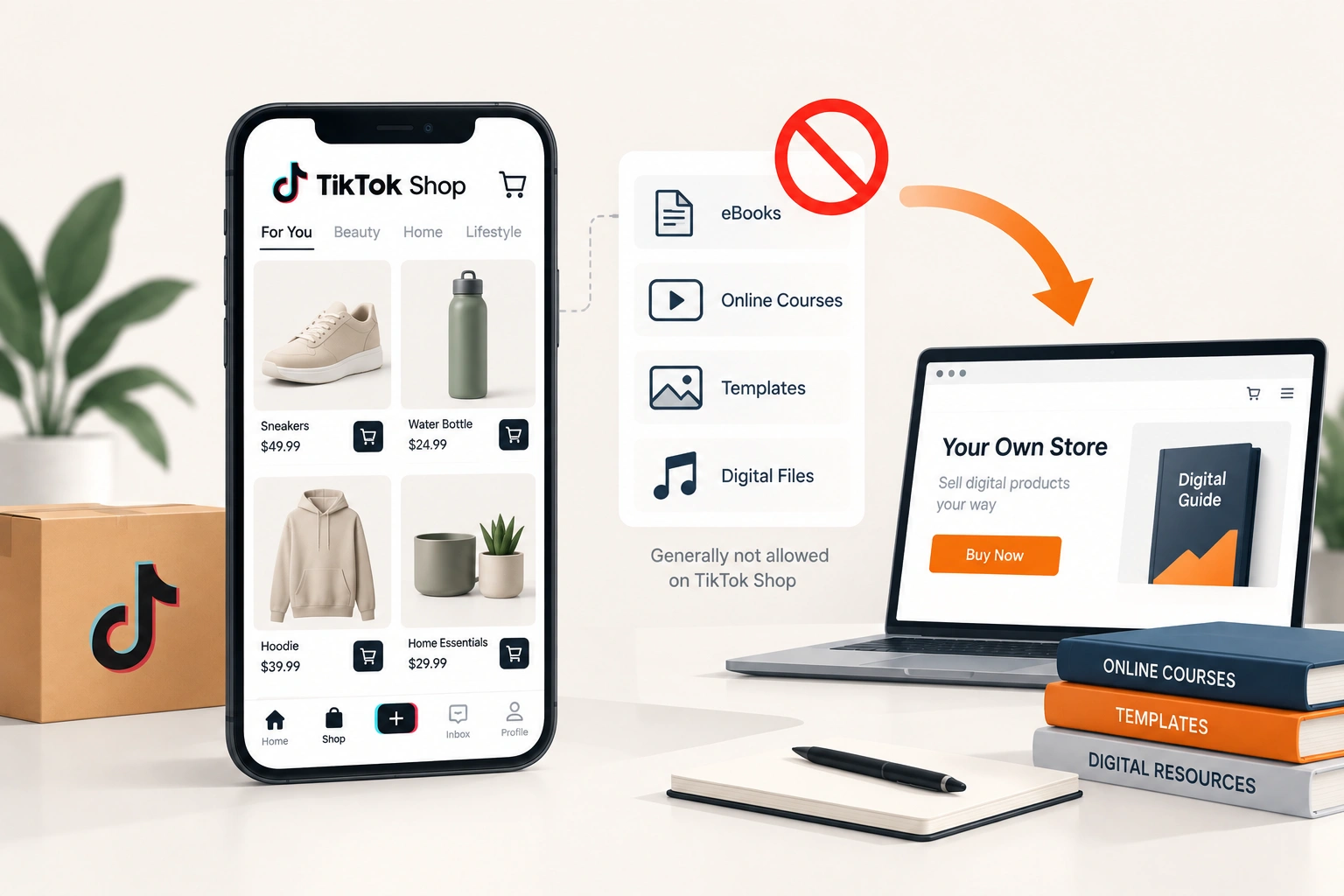
This is one of the most searched questions about the channel and it has a short answer that people do not like: TikTok Shop is built for physical goods, and digital products are not generally sellable through it.
The longer answer is worth having, because the workarounds circulating are mostly policy violations described as clever, and the legitimate routes are genuinely useful.
What the shop is built for
The whole apparatus assumes a physical item: shipping, tracking, delivery windows, returns, and performance measures built on all four. A file has none of those, so it does not fit the model the marketplace enforces.
Availability also varies by market and changes, which is why answers online conflict. The authority is the seller centre for your own market on the day you ask, not an article and not a video. The same caution applies to every marketplace rule that circulates as advice, on Walmart and eBay as much as here.
Where digital goods are supported at all, expect the categories to be narrow and specific rather than a general permission.
That is worth saying plainly because the question is usually asked by somebody who already sells a course, a template pack or a preset library and wants the audience this channel has. The audience is real and reachable. The checkout is the part that is not available to them, and the distinction matters: nothing stops a creator with a digital catalogue building a following here, it is the transaction that has to happen somewhere else.
The workarounds, and why they are a bad idea
Listing a physical item and delivering a file. This is misdescription, which is enforced. It also produces a stream of complaints from buyers who expected a parcel.
Shipping a card with a code on it. Sometimes permitted, often not, and it depends on the category rules rather than on the ingenuity of the idea. It also carries the cost and delay of shipping something almost worthless.
Listing a token item to move people off-platform. Off-platform diversion is against the rules on every marketplace, this one included, and the penalty is the account rather than the listing.
None of these is a loophole. They are the specific behaviours the policies exist to catch, and each one is easy to detect: a listing whose reviews all mention a download, a shipping cost that makes no sense for the item, a description pointing somewhere else. Enforcement on marketplaces is largely pattern matching, and these are the patterns.
What actually works instead
Sell the physical version. A printed book, a deck of cards, a kit, a bundle. If the value can exist as an object, the object can be sold here.
Use the content and sell elsewhere. TikTok is where attention is; the transaction can be on your own store, where digital goods are ordinary and there is no marketplace policy to work around.
Bundle. A physical product with digital material included is a physical product, and the digital part is a reason to choose yours.
Use the creator programme for what it is good at. Physical goods with affiliate commission is the mechanism this channel is built around, and it is a better lever than any workaround.
If you sell digital goods for a living
The honest structure is a store you control for the transaction, and content on TikTok for the audience. That separation costs you the in-app checkout and keeps you out of a policy fight you cannot win.
It also keeps the customer relationship, which a marketplace does not give you. For a business whose product is knowledge or files, the list is the asset.
Building that store and the content that feeds it is the pair of jobs our Shopify account management and design teams do together, with TikTok Shop handling whatever physical range sits alongside it.
How the rules differ from other marketplaces
Amazon sells digital goods in defined programmes with their own rules, so the answer there is yes with conditions rather than no. Selling on Amazon is a different question with a different answer.
eBay permits some digital items under specific conditions, and its rules have moved several times.
Walmart is physical goods on the marketplace.
Your own store has no marketplace policy at all, which is the whole argument for owning the channel where the transaction happens.
If the physical part of the range is what belongs on the channel, how to sell on TikTok Shop is the practical starting point for it.
Related reading: GMV Max, and What It Does With Your Budget, Live Shopping, and What It Actually Takes and The Video Formats That Actually Sell on TikTok Shop.
Frequently asked questions
The questions that come up most often on this subject.