Shopify vs Amazon FBA: Margin Against Traffic
Amazon rents you demand and takes a share. Shopify sells you the shop and leaves the demand to you. Most brands need both, in that order.


Loading Article banner
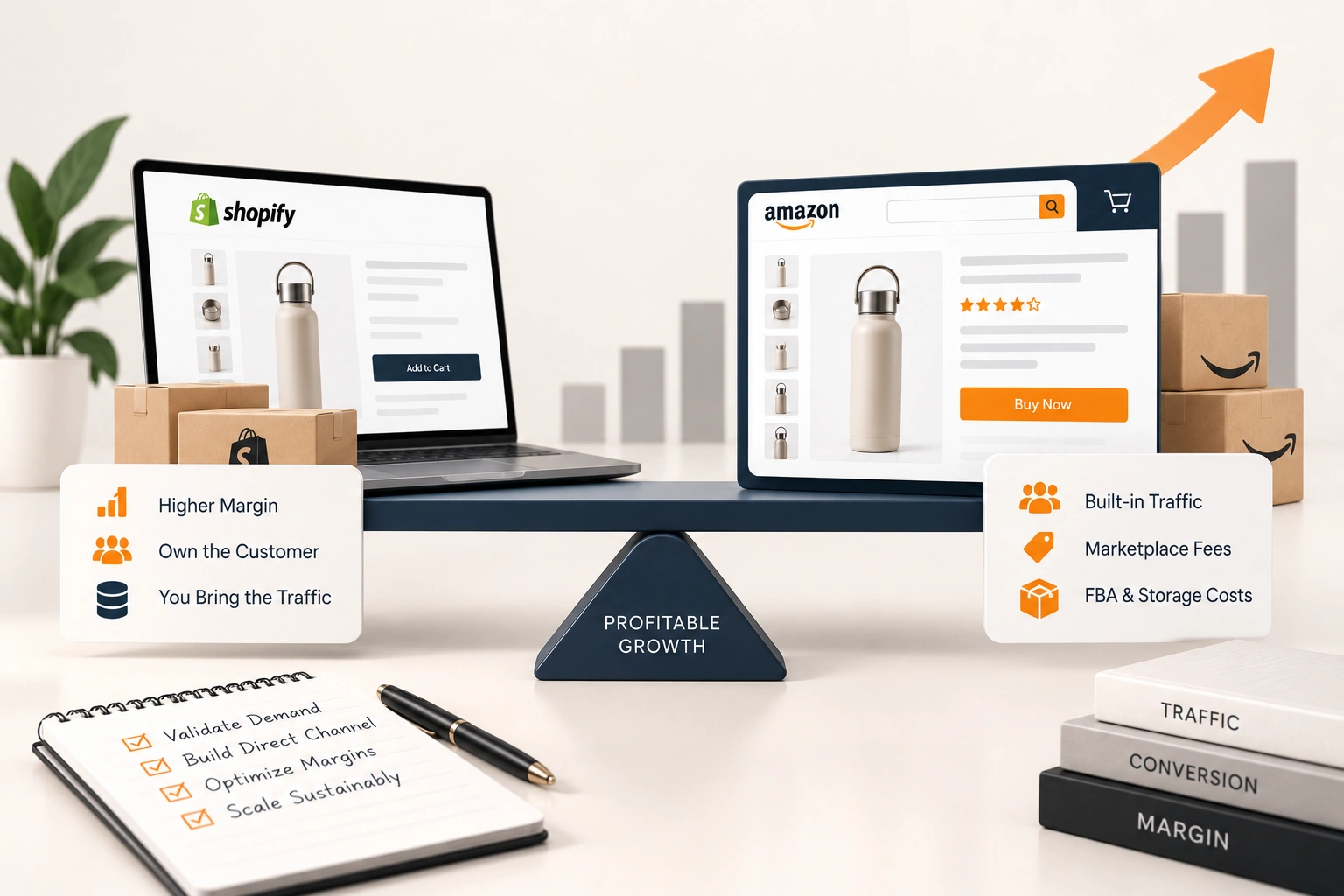
The comparison is usually presented as a choice, and for most brands it is a sequence. They solve different halves of the same problem.
Amazon has the demand and charges for access to it. Shopify has the margin and expects you to bring the demand yourself.
What each actually costs
On Amazon: a referral fee on every sale, fulfilment if you use FBA, storage while stock sits, returns handling, and advertising, which for most catalogues is now the cost of being visible rather than an option.
On Shopify: a platform subscription, payment processing, apps, and the entire cost of getting somebody to the site. That last item is the one that is missing from most comparisons, and it is usually the largest.
A brand comparing a marketplace fee against a Shopify subscription is comparing a number that includes the traffic against one that does not.
Who owns the customer
This is the honest argument for a direct store. On a marketplace the buyer is the marketplace's: you do not get the email address, you cannot market to them, and the relationship ends at the order.
On your own store you have the email, the purchase history and the ability to sell again at no acquisition cost. For a product with genuine repeat purchase, that changes the economics entirely, and it is the reason to build the store even while the marketplace pays the bills.
Where the traffic comes from
This is where most direct stores fail. A Shopify store with no traffic strategy is a beautifully built shop on a road nobody drives down.
The three that work are search, paid social and email, and they arrive at different speeds. Search compounds and is slow. Paid social is immediate and stops the day you stop paying. Email is the cheapest and only exists once the first two have delivered customers.
A brand that has not decided which of those it is investing in has not decided to have a direct channel.
The order that works
For most product businesses: prove demand on the marketplace, where the traffic already exists, then build the direct channel with the margin the marketplace generated.
The reverse order is possible and expensive. Buying traffic to prove demand for an unproven product means paying to learn something the marketplace would have told you for a referral fee.
The exception is a brand with an existing audience. If people already know who you are, the direct store is the right first channel, because the demand is not the thing you are missing.
Running both without starving one
Stock is the constraint that ties them together. A unit committed to a fulfilment centre is a unit the direct store cannot ship, and the allocation should follow margin after all costs rather than habit.
Pricing has to be deliberate too. Marketplaces compare your price against the open web, your own store included, and on some of them a cheaper price on your own site can take the listing off the marketplace. A promotion on the direct store is therefore a marketplace decision as well.
The two channels also inform each other: search terms that convert on a marketplace are the terms the store's product pages should be written around, which is the subject of product descriptions and supplier feeds.
What the store has to be good at
Speed, because a slow store loses the visitor before the product does. Product pages that answer objections rather than describing features. A checkout that does not ask for anything it does not need.
And measurement that reaches contribution margin rather than stopping at revenue, because a direct channel can be busy and unprofitable in a way a marketplace channel usually cannot.
What we do with this
We run both sides, which is the only way to answer the allocation question honestly: Shopify store management and Amazon account management under one plan rather than two agencies with two opinions.
The traffic for the direct side comes from search, from Google Ads and from Meta, and the same product research feeds all three.
If the question is which channel deserves the next quarter, that is where to start.
Frequently asked questions
The questions that come up most often on this subject.
They solve different halves of the problem. Amazon supplies demand and charges for it; Shopify supplies the shop and leaves the demand to you. For most product businesses the sequence is to prove demand on the marketplace and build the direct channel with the margin it generates.
Per order, the direct store, because there is no referral fee. In total it depends entirely on what the traffic costs, which is the number missing from most comparisons. A store with expensive paid acquisition can be less profitable than the marketplace it replaced.
Yes, and most established brands do. Share the inventory plan, because a unit committed to one channel cannot ship from the other, and be deliberate about price: marketplaces compare against the open web including your own site, and on some of them a cheaper direct price can suppress the listing.
Yes, and that is the strongest argument for a direct channel. You get the email address, the purchase history and the ability to sell again with no acquisition cost. On a marketplace the relationship ends at the order, and the buyer belongs to the marketplace.
None, until somebody buys it or earns it. That is the single most important sentence in this comparison. Search compounds slowly, paid social works immediately and stops when the spend does, and email only exists once one of the other two has delivered customers.
On the marketplace, unless the brand already has an audience. Buying traffic to test an unproven product means paying to learn something the marketplace would have told you for a referral fee. A brand people already know should start direct, because demand is not what it is missing.
Not directly. What can hurt is price: marketplaces compare your listing against the same item elsewhere, your own site included, and a promotion on the store can affect the listing's buy box or visibility depending on the marketplace. Coordinate the promotions rather than the platforms.
The subscription, payment processing and apps are the predictable part and rarely the large one. Acquisition is the real cost, and it is the number to model first, because it decides whether the extra margin per order survives the traffic that produced it.
Not directly, and attempting it through package inserts or messaging breaks marketplace policy. What works is being findable when the customer looks for the brand later, which is a search and brand problem rather than a redirection one.
Whichever earns more per unit after every cost, including the traffic. That is usually the direct store for repeat purchase products with a warm audience, and the marketplace for products whose demand is entirely search driven. It is an arithmetic question and it is worth doing per product.