Universal Cart, UCP and Meta's Agent Protocol: What AI Shopping Agents Read From Your Catalogue
In October 2026 Google launched Universal Cart in the US on its Universal Commerce Protocol, and Meta previewed a Personal Agent Protocol with Shopify, Stripe and Walmart among its partners. What each standard asks of a brand, in the companies' own words, and the product data work that serves every agent at once.


Loading Article banner
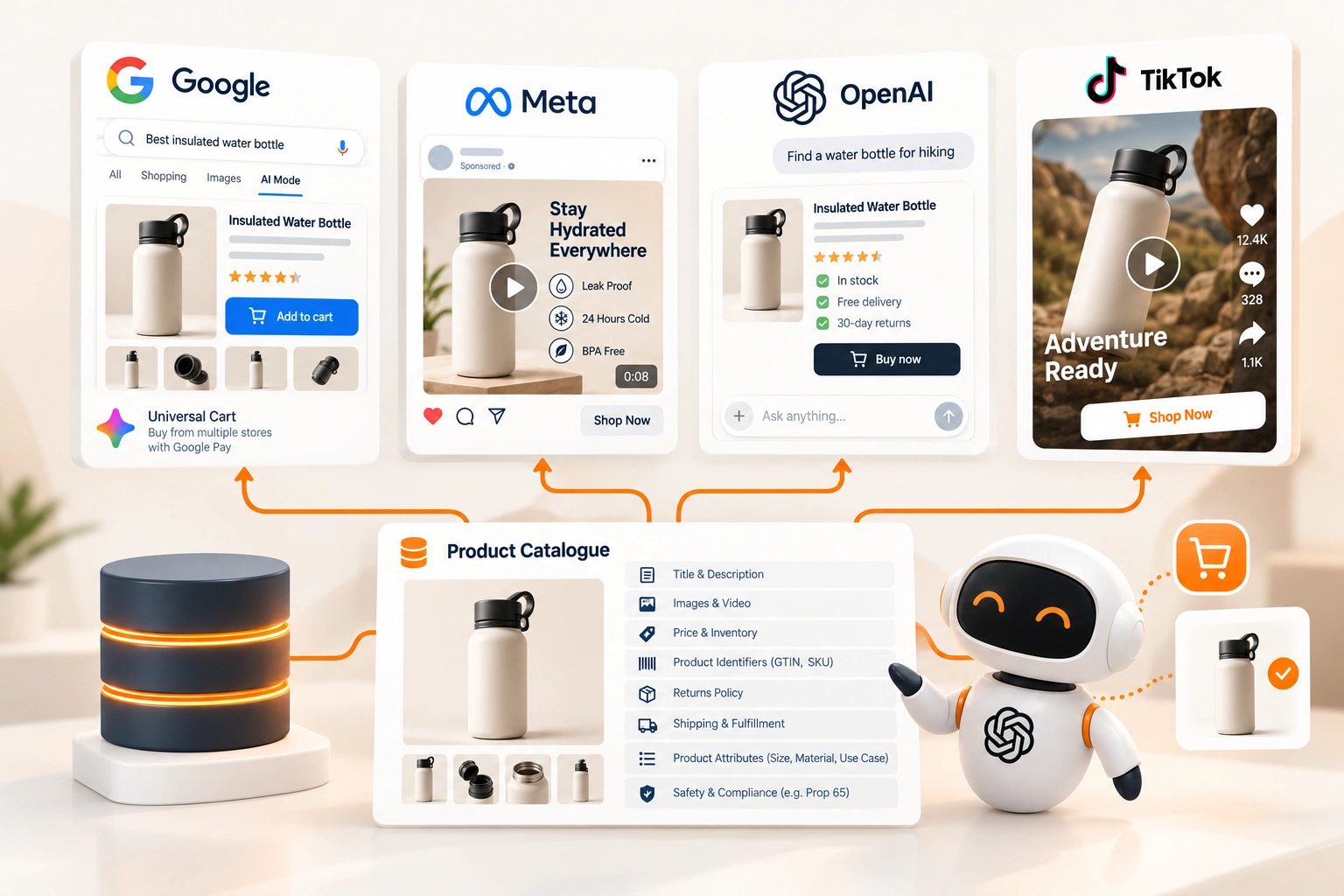
Two announcements nine days apart changed who reads a brand's product catalogue. On 6 October 2026 Meta previewed Personal Agent Protocol, "an open standard" that "defines how personal agents interact with businesses", with Shopify, Stripe and Walmart among its named partners. On 15 October Google wrote: "Today, Universal Cart is rolling out in the U.S. across Google Search and in the Gemini app", with checkout "powered by the Universal Commerce Protocol (UCP)".
Both are about software that shops on a person's behalf. Neither asks a brand to rebuild its store. What both read is the catalogue: the price, the stock, the returns policy, the identifiers, and the answers to the questions a shopper would have asked. This article sets out what each standard is in the companies' own words, what OpenAI's version asks for, and the product data work that serves all of them at once.
Google: UCP, Universal Cart and the Merchant Center feed
Google launched UCP in January 2026 as "a new open standard for agentic commerce" that "works across the entire shopping journey, from discovery and buying to postpurchase support", "codeveloped with industry leaders, including Shopify, Etsy, Wayfair, Target, and Walmart". Its first use was checkout on eligible product listings in AI Mode, paid with Google Pay, with the retailer remaining the seller of record.
Universal Cart is the shopper's side of it. In Google's launch post the cart holds items from several retailers, "is built on the 60+ billion continually refreshed product listings in Google's Shopping Graph", and sends notifications about "price drops or when an item comes back in stock". The shopper checks out with Google Pay or moves the items to the merchant's own cart. In May Google said UCP checkout would reach Canada and Australia in the coming months, and the UK later.
For a brand, the mechanism is Merchant Center. Google's developer guide for UCP (updated 2 October 2026) lists what a merchant needs: "a Merchant Center account in good standing and approved products for free listings"; return policies defined in Merchant Center, "as it is a Merchant of Record requirement", with "return cost, return speed (window), and a link to the full policy"; at least one customer support contact; and consumer notices, "mandatory for items with regulatory warning requirements (e.g., California Proposition 65)". Checkout is opt-in per product through the attribute native_commerce(checkout_eligibility), which "defaults to FALSE", and subscriptions, personalised goods, pre-orders, age-restricted items and freight deliveries are among the exclusions.
Google has also added product data built for conversation. In January it announced "dozens of new data attributes in Merchant Center" covering "answers to common product questions, compatible accessories, or substitutes", and in May it said retailers globally can use conversational attributes "to update their product descriptions to reflect the more conversational way people search".
Meta: Personal Agent Protocol
Meta's announcement is a preview, with no dates, regions or published specification. What it describes is the other direction: not a shopping surface that reads a feed, but a standard for how a shopper's own agent behaves on a business's website. Meta says a business should be able "to guide personal agents in how to use its website", to send them to a connector or a structured source (its example is checking "this structured source for real-time inventory"), and to have "visibility into what personal agents do through their websites, APIs or company agents". It was developed with Sierra, the named partners are Genesys, NiCE, Decagon, Rocket, Shopify, Stripe and Walmart, and the protocol is "open for anyone to implement".
The practical reading is that an agent will be told where a business's authoritative stock and price live, and a brand that cannot point to one source has nothing to tell it. Meta says its own assistant, Muse, can already make purchases, and that it "will seek approval for sensitive actions taken on your behalf".
OpenAI: the Agentic Commerce Protocol feed
OpenAI's developer documentation describes the merchant's side of its Agentic Commerce Protocol in a sentence that could stand for all three: "Merchants provide a secure, regularly refreshed feed (CSV or JSON) containing key details such as identifiers, descriptions, pricing, inventory, media, and fulfillment options", starting with a sample feed for validation and then "daily snapshots". As with Google, "OpenAI is not the merchant of record". OpenAI's merchant page refused our reader, and trade coverage reports that its checkout plans changed during 2026, so that part is reported: check OpenAI's current merchant terms before building anything around checkout in ChatGPT.
What every agent reads, and what to fix first
Set the three side by side and the overlap is the whole job. Each reads the same product record, and each depends on it being true at the moment the agent asks.
Price and stock, live. Universal Cart tells a shopper when a price drops or an item returns to stock, so the feed's price and availability are now something a shopper is notified about, not only something a listing displays. A feed that updates once a night, or a stock field that says in stock for a product the warehouse has run out of, is a promise an agent will pass on.
One identifier per product, everywhere. Google's guide lets merchant_item_id take precedence over the feed's id in agentic requests, which helps only if each product carries the same identifier in Merchant Center, the store and the marketplaces. Product descriptions and supplier feeds covers where catalogues drift apart.
Returns, support and notices as data. A return window, a return cost and a policy link in Merchant Center; a support contact; Proposition 65 warnings where they apply. Most stores have all of these on a page. Fewer have them in the feed, and the feed is what the agent reads. On Shopify, return window overrides by product, collection and market are the settings to reconcile with it first.
The answers, as attributes. Compatibility, what is in the box, how a product compares: written into the product data rather than only into the description. This is the discipline of structured data for online stores, with a reader that now acts on it.
What each channel already does. A Shopify store may already be sharing products with AI channels by default, which Shopify's agentic storefronts sets out. Read those settings before adding anything new.
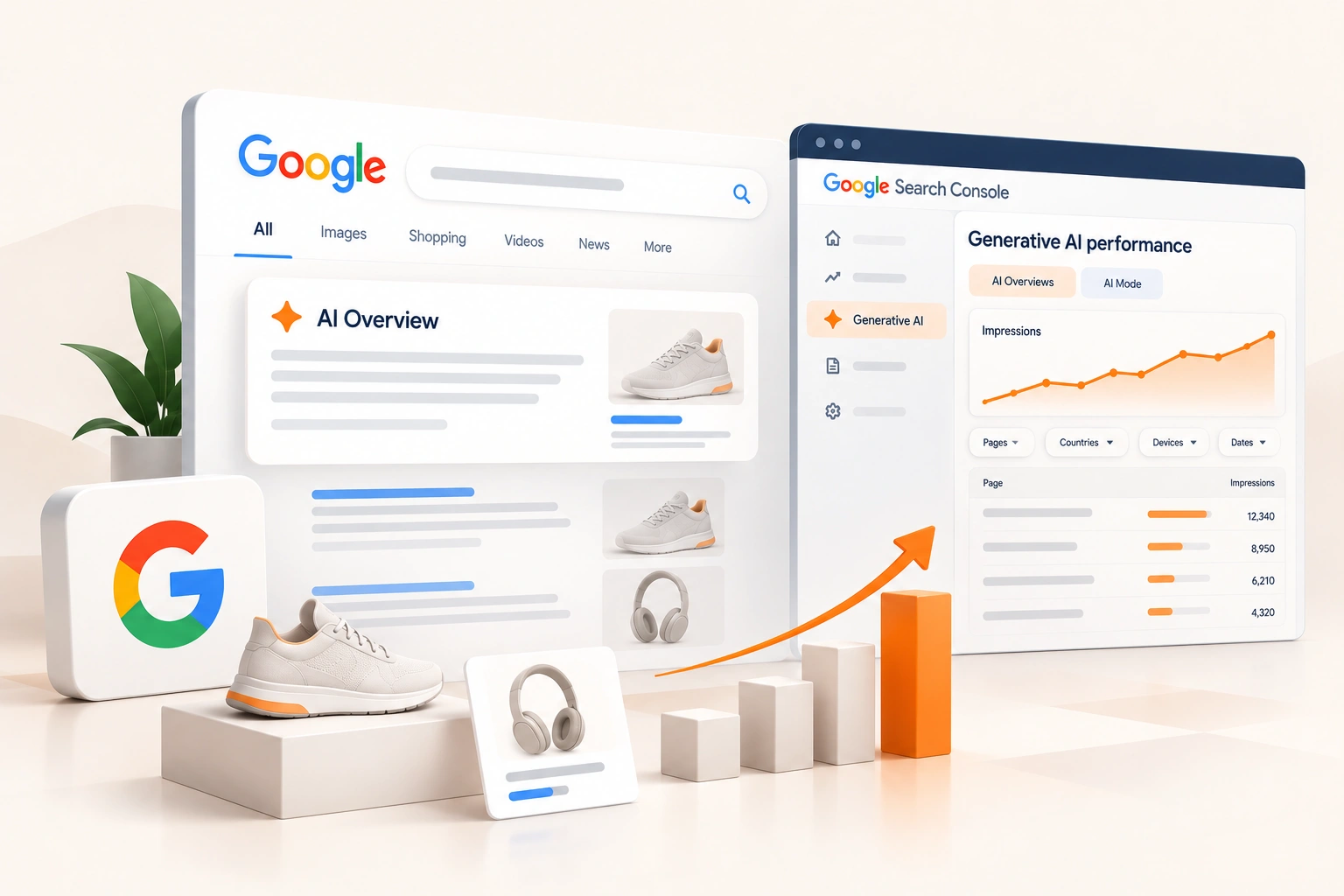
How it is measured. Google's May post said an AI performance insights tool in Merchant Center will compare a brand's share of voice on AI surfaces, rolling out in Australia, Canada, India, New Zealand and the US in the coming months. Until it arrives, Search Console's generative AI report is what an online store can see.
Where we fit
None of this needs a new platform. It needs one product record that is accurate wherever an agent might read it, and kept that way as prices and stock move. That is the catalogue work at the centre of our commerce services: listing content, attributes, identifiers, price and availability treated as one system, because Google's cart, Meta's agents and OpenAI's feed read them as one. If you would like to know what an agent sees when it reads your catalogue today, a Merchant Center export is where we would start.
Frequently asked questions
The questions that come up most often on this subject.
An open standard Google launched in January 2026 for agentic commerce, covering the journey from discovery and buying to post-purchase support. Google co-developed it with Shopify, Etsy, Wayfair, Target and Walmart. It powers checkout on eligible Google product listings in AI Mode and in Universal Cart, with the retailer remaining the seller of record.
A shopping cart that works across retailers, which Google began rolling out in the US on 15 October 2026 in Search and the Gemini app. It is built on the product listings in Google's Shopping Graph, notifies shoppers about price drops and items back in stock, and lets them check out with Google Pay or move the items to the merchant's own cart.
Through Merchant Center. Google's guide asks for an account in good standing with products approved for free listings, return policies defined in Merchant Center with the cost, the window and a policy link, a customer support contact, and consumer notices where a product needs a regulatory warning. Each product opts in with the native_commerce(checkout_eligibility) attribute, which defaults to false, and some types, such as subscriptions, pre-orders and personalised goods, are excluded.
An open standard Meta previewed on 6 October 2026 for how personal agents interact with businesses: how a business guides an agent through its website, points it to sources such as real-time inventory, and sees what agents do. It was developed with Sierra, with Shopify, Stripe and Walmart among the named partners. Meta has published no dates, regions or specification yet.
No. Google's Merchant Center feed, OpenAI's feed and the sources Meta's protocol points agents to all ask for the same things: identifiers, descriptions, price, stock, media, fulfilment and returns. The work is keeping one product record accurate and current in every system that publishes it, not building a feed for each agent.