eBay Categories That Require Additional Readiness: Who It Affects and How to Qualify
Since 13 July 2026 eBay has gated some categories behind account standing and selling history for sellers registered in covered countries, and it does not publish which categories. What the policy says and how an account qualifies.


Loading Article banner
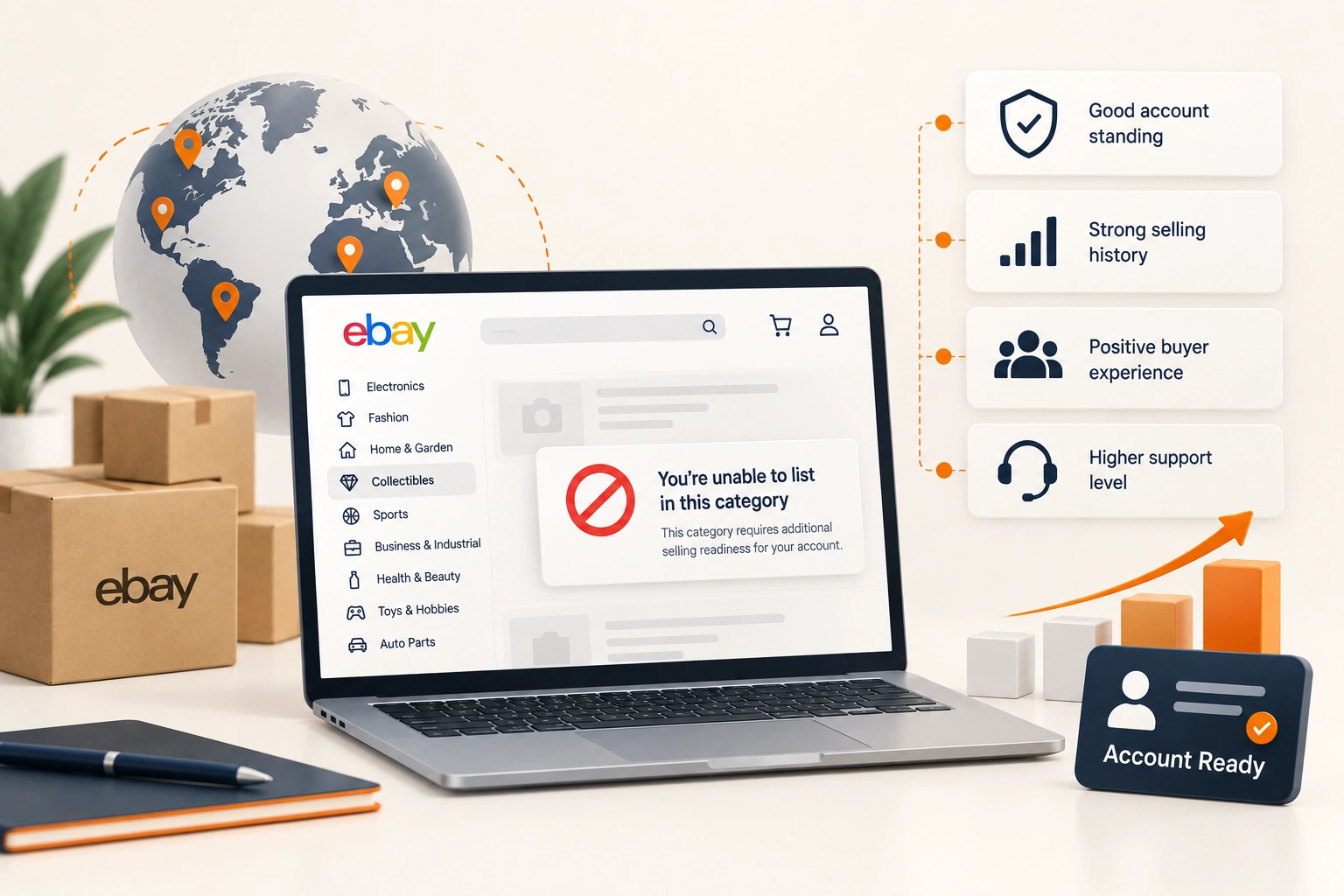
Since 13 July 2026, sellers registered in a set of countries eBay calls covered have had to meet additional selling readiness requirements before they can list in certain categories. If your account does not qualify, you find out when you try to create the listing.
It is an unusual policy in one specific way: eBay does not publish the list of categories it applies to. That is deliberate, and it changes how a seller has to deal with it, because there is nothing to look up and check against.
What the policy says
eBay's wording is that from 13 July 2026, sellers in covered countries need to meet additional selling readiness requirements before listing in certain categories that require extra safeguards. Sellers who do not meet the qualification criteria may be unable to create new listings in those categories, and existing listings that do not meet policy requirements may be ended.
The reason given is that some categories involve higher value, higher complexity or higher risk transactions, and that the policy exists so sellers listing in them have the right account standing, selling history, buyer experience performance and support level for the transaction to go smoothly.
Read plainly, this is eBay deciding that certain categories are not a place for a new or thinly performing account to start.
Who it applies to
The test is where the account is registered. eBay applies this to sellers whose registered account address is in one of the covered countries, and the list is long: it runs to well over a hundred, and includes markets such as India, Brazil, Mexico, Nigeria and Vietnam. The policy page carries the current list, and it is the only place worth checking, because a third party summary of it dates the moment eBay adds a country.
This is the point most coverage gets wrong. It is not a global change to how eBay handles risky categories. It is a readiness requirement attached to where a seller is registered, which means two accounts with identical performance can get different answers on the same category.
If you sell into the United States or the United Kingdom from one of those markets, this is your policy even though the buyers are not in a covered country.
Why eBay does not publish the list
eBay says it does not publish a specific list of the categories in order to protect the integrity of the marketplace and prevent misuse of the policy, and that if a category is not currently available to your account, you will be notified when you attempt to create a listing.
That is a reasonable position and an awkward one to plan around. It means a seller cannot confirm in advance whether a new product line is listable, and the only reliable test is to attempt a listing before committing to stock. Anyone sourcing into a new category from a covered country should run that test first, at the point where the decision is still cheap.
What qualifies an account
Four things, in eBay's own words: account standing, selling history, buyer experience performance, and support level. The policy is not more specific than that, and it should be read as eBay reserving discretion rather than as a checklist with a passing mark.
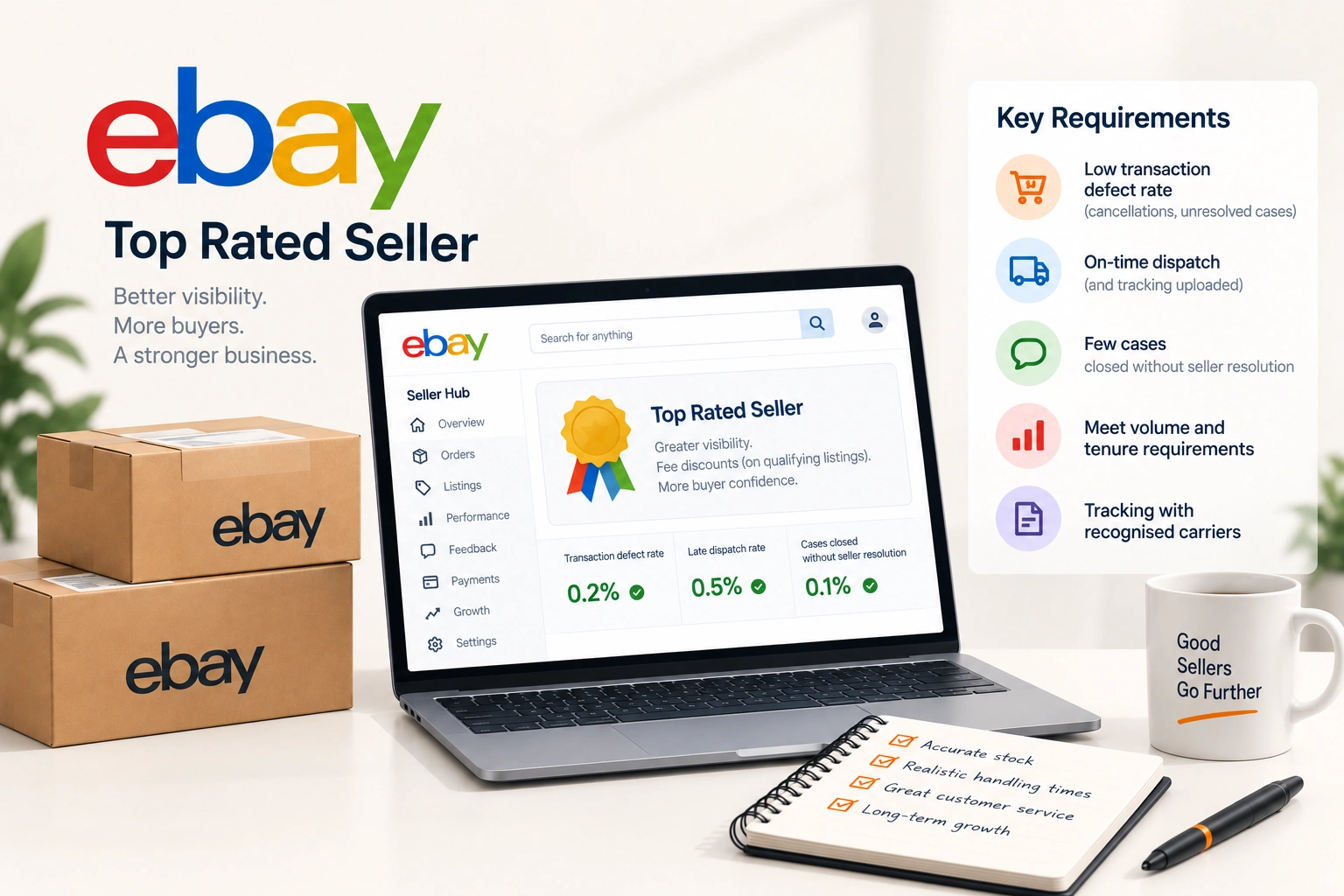
In practice the things inside those four are the ones eBay already measures. Account standing means no open policy issues and no defect problem. Selling history means volume and time, not a promise. Buyer experience performance means the metrics behind Top Rated Seller status: late dispatch, tracking uploaded on time, cases closed without seller resolution, feedback.
Support level is the least familiar of the four and probably means the account's level of eBay support and relationship, which is a function of volume and standing rather than something a seller elects.
What happens to listings you already have
eBay states that existing listings which do not meet policy requirements may be ended. Not hidden, not flagged. Ended.
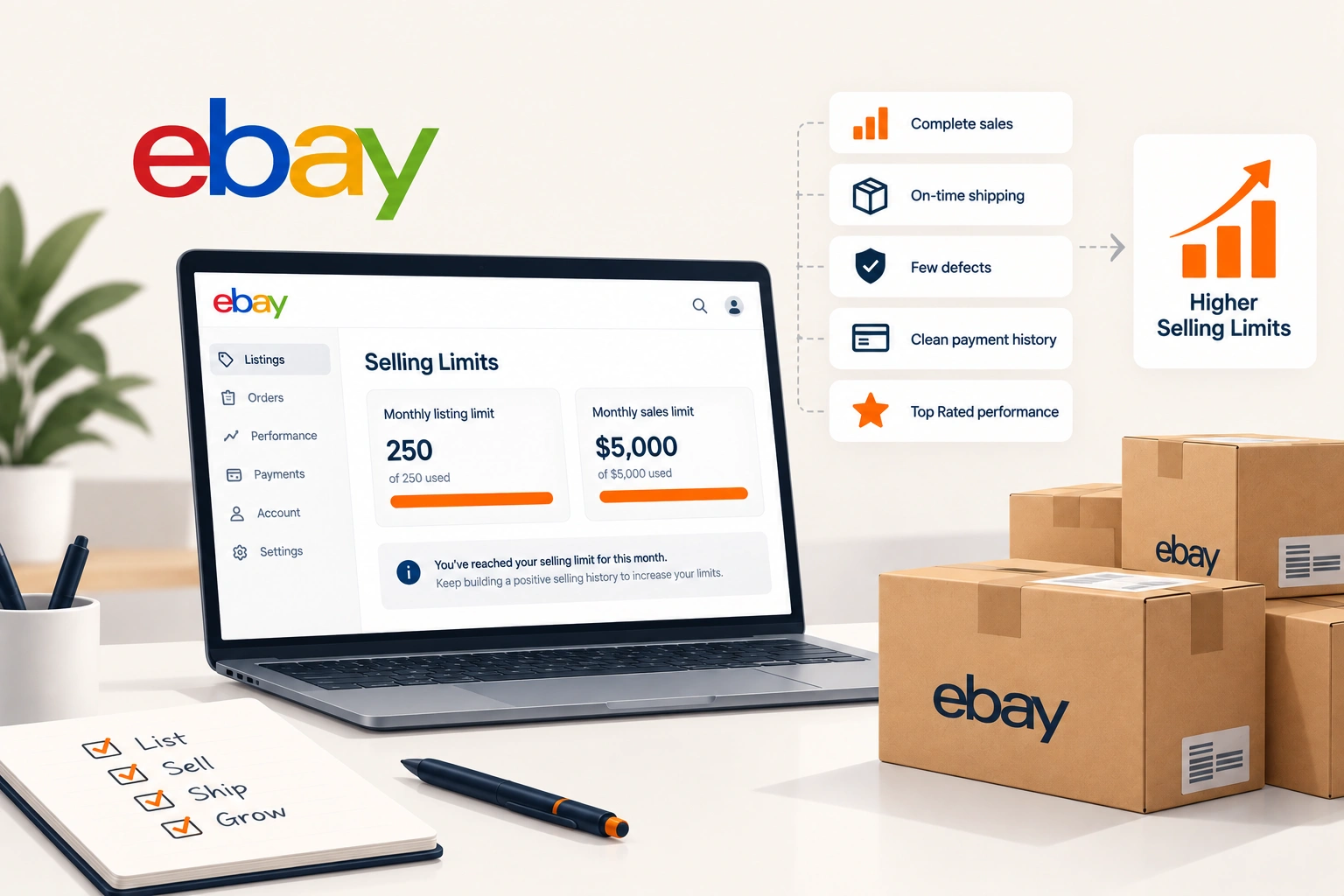
For a seller with stock committed to a category, that is the risk worth taking seriously, and it is a different risk from a selling limit. A limit caps quantity and value and is visible in Seller Hub with a route to request an increase. This does not cap anything. It removes access to the category, and the route back is account performance over time.
The route back
eBay says it reviews relevant accounts periodically, and that if your account meets the qualification criteria you may be enabled to list in these categories in the future. There is no application form described, and no stated timeline.
So the work is the ordinary work, done deliberately: clear any open policy issues, build selling history in categories that are open to you, and get the buyer experience metrics into the band where an account looks established. Staying inside seller protection matters more than usual here, because a case decided against you is a mark on exactly the record being reviewed.
Dispatch time and tracking are the fastest levers. They are also the two that Best Match rewards, so the effort is not wasted even if the category never opens.
What to do if a category has closed on you
First, confirm what you are looking at. The notification appears when you attempt to create the listing, and it is easy to confuse with a category specific requirement such as an authenticity or documentation rule, which is a different thing with its own route.
Second, move the stock rather than waiting. A product that cannot be listed in its natural category on eBay is not automatically stuck: it may list in an adjacent category that is open, and it will list on other marketplaces. Sellers who keep stock idle waiting for an account review pay for the wait twice.
Third, treat the account as the asset. The categories that require readiness are the ones with margin in them, which is exactly why they are gated, and an account that qualifies for them is worth more than one that does not. That is an argument for running the account as a business rather than as a channel that gets attention when Amazon is quiet.
Where this goes next
The direction is not in doubt. Every marketplace is moving the same way: access to the profitable parts of the catalogue is becoming a reward for performance rather than a default, and the accounts that get there first get a quieter market to sell into.
Getting an account from restricted to qualified is unglamorous work on dispatch, tracking, cases and standing, over a period eBay does not publish. It is the substance of eBay marketplace management, and it is worth starting before a category you want is the reason you noticed.
Frequently asked questions
The questions that come up most often on this subject.
eBay does not publish the list. It says withholding it protects the integrity of the marketplace and prevents misuse of the policy, and that you will be notified when you attempt to create a listing in a category that is not currently available to your account. The practical test is to attempt a listing before you commit to stock.
The policy applies to sellers whose registered account address is in one of the covered countries. That list is long and includes markets such as India, Brazil, Mexico, Nigeria and Vietnam. Check eBay's policy page for the current list rather than a summary of it, because countries can be added.
Yes. eBay states that existing listings which do not meet policy requirements may be ended. That is the main reason to treat it as a stock risk rather than as a listing inconvenience.
There is no application described. eBay says it reviews relevant accounts periodically and that an account meeting the qualification criteria may be enabled in future. The four things named are account standing, selling history, buyer experience performance and support level, so the work is clearing policy issues, building history and improving dispatch, tracking and case outcomes.
No. A selling limit caps how much you can list and sell, is visible in Seller Hub, and has a route to request an increase. Category readiness removes access to a category entirely, is not published, and reopens only on a periodic account review.