Most eBay guides are written for somebody selling a bicycle. A business adding eBay as a channel is registering an entity, taking payouts into a company account, listing a catalogue rather than an item, and asking to be ranked against sellers who have been on the platform for fifteen years.
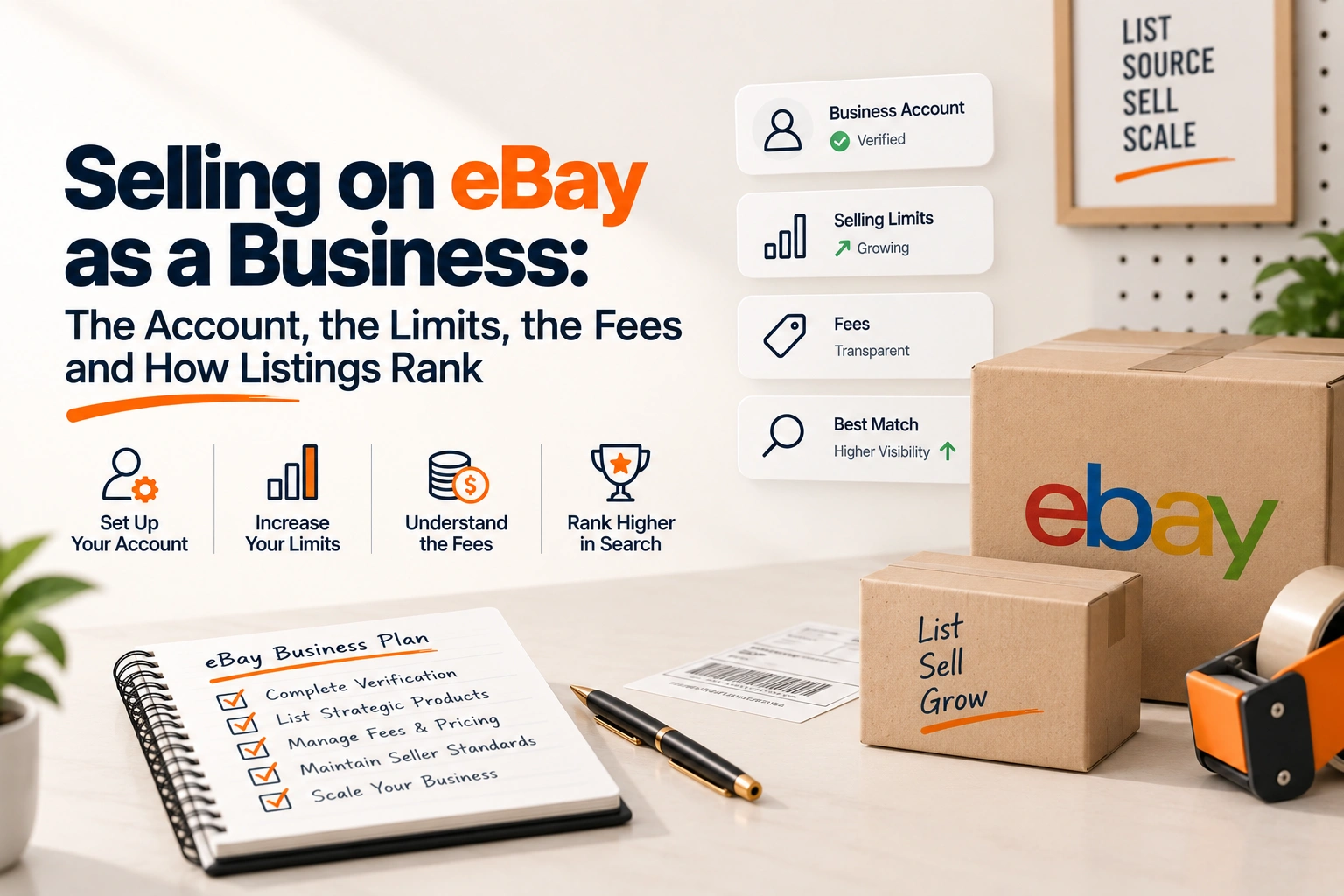
eBay treats the two differently from the first form onwards: the account type decides what verification asks for, the selling limit decides how much of the catalogue goes live in month one, the fees decide the price, Best Match decides who is seen, and seller standards decide the fee discount and a share of the ranking. This is the map of that system. Each part has its own article one level down.
eBay offers two account types at registration, individual and business. A registered business, whether a sole proprietor, an LLC, a corporation or a partnership, selects business, and eBay asks for the legal business name as it appears on the registration documents, any Doing Business As name, the business address, and identification for everyone with control of the business: the primary contact, beneficial owners, directors, partners and principal officers.
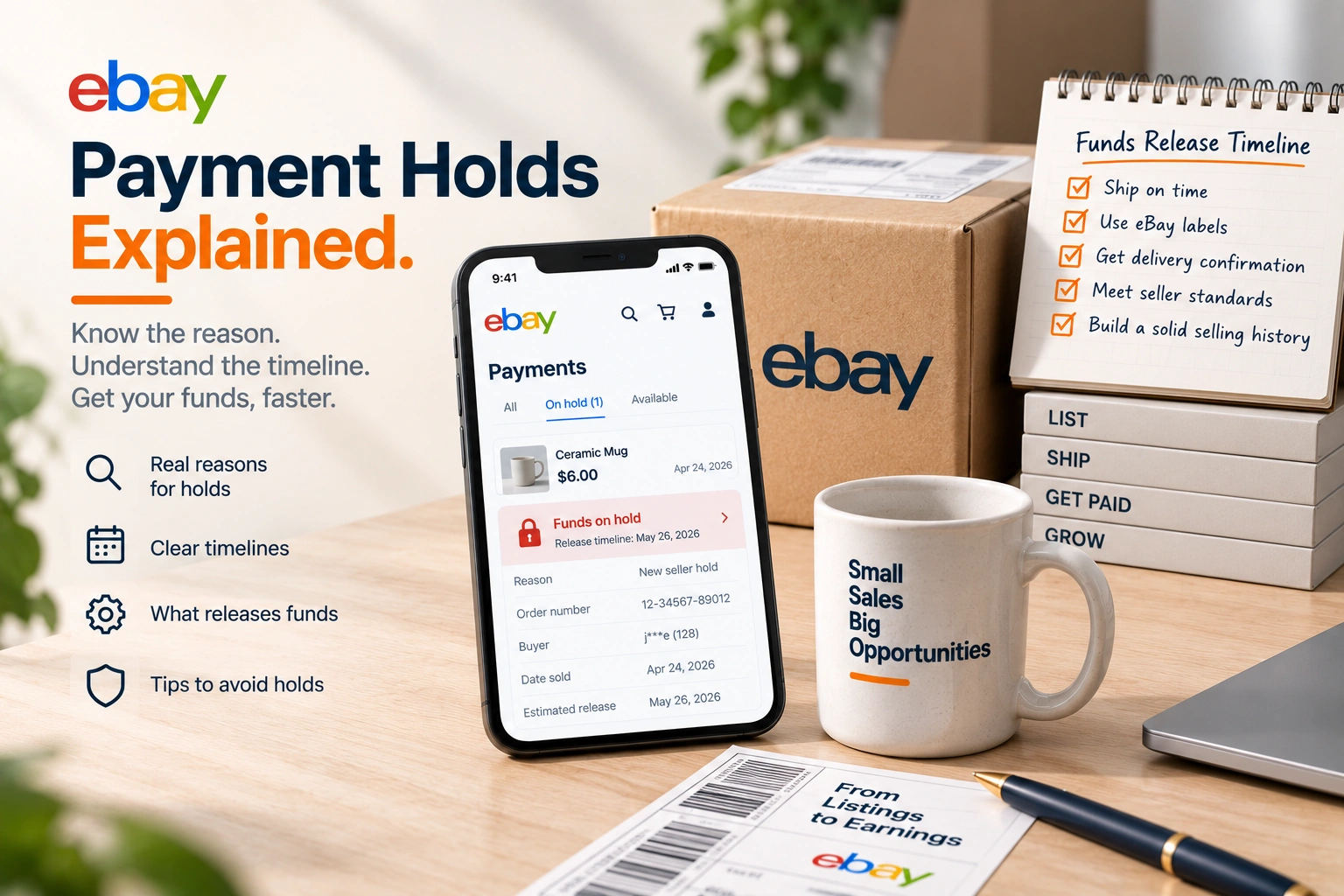
It also asks for a tax identification number, an Employer Identification Number for a business or a Social Security Number for an individual, and for the account payouts go to. That account has to match: eBay's rule is that the business name on the checking account is the same as the name on the eBay account, and a business eBay account needs a business checking account. Payouts are held until the details are verified, and eBay verifies again whenever a relevant detail changes.
Every later step reads from this form: the limit review, the year end tax form, and a request to raise limits, which may ask for business details an individual account was never asked for. An account started under a personal name and moved later earns a second verification at the moment it is least convenient.
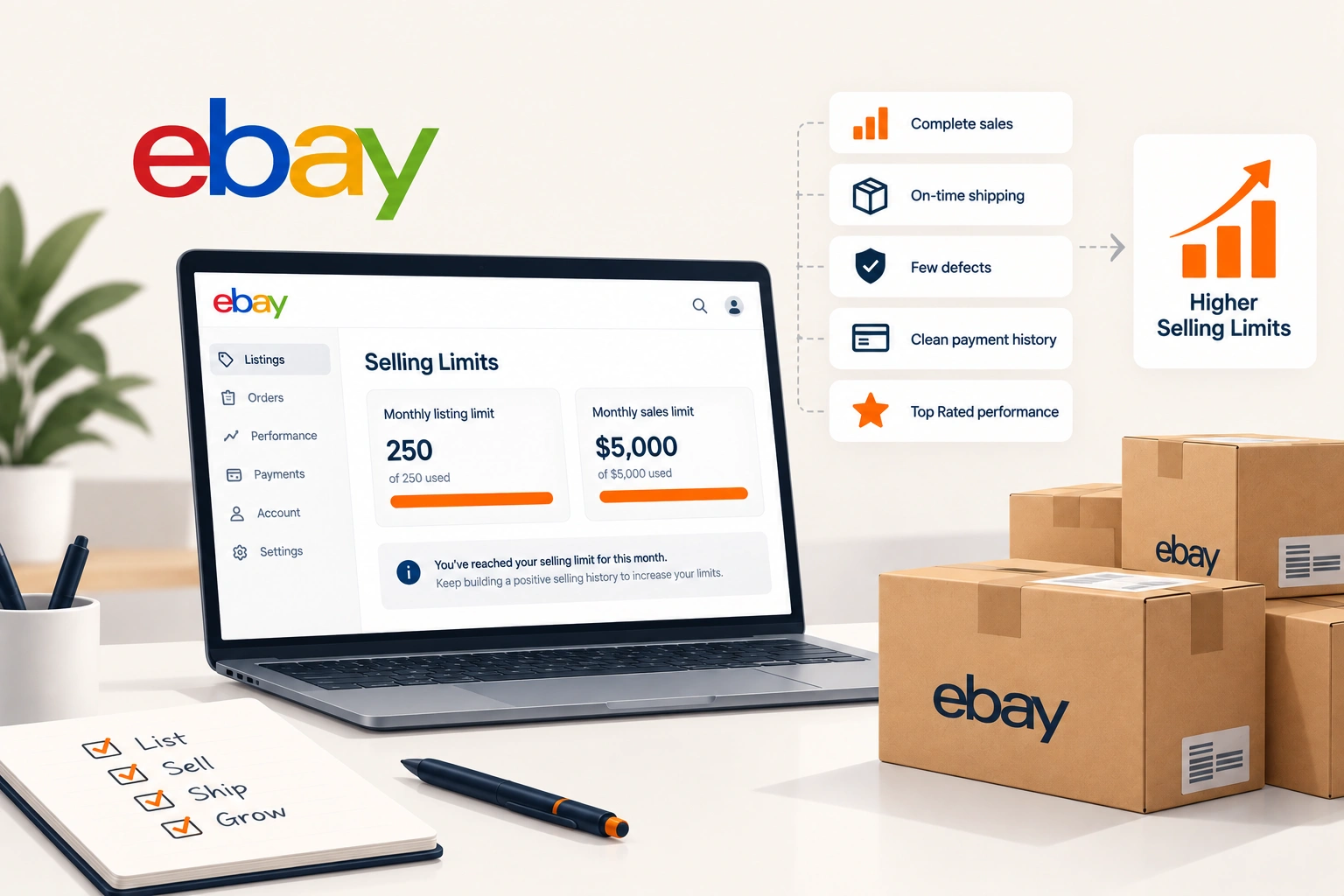
A new account cannot list its whole catalogue. eBay sets a monthly selling limit, a cap on the number of items and their total value, described as a way to grow "in a manageable way" while the account proves it can serve buyers. The starting figure is not published; new accounts commonly report a limit in the region of ten items and a few hundred dollars, which is a reported experience rather than a rule.
What is published is how it moves. eBay reviews every account monthly and raises the limit automatically on sales volume and buyer feedback, and a seller can request an increase before that, from the message eBay sends as the limit approaches. A request may ask for contact or business details, which is the second place the business registration pays off.
For a catalogue business that means sequencing. The first month's slots go to the lines with the best margin and the surest stock, because their sales and feedback earn the next month's limit; the slow lines spend it on transactions that do not come. The mechanics, and what to do when a request is refused, are in
how eBay selling limits work and how to raise them.
The fees below are as eBay publishes them for its US site in September 2026. They change, so the fee page is the last word before a price is set.
Listing. Every account gets 250 zero insertion fee listings a month, more with a Store subscription, and pays $0.35 per listing beyond that.
Selling. In most categories the final value fee is 13.6% of the total amount of the sale, which includes item price, shipping and any tax collected, up to $7,500 per item, and 2.35% on the portion above $7,500. On top of that is a per order fee of $0.30 for orders of $10 or less and $0.40 for orders over $10. A US seller shipping to a buyer outside the US without eBay International Shipping pays an international fee of 1.65% of the total amount.
Stores. A Store subscription buys more free listings and lower insertion fees beyond them: Starter at $4.95 a month on a yearly plan ($7.95 month to month) with 250 fixed price listings, Basic at $21.95 ($27.95) with 1,000, Premium at $59.95 ($74.95) with 10,000, Anchor at $299.95 ($349.95) with 25,000, and Enterprise at $2,999.95 a year with 100,000. The arithmetic is simple: a catalogue of 1,000 active listings pays about $262 a month in insertion fees without a Store and $21.95 with a Basic one, so a Store pays for itself from roughly the 320th listing.
Advertising. Promoted Listings with the general strategy charge an ad rate the seller chooses, between 2% and 100% of the total sale amount, and only when the promoted item sells within 30 days of a click on the ad. eBay suggests a rate per listing, and a dynamic rate follows the suggestion daily. Only Above Standard and Top Rated sellers with enough account activity can promote, which is one more reason the standards below matter early.
Put together on one order: a $40 item with $6 shipping is a $46 sale. The final value fee is $6.26, plus the $0.40 order fee, which is $6.66, or 14.5% of what the buyer paid. An 8% ad rate adds $3.68 and takes the platform's share to 22.5%, before postage, packaging and the cost of the goods. That is the number a price has to be built on, and it is why
a repricing strategy that only chases the lowest price on the channel ends in sales that lose money.
eBay's default sort is Best Match, and eBay lists what it weighs: how closely the listing matches the search terms, how popular the item is, its price, the quality and completeness of the listing, the terms of the offer such as returns and handling time, and the seller's track record. Half of that list is the listing and half is the seller, which is the half a business arriving from its own store or from Amazon tends to miss.
On the listing side eBay's guidance is specific: a title of no more than 80 characters, correctly spelt; item specifics such as make, model, size, colour and style, because they feed the filters and the relevance; up to 24 photos, free; a description built from the catalogue's product details; and the most relevant category. Item specifics are the field imported catalogues leave half empty, and a listing missing a specific a buyer filters on is not ranked lower, it is removed from the results. The signals, and the two a seller can move in a day, are in
how eBay listings actually rank.
eBay grades every seller against thresholds it publishes. Top Rated needs an account at least 90 days old with at least 100 transactions and $1,000 in sales to US buyers over the past 12 months, a transaction defect rate of no more than 0.5% involving no more than three different buyers, no more than two cases (or 0.3% of transactions) closed without seller resolution, no more than five late shipments (or 3% of transactions), and tracking uploaded within the handling time and validated by the carrier on at least 95% of transactions.
A Top Rated seller who also offers same day or one business day handling and 30 day or longer free returns on a listing earns Top Rated Plus on it: a 10% discount on the final value fee, which on the $46 order above is $0.63 back, and across a thousand orders a month is the Store subscription several times over. At the other end an account falls Below Standard at a defect rate above 2% or cases closed without resolution above 0.3%, cannot promote, and ranks behind the accounts that are not.
A business on eBay is running stock, prices and cases across a channel that reads all three. Stock first: an oversold order is a cancellation, a cancellation is a defect, and a defect counts against the standards above, so a catalogue sold on more than one channel needs its quantities held in one place and pushed to eBay, which is the subject of
eBay inventory management. Prices next: the fee share above is the floor, and a rule that reprices below it pays eBay to sell at a loss. Cases last: a case left to eBay to decide is the metric that reaches Below Standard fastest, so cases are a same day job from the first order.
The sourcing decision sits above all of it. A line that sells on Amazon does not automatically sell on eBay, where the buyer is comparing condition and price across many sellers rather than buying the first Prime result;
where to source products to sell covers the models that suit each channel.
Register as a business, with the entity's legal name, the EIN and a business checking account in the same name, and wait for verification before listing. Put the first month's limit on the lines with the best margin and the surest stock. Fill every item specific eBay marks recommended for the category before writing a clever title. Set one business day handling and 30 day free returns from the start, so the hundredth transaction is the day Top Rated Plus and its fee discount arrive. Request the first limit increase as soon as the limit is in sight, with the business details ready.
That sequence is what we run for brands whose eBay channel is one of several, through our
eBay marketplace management: the account and its verification, the catalogue and its specifics, the pricing against the real fee share, and the standards watched daily, so the channel is earning its next limit rather than its first warning.