eBay Live for Sellers: Eligibility, Formats, Fees and the Rules of a Stream
eBay is inviting sellers to its live selling webinar and opening new categories. Who gets access to eBay Live, what can be sold in a stream, how auctions, Buy It Now and flash deals work on air, the eight hour shopping window, the conduct rules, and what live sales do to your seller standards from 15 October.


Loading Article banner
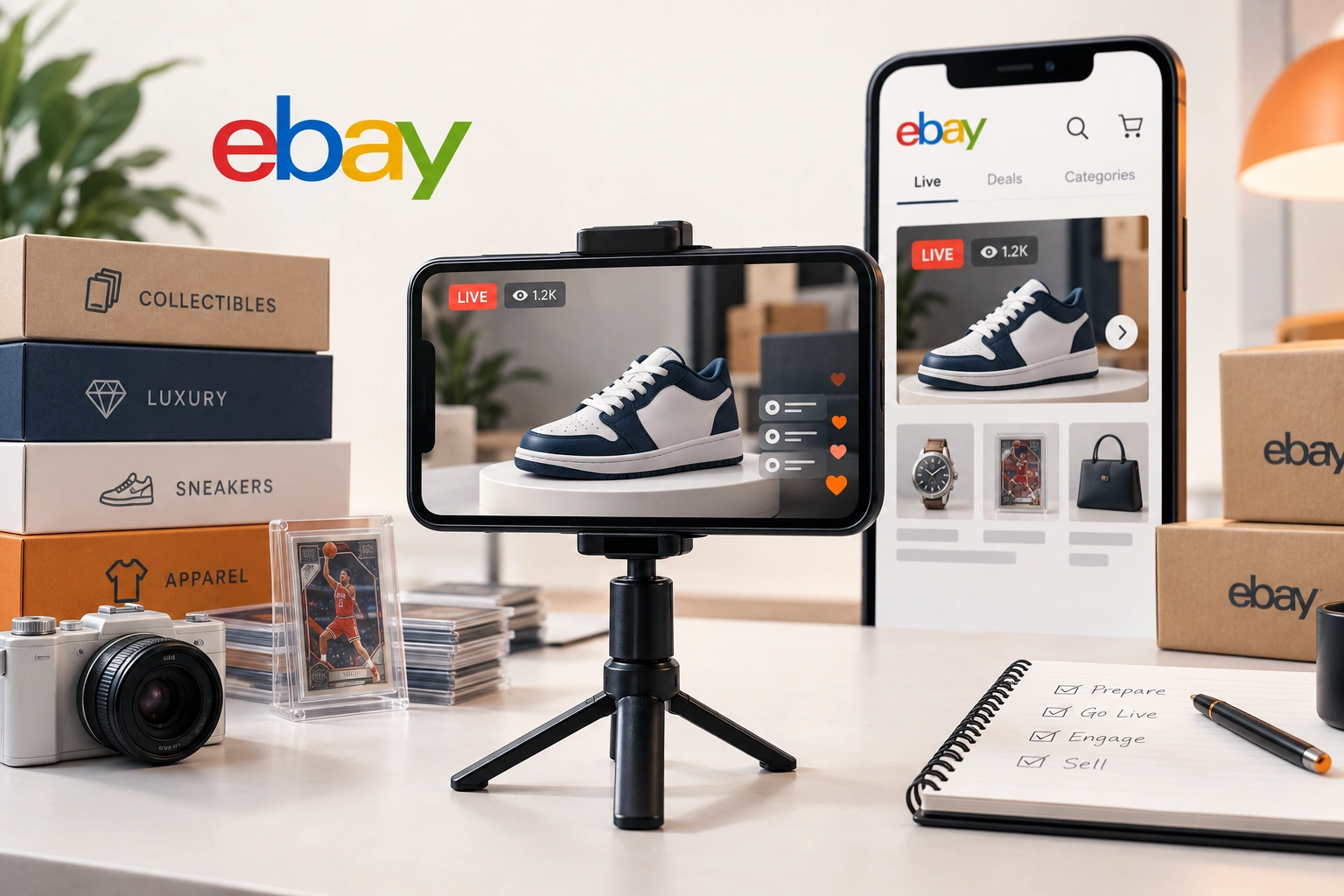
eBay has spent September inviting sellers to a webinar on selling live, and the front page of the eBay Community carries the invitation twice. Behind it is a channel that has been in beta for a while and is now opening a category at a time: eBay Live, where a seller streams from a desk, a buyer in the app watches, asks and bids, and the sale closes on air. The seller press reports that registration opened to eligible US sellers across more than three hundred categories in July, that a sales match promotion ran in the second week of September, and that from 15 October live transactions leave the seller standards altogether.
This article is the seller's side of it, from eBay's own pages: who gets in and how to ask, what can be sold on a stream, what you need on the desk, how the formats work on air, the shopping window that decides when handling time starts, the rules a stream has to keep, and what eBay has told sellers about fees and standards. The judgement at the end, whether it is worth your hours, is the same one live shopping on TikTok asks, with different arithmetic.
What eBay Live is, and where buyers watch it
eBay describes it as "a new way to sell on eBay": a live event in which a seller tells "the story behind your business and products" while buyers "view, chat, ask questions, give feedback, vote, and buy online." The listings are ordinary eBay listings attached to an event; the event is the stream. The one thing to know before anything else is where the audience is: "eBay Live events are only viewable on the eBay app." A buyer on the desktop site does not see the stream. Your audience is whoever has the app open, which is a different crowd from the one that finds your listings through search.
It is still a beta. eBay's seller page says it operates with "select sellers, and growing," and that eBay is "quickly opening new categories, and applications for all categories are welcome." That is the honest state of it: a channel that is expanding faster than its help pages, which is why the categories on eBay's own two pages do not agree with each other.
Who gets access, and how to ask
The help page says eBay Live is "only available to select sellers," and the route in is to "apply to host an event on the eBay Live seller page," after which eBay will "notify you as soon as you're eligible to start selling live." The seller page calls it registering your interest, which is the accurate description: eBay has not published the criteria, and the form is a request rather than an application with a stated pass mark.
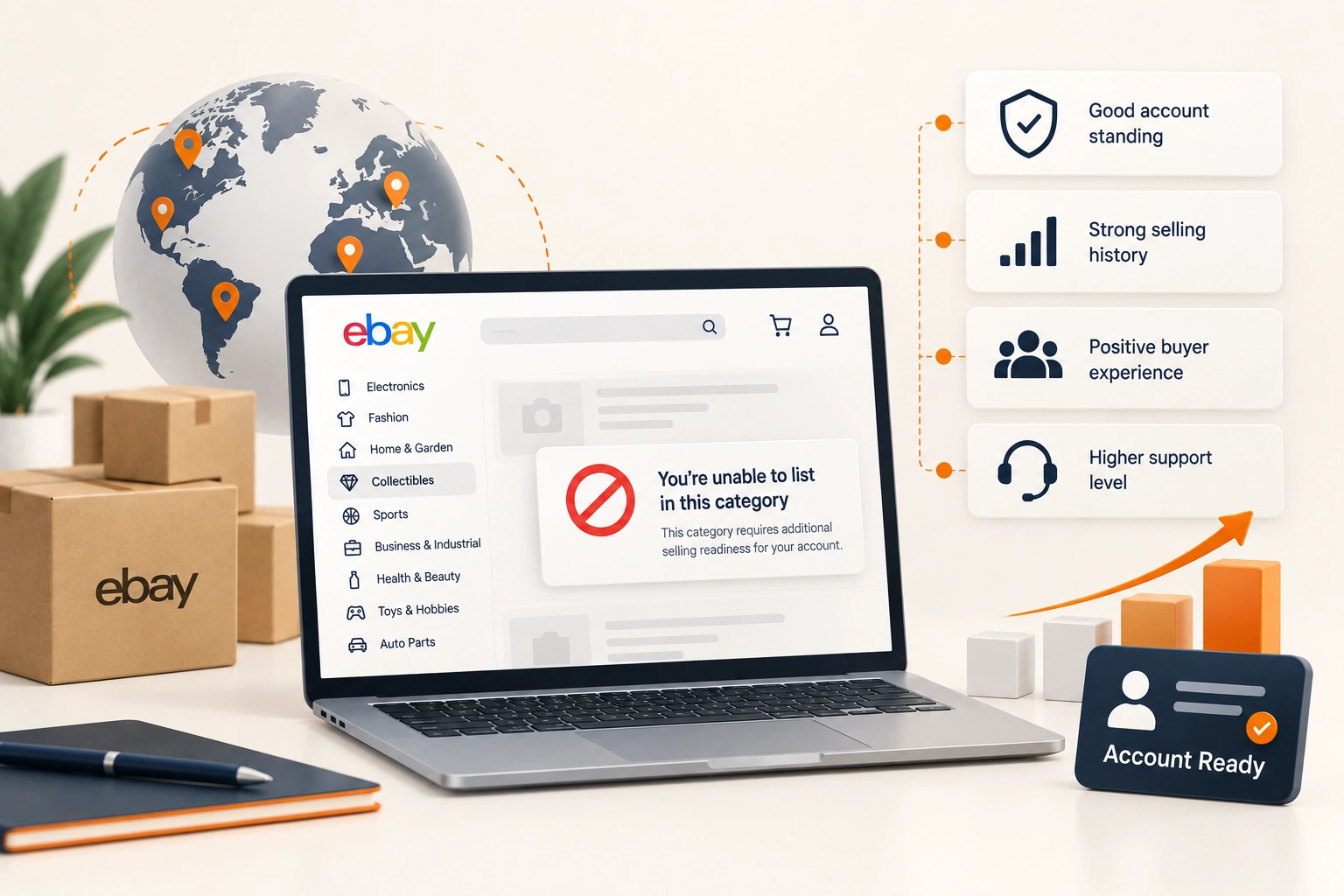
What the seller press reports fills in some of the gap, and it is reported here as that: registration became self-service in 2026, it asks for a business account with business policies, it asks about live selling experience and the categories you sell, an eligible seller can get access to the Live Studio at once, and some accounts are held on a waitlist for review. A seller with selling limits still tight on the account or a thin history in the category is the seller most likely to wait, because a live event is a sale eBay cannot inspect before it happens.
What can be sold in a stream
eBay's help page lists the categories an event can be hosted for: Collectibles, Luxury, Sneakers, Apparel, Sporting Goods, Home & Garden, Health & Beauty, and Electronics. The seller page still names only the first two, with sports trading cards, collectible toys and comics under Collectibles and watches, handbags and jewellery under Luxury, and says the rest are opening. If your category is on the longer list, apply; if it is on neither, apply anyway, because the page asks you to.
The eBay Live policy then takes some items back out. Not allowed on Live at all: baby gear, gift cards, sexual wellness items, real estate, firearm parts, alcohol and micromobility devices. Allowed with conditions: vitamins, over the counter medicines, blades, pesticides and knives, which need complete, ready to purchase listings and domestic shipping only. And no chance-based selling: raffles and anything where what the buyer gets is decided by luck are out, with mystery boxes and grab bags permitted only under the policy's specific conditions. Case breaks, the collectibles format where a sealed case is opened on air and its contents allocated to buyers, are allowed for sellers eBay has approved for them.
What you need on the desk
eBay is specific. You need "a desktop or laptop computer to create and manage your events," "a stable internet connection," and either "a mobile camera or a camera set up with a third party broadcast tool such as Open Broadcaster Software (OBS)." The event is built in the Live Studio and run from the Stream manager, and you can "add up to 750 listings to each event." Streams "automatically end after 60 minutes of inactivity," except for case break sellers, so a host who walks away loses the room.
Two of the policy's conduct rules are also equipment rules. "All products must stay within the camera frame" and be "clearly visible at all times while being opened," which decides where the camera sits. And you "may only play music or sounds, or display images or videos, to which they own the rights or have explicit, written consent," which decides what plays in the background: the licensed track on your phone is not licensed for a stream.
Auctions, Buy It Now and flash deals on air
Two formats run in every event: "Auction and Buy It Now listings can be added by all sellers." What cannot be added is the pricing that needs a negotiation: "Best Offer or reserve pricing" is not available on Live listings, so an auction starts where it starts and the room decides where it ends. A bid on Live is a bid: eBay's policy states that placing a bid or selecting Buy It Now is "a binding agreement to purchase the item," that eBay "will automatically charge your payment method as soon as the auction ends," and that "cancellations aren't allowed for most eBay Live purchases." For a seller that is the attraction of the format. The sale closes on air and the buyer has already paid.
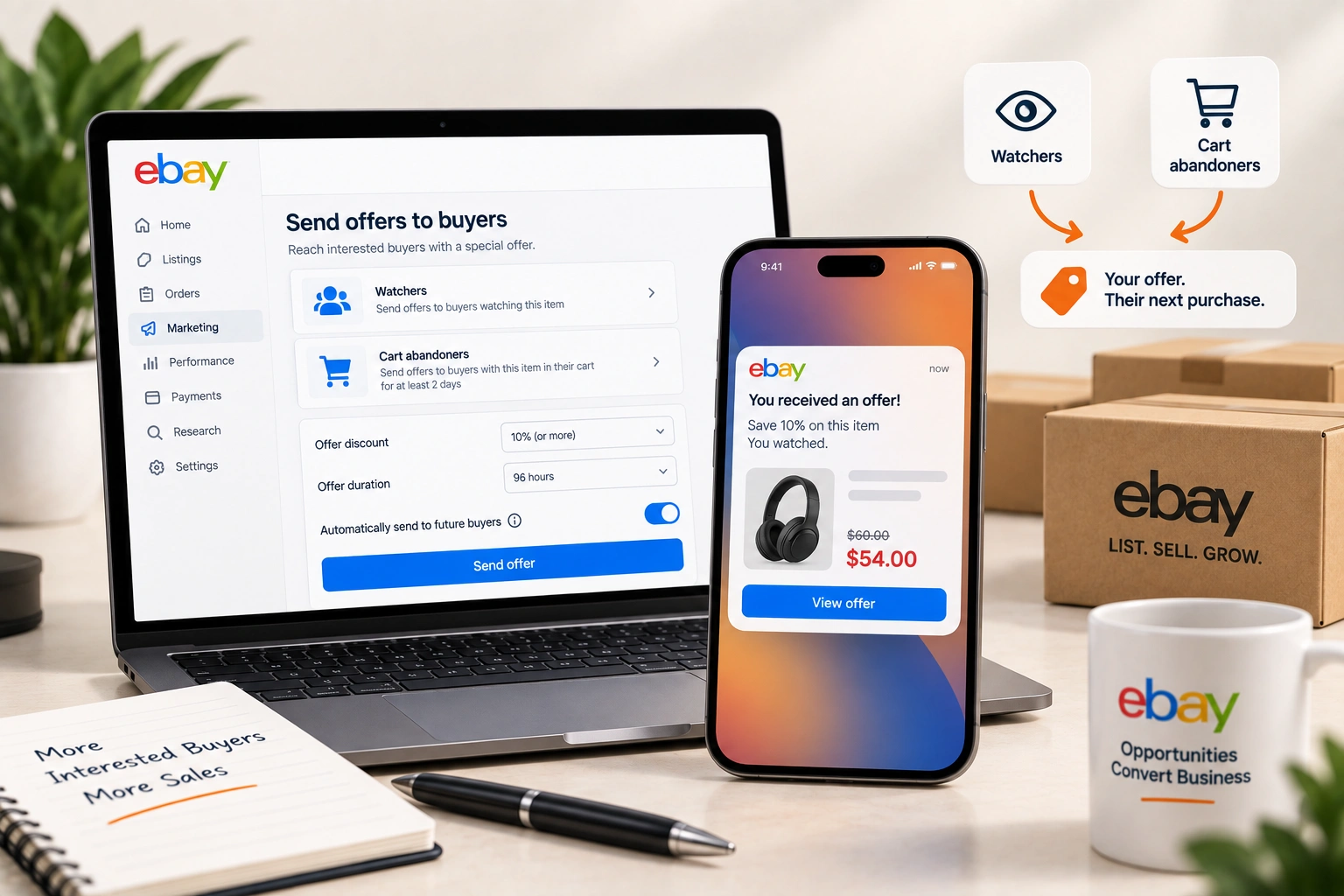
Flash deals are the stream's lever, and they need "a store subscription." A flash deal takes "either a percentage-off or amount-off discount" for "2, 5, 10, or 15 minutes" or "for the entire event." The fifteen minute deal on a slow item and the two minute deal on the item the chat is asking about are the two moves a host makes most, and both are set before the event and fired during it.
Everything else about the listing is still eBay. A Live listing ranks nowhere while the stream is on, because the buyer is already looking at it; the day after, it is a listing like any other, and Best Match weighs it the way it weighs the rest of your store.
The eight hour shopping window, and when handling time starts
The part of the help page a seller most needs and least expects is the shopping window. It "lasts 8 hours after your scheduled start time," and "after this window closes, handling time starts." So an event scheduled for 7 pm has a window that closes at 3 am, and the handling time clock on every order from the stream starts then, not when the order was placed and not when the stream ended. A one day handling time on a Thursday evening event means Friday's dispatch, with the parcels packed after a night's sleep and before the carrier's cut off.
eBay also keeps the tape. "Video Receipts are automatically generated clips" of each sale, available "for up to 180 days after your event ends," and they are the evidence when a buyer says the card they received is not the card they watched being pulled. Keep the product in frame, say the grade and the flaw out loud, and the receipt does the arguing for you.
The rules of a stream
The eBay Live policy is a code of conduct for the host and everyone in shot, and eBay makes the seller "responsible for the acts and omissions of any personnel and guests who appear in your live streams." The rules are what a broadcaster would expect: no violence or threats, no hate or harassment, no severe or explicit profanity (mild profanity "is discouraged but may be permitted"), no nudity or sexualised content, and no attempt "to move transactions off-platform" or share contact or payment details to bypass eBay. Accuracy is a rule too: "all information presented during a live stream and in listings" must be "accurate, complete, and not misleading."
Enforcement runs a ladder: a warning, the stream ended, the seller's authorisation to use eBay Live removed, listings removed, selling restricted, and the account suspended. The step that matters is the third one, because Live authorisation is the scarce thing, and the policy lets eBay take it back without touching the rest of the account.
Fees, and what Live does to your seller standards
eBay's public pages do not carry a Live fee table, and the figures in circulation are the seller press quoting eBay's seller communications, so they are reported here as that: a final value fee of 8.9% plus $0.30 per order on most Live categories, 6.9% plus $0.30 on coins, bullion and eligible sneakers, no insertion fee on listings created for a Live event, and Promoted Listings General fees waived on qualifying Live sales. Check the rate on your own fee page before pricing a stream, because a category's Live rate and its ordinary rate are not the same number.
The change that matters more is the one eBay put in an email to Live sellers, as the seller press quotes it: "Starting October 15, 2026, transactions completed through eBay Live will no longer be included in your Seller Level, Top Rated Plus eligibility, or Service Metrics." Live orders stay in your order history, reports and payouts; they stop counting toward the standards, and eBay says Live performance will be evaluated separately. For a seller near the line, that cuts both ways. A stream that ships a hundred orders on time no longer lifts the Top Rated Seller figures, and a stream that goes wrong no longer sinks them, which is the reason eBay gives: a live sale moves faster and looks different from a listing sale, and eBay would rather judge it on its own.
Is it worth the hours
Live selling costs the same thing on every platform: a host's evenings. The eBay version has a narrower audience than TikTok's, because it lives in one app's tab rather than in a feed, and a more committed one, because a buyer who opens a Live event on eBay came to buy rather than to scroll. It suits the categories eBay opened first for a reason. Cards, comics, watches, sneakers and handbags are bought by people who want to see the item turned over in someone's hands and to ask a question before they bid, and a stream answers that better than twelve photographs do.
For a brand or a reseller with that kind of stock, the arithmetic is the one from the TikTok live article: a session has to clear a number that pays for the host's time and the discounts the flash deals gave away, and the first sessions will not. Run four before deciding, keep the eight hour window and the handling time in the schedule from the first, and keep the product in frame. If you would rather someone ran the channel with the rest of the account, our eBay account management does, and a free marketplace audit says whether your catalogue is the kind a stream sells.
Frequently asked questions
The questions that come up most often on this subject.
Register your interest on eBay's Live seller page; eBay says it will notify you as soon as you are eligible. Live is in beta with select sellers and eBay has not published the criteria. The seller press reports that registration is now self-service, asks for a business account with business policies and your categories, and can hold an account on a waitlist for review.
eBay's help page lists Collectibles, Luxury, Sneakers, Apparel, Sporting Goods, Home & Garden, Health & Beauty and Electronics, and says more categories are opening. The Live policy bans baby gear, gift cards, sexual wellness items, real estate, firearm parts, alcohol and micromobility devices, restricts vitamins, medicines, blades, pesticides and knives to complete listings shipped domestically, and does not allow chance-based sales.
Not from 15 October 2026. eBay told Live sellers, as the seller press quotes it, that transactions completed through eBay Live will no longer be included in Seller Level, Top Rated Plus eligibility or Service Metrics, and that Live performance will be evaluated separately. Live orders still appear in your order history, reports and payouts.
eBay's policy says cancellations are not allowed for most eBay Live purchases: a bid or a Buy It Now is a binding agreement, and eBay charges the buyer's payment method automatically as soon as the auction ends. Video Receipts of each sale are kept for up to 180 days as the record of what was shown.
Not to host an event, but flash deals, the timed percentage or amount discounts that run for 2, 5, 10 or 15 minutes or the whole event, require a store subscription. You also need a desktop or laptop to create and manage events, a stable connection, and a phone camera or a camera through a broadcast tool such as OBS.