Selling on eBay vs Amazon: Which Suits What
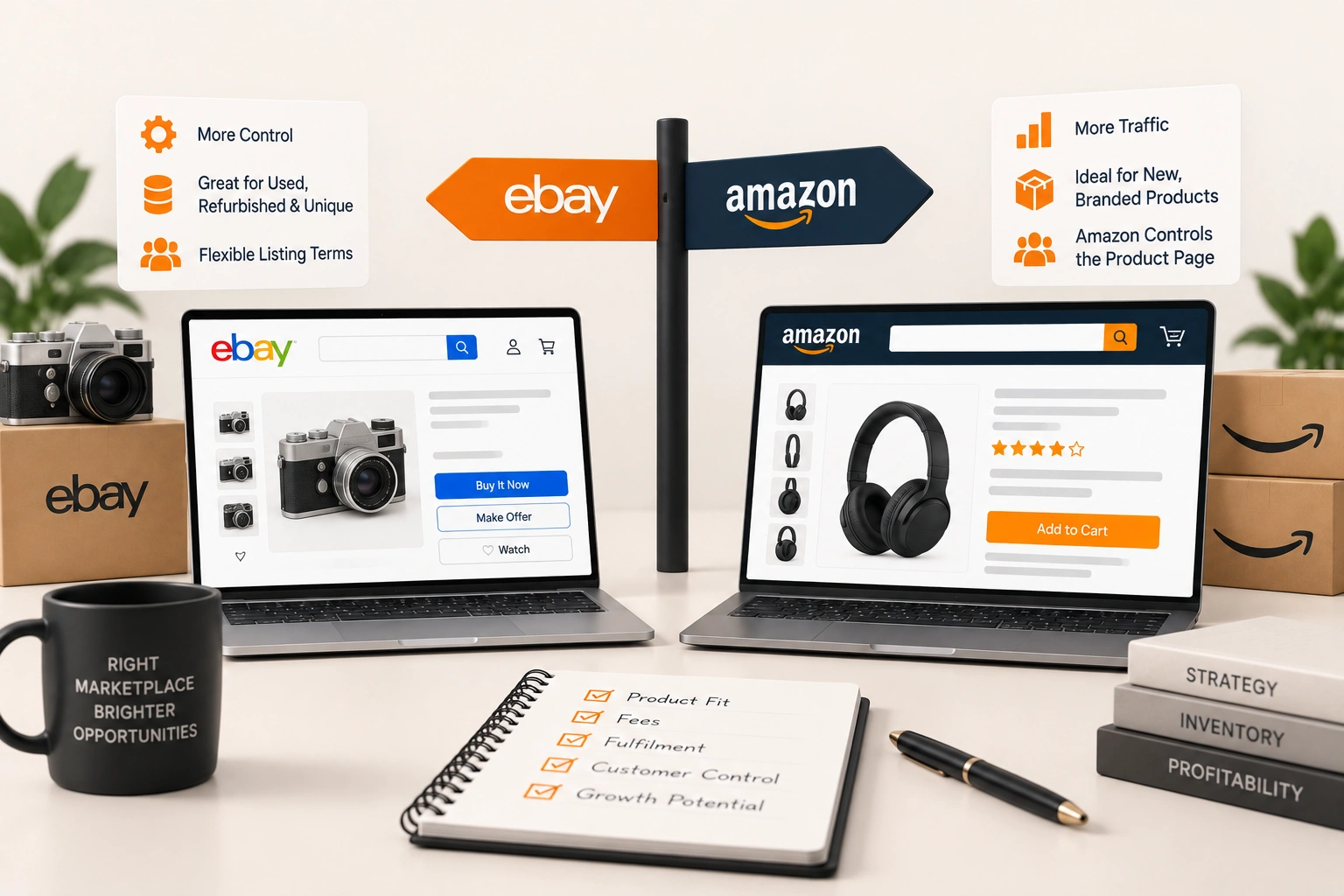
eBay gives a seller more control and less traffic. Amazon gives more traffic and almost no control. Which is better depends entirely on what you sell.


Loading Article banner
The comparison is usually framed as which marketplace is bigger, which is the least useful question available. They work differently enough that plenty of products do well on one and badly on the other.
The difference that matters is control. On eBay the seller owns the listing. On Amazon the catalogue owns the listing and the seller has an offer on it.
Who owns the page
On Amazon, one product has one detail page, and every seller of that product competes for the buy box on it. The page's images and copy are the catalogue's rather than yours, which is why brand registry matters so much there.
On eBay, your listing is yours. Your photographs, your description, your terms. Two sellers of the same item have two listings competing in search rather than two offers competing on one page.
That single difference explains most of the others.
What each is good for
eBay suits used and refurbished goods, parts and spares, anything where condition varies, collectables, and products that need explaining. Fitment data on parts is a genuine competitive moat, and eBay's is better than Amazon's.
Amazon suits new, branded, standardised products with strong demand and a clear identifier, where the buyer knows what they want and the decision is price and delivery.
A brand with a new product and a barcode should usually be on Amazon first. A seller with mixed condition stock, or with items no catalogue has a page for, will find eBay much less hostile.
Buyer behaviour
Amazon buyers are shopping. eBay buyers are frequently hunting: comparing, watching, and willing to make an offer.
Watchers and offers are real mechanics on eBay and have no equivalent on Amazon. A listing with watchers is a listing with an audience you can act on with a promotion, which is a lever Amazon does not give a seller.
Fees and fulfilment
eBay's final value fee is charged on the total including postage, with category variation. Amazon charges a referral fee on the same basis, plus fulfilment where FBA is used.
Fulfilment is where the structural difference lies. Most eBay sellers fulfil themselves, so postage and handling are the costs to manage rather than a band table, and delivery speed is a competitive lever you control rather than a service you buy.
Search, and how it rewards you
Both reward sales velocity and conversion. eBay adds seller performance and service metrics to the calculation in a way Amazon largely does not, which means the way you run the account affects the visibility of every listing on it.
That is why top rated status is worth pursuing rather than being a badge, and why feedback management is an operational discipline rather than customer service. Both are covered in top rated seller requirements and handling negative feedback.
Returns, and who decides
Amazon's returns policy is Amazon's, applied to your orders whether you agree with it or not. On eBay the seller sets the return window and who pays the postage, within the marketplace's minimums.
That is real control and it is a real trap. Free thirty day returns improve visibility and conversion, and they also invite them, so the setting has to be priced rather than copied from whichever competitor is winning.
The pattern worth watching is returns concentrated in one product, which is a listing problem rather than a policy one. The description promised something the item is not, and the cheapest fix is on the page.
Running both
Most established sellers do, and the mistake is running them the same way. The listing copy, the pricing strategy and the fulfilment model should differ, because the mechanics differ.
The inventory plan should be shared, because stock is stock. A unit committed to one marketplace is a unit the other cannot sell, and the allocation should follow margin after fees rather than habit.
What we do with this
We run both, so the answer to which channel deserves a given product is one answer rather than two opinions: eBay account management and Amazon account management under one plan.
For brands adding a third, Walmart behaves differently again, and a direct store trades marketplace fees for the cost of buying the traffic.
If the question is which of these deserves the next quarter's attention, that is the conversation to have.
Related reading: Selling on eBay as a Business: The Account, the Limits, the Fees and How Listings Rank, Selling on Walmart vs Amazon: What Really Differs, eBay Categories That Require Additional Readiness: Who It Affects and How to Qualify and eBay Send Offers to Buyers: How It Works, the Rules and When It Pays.
Frequently asked questions
The questions that come up most often on this subject.
It depends on the product. Amazon suits new, branded, standardised goods with a clear identifier, where the buyer already knows what they want. eBay suits used and refurbished stock, parts, anything where condition varies, and products that need explaining, because the seller owns the listing rather than sharing a catalogue page.
They are broadly comparable on the sale itself, with category variation on both. The larger difference is fulfilment: most eBay sellers ship themselves, so the cost is postage and labour rather than a fee band, which makes the comparison a per product exercise rather than a headline rate.
Usually, and it is a different kind of competition. On Amazon several sellers compete for one buy box; on eBay several listings compete in search. Being outranked is recoverable in a way that losing the buy box is not.
Yes, and most established sellers do. Run them differently: separate copy, separate pricing strategy, separate fulfilment decision. Share the inventory plan, because a unit committed to one is a unit the other cannot sell.
Less naturally than Amazon, because eBay's demand skews towards buyers hunting for something specific, including used and hard to find items. A new branded product with a barcode and existing demand usually finds Amazon the faster route, and does well on eBay once the listing has history.
eBay, comfortably. Condition is a first class concept there, the buyer expects variation, and the seller controls the description and the photographs, which is what selling a used item requires.
More than most sellers expect. Service metrics and seller standing feed into search visibility across the whole account, so late dispatches on one product can dampen listings that had nothing to do with it. On Amazon the effect is narrower and mostly reaches the buy box.
No. Amazon reviews and eBay feedback are separate systems and neither carries across, so a listing arriving on the other marketplace starts from nothing and has to earn its history there.
eBay, generally. Listing is quicker, the catalogue is less strict, and there are fewer category gates. Amazon takes longer to set up properly and offers more traffic once it is done.
Copying the account across. Same copy, same price rules, same fulfilment model, same expectations. The two marketplaces reward different behaviour, and the account that treats them as one usually underperforms on both.