Amazon Reimbursement Types: Reading the Reimbursements Report Line by Line
Every line of Amazon's Reimbursements report is a unit Amazon paid for or took back. What each reimbursement type means, cash or inventory, how a unit is valued since the 2025 policy change, why reimbursements are reversed, and the monthly reconciliation that finds what was never paid.
 Faizan Mughal, COO11 min read
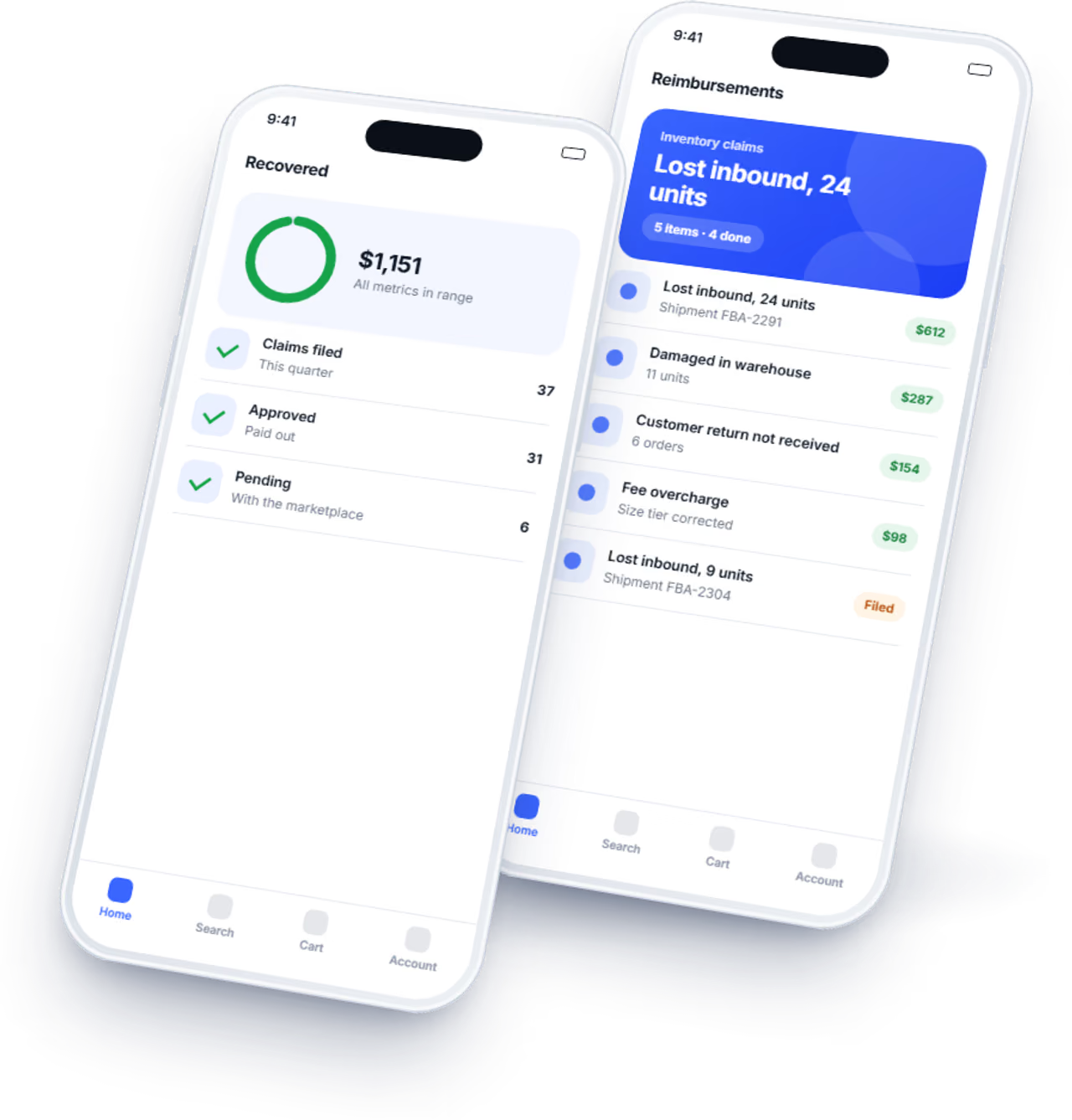
Open the Reimbursements report in Seller Central and every line is a unit Amazon paid for, or took back. What most sellers cannot tell at a glance is which Amazon reimbursement type each line is, why the amount is lower than the price the item sells for, and whether a negative line means money lost or a unit found. Those three answers decide whether the report is a record of money recovered or a list of money still owed.
This guide reads the report column by column, explains the reimbursement types Amazon's own staff describe, shows how each one is valued since Amazon changed its policy in 2025, and sets out the monthly reconciliation that finds the gaps. It is written for Fulfillment by Amazon (FBA) sellers who download the report and are not sure what it is telling them.
What Is the Amazon Reimbursements Report?
The Reimbursements report is Amazon's itemised list of every reimbursement paid to an FBA seller, one line per event, with the reason, the product, the amount and how the units were settled. It sits under Reports, Payments, Reimbursements in Seller Central, and Amazon says its content is updated daily. Reversals are recorded in it too, against the reimbursement they undo.
The menu path comes from an Amazon staff post on filing reimbursement claims, which advises checking this report before filing anything by hand, because Amazon reimburses many warehouse damage events on its own. The columns and the daily update are listed in Amazon's developer documentation for the report, updated on 13 October 2026, which describes the same data a connected reporting tool reads:
| Column | What it tells you |
|---|---|
| approval-date | The day Amazon approved the reimbursement |
| reimbursement-id | Amazon's reference for the line, the one to quote in a case |
| case-id | The case that produced it, empty when Amazon paid without one |
| amazon-order-id | The customer order, on lines tied to one |
| reason | The event Amazon paid for: the reimbursement type |
| sku, fnsku, asin, product-name | The product, down to the FNSKU the warehouse tracks |
| condition | The condition of the unit |
| amount-per-unit, amount-total, currency-unit | What was paid per unit and in all |
| quantity-reimbursed-cash | Units settled in money |
| quantity-reimbursed-inventory | Units settled by putting stock back into your inventory |
| quantity-reimbursed-total | Both together |
| original-reimbursement-id, original-reimbursement-type | On a reversal, the reimbursement it undoes |
Amazon's documentation names the columns without describing them, so the right-hand column is our reading of the names, checked against the reports we reconcile for brands. Two matter most: reason, which is the reimbursement type, and the pair of quantity columns, which say whether you were paid or given the unit back.
What Are the Amazon Reimbursement Types?
The reimbursement type is the reason column: the event Amazon is paying for. Amazon's staff guidance names five events that produce reimbursements: a unit lost in a fulfilment centre, a unit damaged there, units missing from an inbound shipment, units lost or damaged on a removal order, and a customer return that never came back or came back unsellable through Amazon's fault.
A sixth kind of line runs the other way: a reversal, when Amazon takes a reimbursement back. Amazon does not publish the labels the reason column uses on a public page, so read them as they appear in your own file. A seller on the Indian Seller Forums, quoting Amazon's help material, names the reversal type as Reimbursement_Reversal; that is reported, and we have not seen it on a US Amazon page.
The table sets each event against how Amazon values it and the window for a manual claim when no reimbursement appears, in Amazon's staff wording:
| Event | How the unit is valued | Manual claim window |
|---|---|---|
| Lost in a fulfilment centre | Manufacturing cost; Amazon says these are now reimbursed automatically | Within 60 days of the event appearing in your reports |
| Damaged in a fulfilment centre | Manufacturing cost; many are reimbursed automatically | Within 60 days of the event appearing in your reports |
| Missing from an inbound shipment | Sourcing cost | After the shipment is closed, within 9 months |
| Lost or damaged on a removal | Sourcing cost | Within 18 months of delivery or loss |
| Customer return not received | Sales price less applicable fees; in most cases the customer is charged | No sooner than 60 days after the refund, within 18 months |
| Returned unsellable through Amazon's fault | Reimbursed; the unit is not added back to inventory | Not stated in the post |
The windows come from the staff post linked above, shown on the forum as four months old when we read it on 27 November 2026; the valuation comes from Amazon's 2025 policy change, set out below. Our guide to FBA claim windows through the holiday sets the same windows against the fourth quarter's calendar.
Does Amazon Pay Cash or Replace the Unit?
Either, and the report says which. Each line splits its units between quantity-reimbursed-cash, units Amazon paid for in money, and quantity-reimbursed-inventory, units settled by putting stock back into your inventory, with the total beside them. One line can carry both. So read the money columns against the cash units, not the total, before deciding a line was underpaid.
That last point is our reading of the columns, which Amazon's documentation names without describing. The staff post does give one case where the unit is not put back: a customer return that arrives unsellable through Amazon's fault is reimbursed, and Amazon says it will not add the item back to your inventory. A return damaged by the customer is not reimbursed at all.
So when a return goes missing in the ledger, the question is which of three things happened: the item was never returned, it was returned and damaged by Amazon, or it was returned and damaged by the customer. The licence plate number on the returned unit is how a seller traces one, as our guide to the LPN on an Amazon return explains.
How Does Amazon Value a Reimbursed Unit?
It depends on when the unit was lost. For stock lost or damaged before a customer ordered it, Amazon has paid the product's manufacturing cost since 31 March 2025, taken from the cost you enter or from Amazon's own estimate. For losses after a customer order, Amazon still pays the original sales price minus applicable fees.
The change was announced by News_Amazon in an update to the FBA inventory reimbursement policy, revised on 19 December 2024 to clarify the term. Manufacturing cost means your cost to source the product from a manufacturer, wholesaler or reseller, or to produce it if you make it, and it excludes shipping, handling, customs duties and other costs. Where you enter nothing, Amazon estimates the cost from comparable products sold by Amazon, by other sellers and through wholesale channels, and you can change it later.
The policy was first due on 10 March 2025. A second News_Amazon post moved it to 31 March 2025 and said every seller would have the Manage Your Sourcing Cost page by 28 February 2025, which is where the cost is entered and reviewed. Amazon's staff post on claims adds that a unit already unsellable when it was lost, damaged or removed is reimbursed at a reduced estimated cost, and that Amazon may ask for documents to set it.
The practical result is that amount-per-unit on a loss before an order is only as good as the cost on file. A seller replying in the claims thread reports being paid about $12.38 for an item invoiced at nearly $30, a reported experience rather than a figure Amazon confirms. On a line like that, the first thing we check is the sourcing cost Amazon held for the SKU on the day it paid.
Why Was My Amazon Reimbursement Reversed?
Because Amazon decided the payment was a mistake or found the units. Amazon's moderators on the Seller Forums give two causes: you were reimbursed in error, or the units were located later or the shipment had errors. A unit that is found should go back into your inventory, so a reversal on a found unit should leave the stock count higher.
Those causes are KJ_Amazon's, in a thread titled Reversed reimbursements and no inventory added back, with 26 replies and shown as twelve months old on 27 November 2026. The same moderator notes that units may have been recovered at a different time from the reversal, so the stock and the reversal do not always land on the same day, and that a reversal can be contested by contacting Seller Support.
The thread's title is the complaint sellers keep raising, and it is a reported experience: a reversal with no units visible in the inventory. In another thread, a seller reports a reimbursement for a lost inbound shipment taken back five months later as a fee equal to the original payment, with no word on whether the stock was found; an Amazon moderator passed the case to the team that handles it. Neither is a rule. Both are reasons to match every reversal to a unit.
To match one, take the original-reimbursement-id on the reversal line, find the reimbursement it undoes, and look for the same FNSKU coming back in the Inventory Ledger around that date. A reversal with a unit back is the system working. A reversal with no unit is a case to open, with both reimbursement IDs and the ledger extract attached.
Reconciling the Report Against the Inventory Ledger
The report shows what Amazon paid. It cannot show what Amazon did not pay, and that gap is where the money is. Once a month we read it beside the Inventory Ledger, Amazon's record of every movement of every unit, in this order:
- Download the Reimbursements report and the Inventory Ledger for the month, plus the month before, since an approval can trail its event.
- List every ledger adjustment for units lost or damaged in a fulfilment centre, with its date, FNSKU and quantity.
- Match each one to a reimbursement line by FNSKU, quantity and date, and mark the matches.
- For each loss left unmatched, check whether the unit was found later in the ledger. If it was not, and the event is inside its 60 days, it goes on the claim list.
- Check amount-per-unit on the matched lines against the sourcing cost on file for the SKU, and correct the cost where it is wrong.
- Match every reversal to a returned unit, as above.
- Run the same match for removals and customer returns, against the removal shipments and the returns report, inside their own windows.
Where Amazon has reimbursed a warehouse event on its own, the match is immediate; the unmatched lines are the work. Removal shipments have their own traps, set out in our guide to removal orders and unsellable stock. Filing the unmatched lines well, with the IDs Amazon asks for, is covered in our guide to Seller Support cases that get resolved, and what each kind of claim needs as evidence is in what Amazon owes you in FBA reimbursements.
Mistakes That Cost Money in This Report
The losses we find most often in this report come from reading it, not from Amazon refusing to pay:
- Reading amount-total as the whole settlement, when units settled as stock carry no payment of their own.
- Treating a negative line as a charge without checking whether a unit came back.
- Leaving the sourcing cost blank, so every loss before an order is paid at Amazon's estimate.
- Filing a claim for a unit Amazon has already paid, which wastes a case on nothing.
- Reconciling once a quarter, when warehouse losses have a 60 day window.
- Reading only fulfilment centre events and never removals or returns, whose 18 month windows make them easy to forget until they have passed.
Making It a Monthly Routine
The report earns its keep read every month, not opened when a settlement looks short. We read it with the ledger, keep a running list of unmatched events with their windows, and file before the shortest window closes. It sits beside a few other reports worth a monthly look, listed in our guide to the Seller Central reports worth reading.
For the brands whose accounts we run, our marketplace analytics, xRack, puts a Money Recovery view beside Cash and Payouts for Amazon accounts in the United States, Canada and Mexico; it is included with our account management by invitation and is not sold separately. Where a backlog of losses, reversals or underpaid lines has built up, our cost recovery service audits it and works each claim to a decision.
Frequently Asked Questions
The questions that come up most often on this subject.